
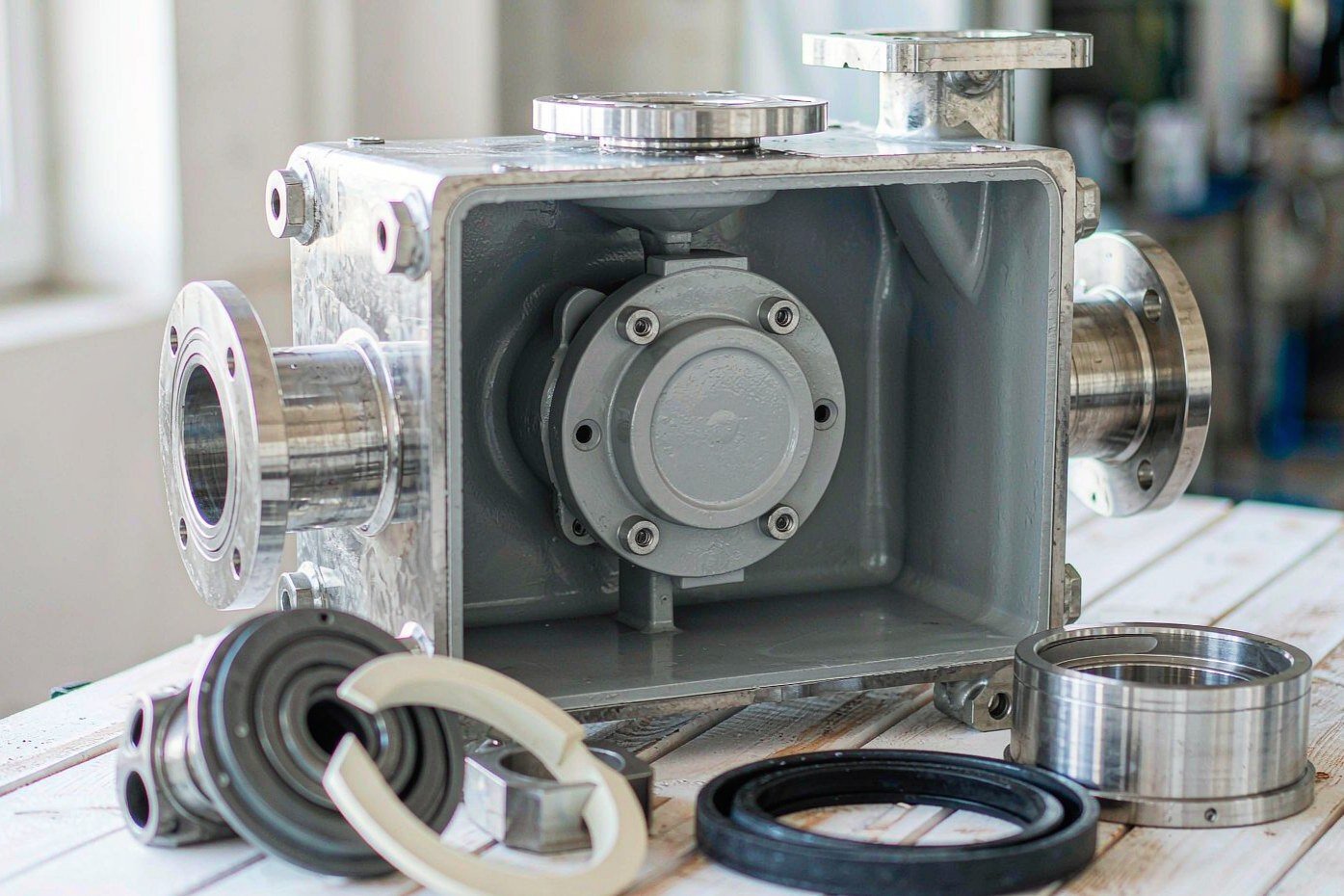
A chemical pump fails in one of two places: the seal face, or the elastomer that holds the face against its spring. The faces are a materials problem solved years ago — silicon carbide against carbon handles almost everything. The elastomer is where plants still lose pumps, because the secondary seal sits in the same fluid, at the same temperature, with no flush and no way to inspect it.
Six materials cover nearly every chemical pump and valve duty sold today. Ranked below by where they earn their cost, not by how exotic they sound, with the specific fluid families that make each one the wrong choice.
What the Fluid Is Actually Doing to the Seal
Chemical attack is the obvious mechanism and the least common one. Four others do more damage in real plants.
Swelling. Aromatic and chlorinated solvents enter the elastomer network and expand it. An O-ring that grows 20% in volume no longer fits its groove; it fills the gland, loses its squeeze margin, and starts to nibble as the pump shaft turns. Swelling is reversible only if the seal is removed before it takes a permanent set.
Extraction. Plasticisers, antioxidants and low-molecular-weight fractions leave the compound and enter the product. The seal shrinks and hardens, and the leak appears on cooldown rather than at temperature. In pharmaceutical and food service this is a contamination issue before it is a sealing one.
Chemical scission. Strong oxidisers, hot caustic and amines break the polymer backbone. The surface goes sticky, then chalky, then cracks. FKM in contact with low-molecular-weight esters, ketones or amine-based inhibitors is the classic case: the compound dehydrofluorinates and the seal turns to a brittle crust.
Permeation and explosive decompression. Gases dissolve into the elastomer under pressure and expand when the pressure drops. A rapid depressurisation blisters the seal internally. This is why gas service at high pressure needs a harder compound or a different polymer, even when the chemical compatibility chart says the material is fine.
The Envelope, Before the Ranking
These are general-purpose service ranges for standard compounds, the kind of number you use to eliminate candidates. A specific grade can extend or restrict any of them by 10–15 °C, and dynamic service narrows every one. The ranges below are cross-checked against the tables that Vulcan Seals publishes for mechanical seal materials, which are organised by pH and temperature rather than by polymer name.
| Elastomer | Service range | Typical pH guidance | Strong at | Fails at |
|---|---|---|---|---|
| NBR | −30 to +120 °C | 5–8 | Mineral oil, water, dilute acids, abrasion | Ketones, esters, ozone, strong acids |
| EPDM | −50 to +150 °C | 6–14 | Hot water, steam, caustic, hypochlorite, ketones, alcohols | Mineral oil and hydrocarbon solvents — swells severely |
| FKM | −20 to +200 °C | 0–8 | Mineral acids, hydrocarbons, fuels, hot oil | Amines, ammonia, ketones, esters, hot water and steam |
| TFE/P (Aflas type) | −5 to +200 °C | 2–14 | Steam plus hydrocarbon, amine inhibitors, sour gas, alternating acid/alkali | Low temperature, aromatic fuels |
| PTFE, filled | −200 to +260 °C | 0–14 | Nearly all chemicals, low friction, wide temperature | Anything needing elastic recovery; cold flow under load |
| FFKM | −15 to +320 °C | 0–14 | Aggressive solvents, oxidisers, plasma, everything else | Cost, and low-temperature flexibility |
#6 NBR: the Default That Fails Quietly
Nitrile is the seal in every pump that leaves a factory without a fluid specification. It is cheap, it has good tensile and abrasion properties, and it is excellent in mineral oil and water up to about 100 °C. A standard NBR O-ring in a plant handling dilute acid at ambient temperature will often run for years.
It also has the narrowest chemical tolerance of the six. One drum of solvent-based cleaner flushed through a line will swell an NBR seal by 40% and end its life in a shift. And because NBR is the cheapest option, it is the material most often left in place after a process change, which is how a $2 O-ring becomes a $20,000 pump rebuild.
If a pump handles only water, dilute acid or oil, NBR is the rational choice. Write the fluid on the seal specification so the next maintenance planner does not assume the seal is generic.
#5 EPDM: Hot Water, Caustic, and One Fatal Blind Spot
EPDM is the material for hot water, steam up to about 150 °C, caustic soda, hypochlorite, and the polar solvents that destroy nitrile — acetone, MEK, alcohols, esters. In a chlor-alkali plant or a CIP circuit it is the standard answer, and for good reason: it is also the most ozone- and weather-resistant general elastomer, which matters for seals on outdoor tanks.
The blind spot is hydrocarbon. EPDM in mineral oil or diesel swells until it fills the gland and then disintegrates. A pump that alternates between a caustic wash and a solvent flush cannot use EPDM, and this combination appears more often than the compatibility charts suggest, because the chart is filled in for the process fluid and not for the cleaning fluid.
Second caveat: EPDM is attacked by some concentrated oxidising acids and by aromatic hydrocarbons. It is not a general-purpose “chemical” rubber despite the reputation.
#4 FKM: the Workhorse With Three Enemies
Fluorocarbon is what most plants specify when they want “chemical resistant” without a materials engineer. It holds to 200 °C, handles mineral acids, hydrocarbons, fuels and hot oil, and has excellent compression set at temperature. In a pump handling 30% sulphuric acid at 80 °C, FKM is usually the right first answer.
Three fluid families break it:
- Amines and ammonia. Including amine-based corrosion inhibitors and amine-cured epoxy residues. The compound dehydrofluorinates; the seal hardens and cracks.
- Ketones, esters and ethers. MEK, acetone, ethyl acetate, THF. Swelling of 20–50% is normal, and the seal loses strength as it swells.
- Hot water and steam. Standard FKM grades are not steam materials. Above roughly 100 °C in water, they degrade by a different route and fail much earlier than the temperature rating suggests. Peroxide-cured and specialty grades improve this; they do not make FKM a steam seal.
A fourth, quieter limit: low temperature. Standard FKM stiffens around −20 °C, and a pump that sits outdoors in winter will leak at start-up even though it never leaked in summer.
#3 TFE/P: the Answer to Steam Plus Hydrocarbon
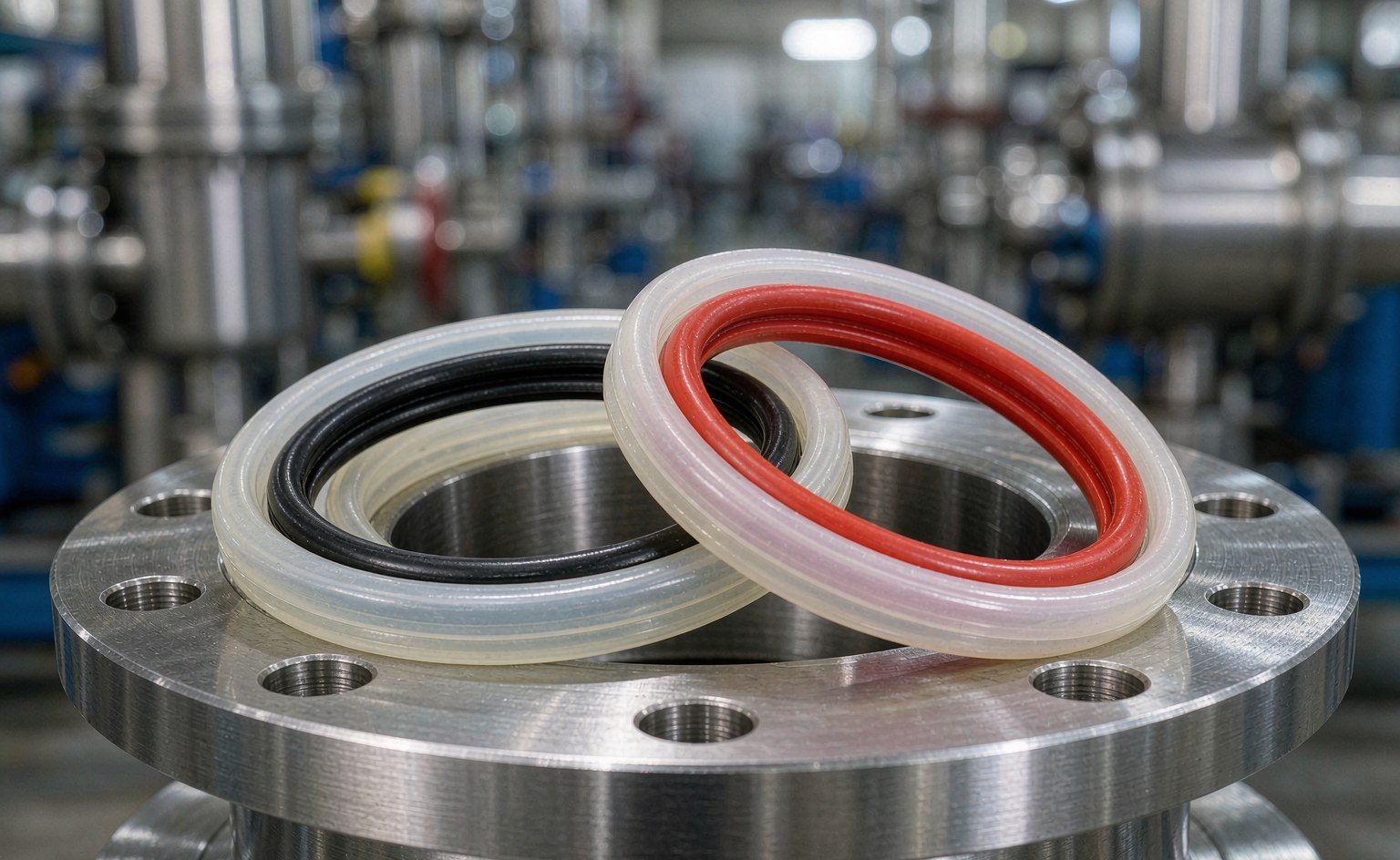
TFE/P — sold as Aflas and under several generic names — occupies a narrow gap that nothing else fills well: it resists steam and hydrocarbon at the same time, plus amines, ammonia, sour gas and the alternating acid-alkali cycles common in refinery and geothermal service. Where FKM fails on amine inhibitors and EPDM fails on oil, TFE/P usually works.
It is not a general upgrade. Low-temperature flexibility is poor — around −5 °C for standard grades — and it swells in aromatic fuels. It is also harder to mould and more expensive than FKM, typically two to three times the compound cost, which is why it stays in the specific duties that need it. Zeon, the producer behind the Aflas family, publishes compound-level data that is worth reading before specifying a generic TFE/P grade.
#2 PTFE and Filled PTFE: Where Elasticity Is Not Required
PTFE is inert to almost everything, holds from −200 to +260 °C, and has the lowest friction of any solid seal material. What it does not have is elastic recovery: it cold-flows under load and takes a permanent set. That single property decides where it belongs.
It belongs in static joints — casing gaskets, flange gaskets, valve seats, chevron packing — and in dynamic positions where a spring supplies the load and the PTFE supplies the chemical resistance. Spring-energized PTFE lip seals and encapsulated O-rings exist precisely to put PTFE in a groove without asking it to behave like rubber; the spring-energized designs sold across the industry all work on that principle.
Filled grades change the mechanical behaviour without changing the chemistry much. Glass raises compressive strength and wear resistance at modest cost, except in hydrofluoric acid and strong caustic, which attack the glass. Carbon and graphite improve dry running and thermal conductivity. Bronze gives the highest load capacity and the worst chemical resistance. For a chemical pump, the filler has to be compatible with the fluid, not just the PTFE.
For valve seats and pump wear rings the same logic applies at a smaller scale: machined PTFE and PEEK components give you a seat that will not swell, at the price of tighter tolerances and a harder installation.
#1 FFKM: When Nothing Else Survives
Perfluoroelastomer is the only material that combines elastomeric recovery with near-universal chemical resistance and a service ceiling above 300 °C. In a pump handling mixed solvent waste, concentrated nitric acid, or a stream whose composition changes weekly, FFKM removes the material question entirely.
It costs 15–25 times a standard FKM seal. That number is worth arguing about, because the break-even is usually one avoided shutdown. A pump rebuild with a day of lost production typically exceeds the price difference by an order of magnitude, and on a hazardous stream the compliance cost of a leak dwarfs both.
Two practical notes. FFKM grades differ enormously — a general-purpose grade and a low-compression-set grade for high-temperature steam are different products with different price points, and the data sheet matters more than the trade name. And FFKM still needs a proper groove: it is not immune to extrusion, and it is not immune to contamination. Our FKM compound selection guide is the place to start before paying for perfluoroelastomer, because the right FKM grade solves more amine and low-temperature problems than buyers expect.
Where Each Material Sits in One Pump
A single pump can use four different materials, because the four sealing positions see different conditions. This is the table we fill in during a pump review.
| Position | Exposure | Default | Upgrade path |
|---|---|---|---|
| Seal face secondary O-ring (rotating) | Full process fluid, temperature, some motion | FKM | FFKM for solvents and oxidisers; EPDM for caustic and hot water |
| Seal face secondary O-ring (stationary) | Same fluid, no motion | FKM or EPDM | Same as above; PTFE encapsulation for sticky or curing fluids |
| Casing / flange gasket | Static, full chemical exposure | Filled PTFE | Graphite laminate above 260 °C; spiral wound for pressure cycling |
| Valve seat and stem packing | Static seat, slow stem motion | PTFE seat, PTFE packing | PEEK seat for abrasive slurries; live-loaded PTFE for emissions |
The rotating secondary seal is the one that gets overlooked. It sees the same fluid as the faces but a fraction of the flush, and it is the seal that fails when a pump is run dry for two minutes.
The Compatibility Chart Trap
Every plant has a compatibility chart, and every chart is a simplification. Three ways it misleads:
| Trap | Why the chart misleads | What to do instead |
|---|---|---|
| Concentration is not listed | 98% sulphuric acid and 10% sulphuric acid behave differently toward the same elastomer | Specify concentration and temperature together, never one without the other |
| Cleaning fluids are missing | Caustic CIP, solvent flush and steam sterilisation all attack seals the process fluid does not | List every fluid the seal touches in a week, including flush and washdown |
| Rating is for static service | A “good” rating for a static gasket does not transfer to a moving O-ring on a shaft | Discount one grade for dynamic service, and check compression set at temperature |
A fourth trap is subtler: the chart rates a polymer family, and suppliers sell compounds. Two FKM compounds from two factories can differ by 30 °C in continuous rating and by a factor of two in compression set. Ask for the compound data sheet, not the family name.
Qualifying a Compound Before the Pump Goes on Line
Four steps, in this order, and most pump seal problems disappear before the pump is assembled.
- List the fluids. Process, flush, cleaning, and any upset condition. Include concentration and normal plus maximum temperature for each.
- Eliminate by envelope. Use the table above to cut the six candidates down to two. Do not start with the most expensive material and work backwards.
- Check the seal’s mechanical duty. A static gasket and a rotating secondary O-ring do not need the same compound even in the same fluid. Compression set at temperature matters for the static one; recovery and friction matter for the moving one.
- Test the actual compound. A 72-hour immersion at operating temperature, measuring volume swell, hardness change and tensile change, costs a few hundred dollars and settles arguments that datasheets cannot. ASTM D471 is the standard method for immersion testing of rubber seals.
Above about 177 °C, secondary sealing stops being an elastomer problem. API 682 guidance, as quoted by most mechanical seal makers, moves the secondary seal to flexible graphite at that point, because no elastomer holds compression set indefinitely at that temperature. This seal maker’s materials summary lays out the same limits from a North American API pump perspective.
FAQ
Can I use one material for the whole pump? Usually not economically. FKM for the secondary seals plus filled PTFE for the gaskets covers most dilute acid and hydrocarbon duties at a fraction of an all-FFKM bill. Standardise the material family, not the part number.
Is FFKM always the safe answer? Safe for chemistry, not always for mechanics. FFKM has poorer low-temperature flexibility than FKM in standard grades, and it is softer in some formulations, which matters in high-pressure gas service with rapid decompression. Specify the grade against the duty.
Why did an EPDM seal fail in a line that only carries caustic? Almost always the cleaning cycle. A solvent-based wash, a kerosene flush, or a hydrocarbon-contaminated water supply will swell EPDM. Check what the line carried before the caustic.
What is the most common cause of seal failure in a chemical pump? In our return analysis it is not the polymer at all: it is running dry, losing flush, or a misaligned gland. Material selection gets the blame because it is the visible variable.
How do I specify a compound instead of a family? Ask for the ASTM D2000 callout, the compression set at your operating temperature, the volume swell in your fluid after 72 hours, and the cure system. Generic “Viton” or “EPDM” on a purchase order leaves the choice to whoever picks the stock.
If you are selecting seals for a pump or valve line and want a second opinion on the compound, send the fluid list with concentrations and temperatures, plus the seal position drawing. We will come back with two candidates, the test each one needs, and the failure each one is likely to show first.
Compounds and Geometries for the Wetted Side
The six materials this article ranks are the six we hold in routine supply: NBR, EPDM, FKM, TFE/P, PTFE and FFKM, as O-rings, X-rings, encapsulated seals, lip and chevron profiles, gaskets and machined PTFE seats. Because the same shop machines the PTFE parts and stocks the elastomer compounds, a pump seal set can be quoted as one bill of materials instead of three purchase orders.
What we add to a selection is the second opinion the article asks for: the fluid list with concentrations and temperatures, the seal position, and the failure mode if there is one. From that we return two candidates, the test each one needs — volume swell, compression set, permeation — and the one position on the pump where the cheaper compound is the safer bet.
Send the fluid list, the drawing and the duty cycle to sales@bosssealing.com, or through the contact form. You will get compound recommendations, a price and a lead time rather than a catalogue page — usually within one working day, and the engineering review is free.