
Semiconductor and chemical process equipment asks two things of a seal at the same time: survive the chemistry, and stay clean while doing it. No elastomer family answers both questions across the whole tool, which is why fab and CPI engineers end up specifying a mix: FFKM where plasma, temperature or aggressive chemistry disqualifies everything cheaper, and PTFE-family designs where permeation, particle generation or creep set the limit. This article walks through how the two families actually behave in process hardware, where each one belongs, and the specification details — cure system, compound grade, gland geometry, PM interval — that separate a seal that lasts a full PM cycle from one that shuts the tool down early. The numbers below come from published manufacturer data and from what we see on incoming inspection when fab-adjacent customers send us failed parts for analysis.
What Process Duty Actually Demands of a Seal
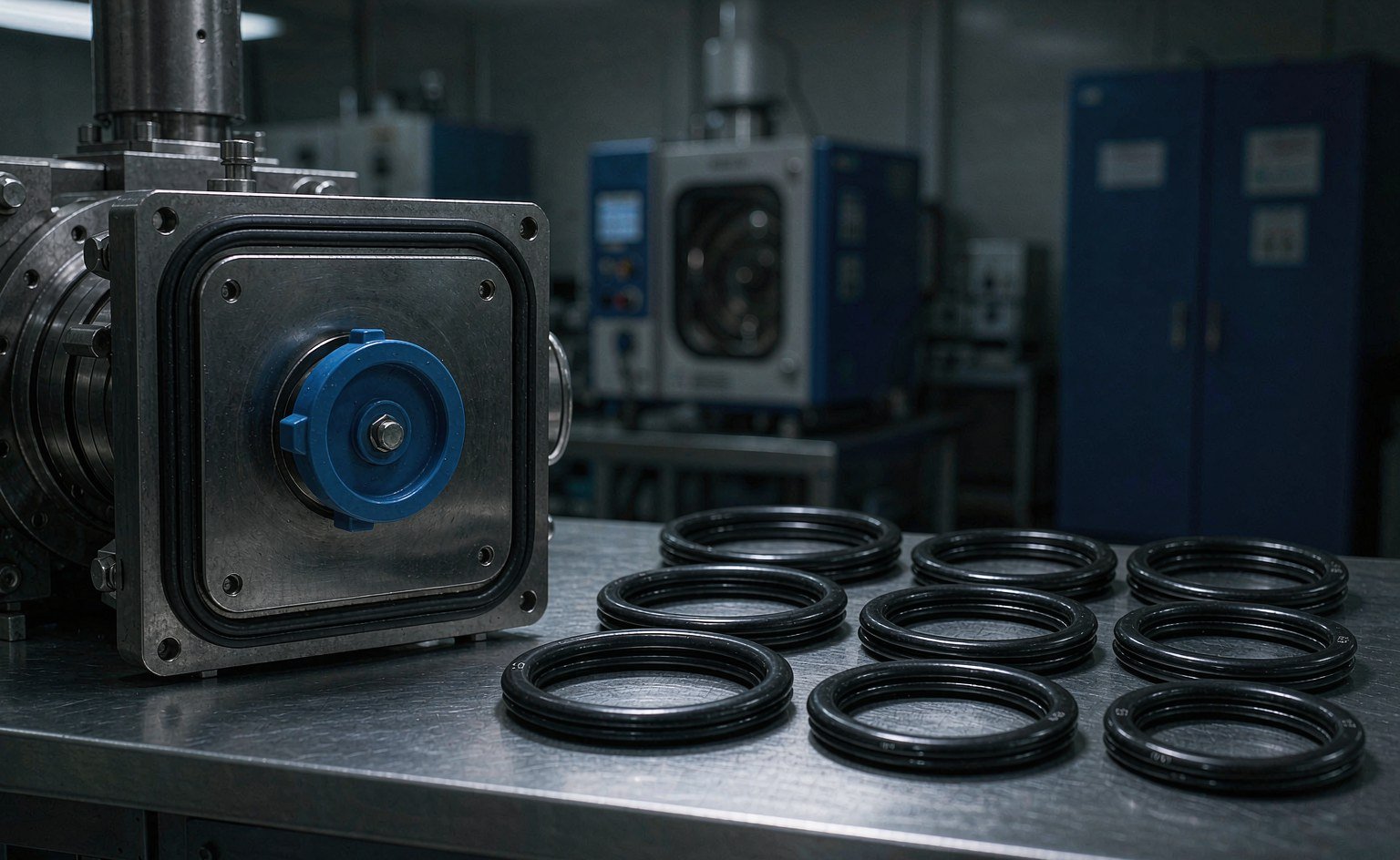
A seal in a deposition or etch chamber faces a combination no other industry throws at an elastomer. Chamber walls cycle from ambient to 200–350 °C in the hot zones. The process gases — NF₃, SF₆, Cl₂, HBr, WF₆ — are themselves reactive, and the plasma generated from them is far more aggressive than the raw gas. Every PM cycle means exposure to in-situ cleans or wet cleans with fluorinated chemistry. And the penalty for seal degradation is not just a leak: a shedding seal contaminates the product. One degraded O-ring in an ICP chamber can put particles onto wafers downstream and wipe out the yield argument for the entire quarter.
Chemical process industries (CPI) plants impose a related but different profile. The temperature is usually lower — 150–250 °C in reactors and transfer lines — but the chemistry is broader and less predictable: amines, ketones, esters, hot steam, sour fluids, oxidizers. A seal that resists everything in the chamber may still fail on compression set after months at temperature, which is a mechanical property, not a chemical one.
Three material families cover almost all of this duty: FFKM for the elastomer sealing positions, PTFE and its filled compounds for static and spring-energized positions, and — at the edges — encapsulated designs that pair a PTFE jacket with an elastomer core. Everything else (FKM, EPDM, silicone) belongs in utility services: chillers, cooling loops, vacuum forelines carrying inert gases, pneumatic actuation. Putting an FKM O-ring inside a process chamber is the single most common sourcing mistake we see, and it usually shows up as the seal that fails three PMs in a row while everything around it runs fine.
FFKM: What the Chemistry Buys You
FFKM (perfluoroelastomer, ASTM D1418 designation) replaces essentially all hydrogen on the polymer backbone with fluorine. The result behaves like a rubber that has borrowed its chemical personality from PTFE: published industry data credit FFKM compounds with resistance to more than 1,800 chemicals, including the concentrated acids, amines, ketones and plasma environments that attack every other elastomer. Continuous temperature ratings run 260–300 °C depending on compound, with high-temperature grades rated to 327 °C intermittent service. Commercial brands include Kalrez (originally DuPont, now produced under the Qnity umbrella), Chemraz (Greene Tweed), Perlast (PPE), Simriz (Freudenberg) and Isolast (Trelleborg) — the Trelleborg sealing library publishes usable comparative data across several of these families.
The physics behind the price is worth understanding, because it explains both what FFKM does well and what it does badly. Fluorination removes the chemical attack sites, but it also removes the sites that give ordinary rubber its low-temperature flexibility and its friction behavior. FFKM compounds generally start around −10 to −15 °C unless a special low-temperature grade is specified, and their coefficient of friction is high — FFKM is not a dynamic-ring material by choice. Cure chemistry matters too: peroxide-cured compounds dominate semiconductor service, and the filler package (carbon black types, PTFE micropowders) is what separates a plasma-grade compound from a general-purpose chemical grade. Two FFKM O-rings with identical dimensions can behave completely differently across a plasma boundary.
| Property | FFKM (typical) | FKM (typical) | PTFE (virgin) |
|---|---|---|---|
| Continuous temperature | 260–300 °C (to 327 °C some grades) | −20 to +200 °C | −200 to +260 °C |
| Chemical resistance | Near-universal; 1,800+ chemicals | Good for oils, fuels, many acids; attacked by amines, ketones, hot steam | Near-universal; not a rubber |
| Plasma resistance | Compound-dependent; plasma grades excellent | Poor | Excellent |
| Compression set, 200 °C × 70 h | 12–30% (compound-dependent) | 15–40% typical | N/A — creep governs instead |
| Elastic recovery | High — seals like a rubber | High | None — cold flow |
| Relative cost | Very high | Medium | Low to medium |
The compression set row deserves attention. A compression set of 12–15% at 200 °C × 70 h — achievable in the better general-purpose FFKM compounds — is what lets an FFKM O-ring hold contact stress through months of thermal cycling, which is the actual mechanism of most hot-zone seal failures. When a chamber seal “looks fine” but leaks after a bake-out, the cross-section has taken a set and the contact stress is gone.
Matching the Compound to the Process
FFKM is not one material; it is a family of compounds tuned by cure system and filler. The published compound guides — including the Kalrez compound selection resources — converge on the mapping below, which we use as the first filter when a customer describes a chamber.
| Process / environment | Typical conditions | Compound family | Why |
|---|---|---|---|
| Plasma etch (CCP/ICP) | 80–250 °C; Cl₂, HBr, SF₆, NF₃ plasma | Plasma-resistant, low-particle grades (Kalrez 6375/7075 class) | Resists fluorinated plasma attack; low outgassing and particle generation |
| PECVD / ALD | 200–350 °C; SiH₄, NH₃, TMA, H₂O | High-temperature grades (Kalrez 9500 / Sahara class, Chemraz 555 class) | Continuous 300 °C+ ratings with stable compression set |
| Ion implant | Near-ambient to 100 °C; BF₃, AsH₃ | General-purpose semiconductor grades | Chemical exposure without heat; cleanliness dominates |
| CPI reactors, transfer lines | 150–250 °C; acids, amines, solvents | General-purpose chemical grades (Kalrez 6375 class) | Broadest chemical envelope at moderate cost within the FFKM family |
| Steam / SIP / CIP service | 150 °C+ saturated steam, repeated cycles | Steam-rated FFKM compounds | FKM degrades in hot steam; FFKM steam grades hold compression set |
| Wet benches, stripping | Ambient to 80 °C; HF, H₂SO₄/H₂O₂, hot caustic | General-purpose FFKM or encapsulated designs | Cost can be cut at lower temperatures with jacketed seals |
Two mapping errors appear repeatedly. The first is specifying a heat-grade FFKM into a plasma application because the datasheet temperature looked impressive — heat grades are not automatically plasma grades, and the filler that improves thermal aging can worsen plasma erosion. The second is treating “FFKM” as interchangeable across brands: a Chemraz 505 and a Kalrez 4079 sit in similar service envelopes, but a buyer substituting on brand name alone without comparing compound data sheets can pick up a 20% swing in compression set at temperature. Compare the compound, not the trademark.
Plasma, Outgassing and Particle Generation
In vacuum process tools, the seal has a second job beyond holding pressure differential: it must not add contamination. Three mechanisms matter, and they are measured differently.
Plasma erosion is chemical attack by ionized, radical-rich gas. It thins the seal surface, generates fluoride particles, and in severe cases changes the seal’s geometry enough to create a leak path. Plasma-resistant FFKM compounds address this with modified cure chemistry and filler packages; published chamber data from the compound makers show multi-cycle life differences of two to three times between a general-purpose and a plasma-grade compound in the same etch position.
Outgassing is the release of volatile species under vacuum and heat — cure residues, plasticizers, low-molecular-weight fragments. It matters in deposition tools because outgassed species end up as films on optics and wafers. Ultra-clean compounds (the Kalrez 7075 class is the usual reference) are formulated specifically for low outgassing and low extractables; screening against ASTM E595-style total mass loss limits is standard practice for optical and deposition hardware.
Particle generation is the mechanical end of the same problem: a seal that rubs, rolls or abrades during door cycling sheds its own surface. This is why fab seals are specified with surface-quality requirements, why bonded or mechanically captured door seals exist, and why PM procedures replace O-rings on a schedule even when the ring “looks fine” — the degradation that generates particles is not always visible.
One practical consequence for buyers: incoming inspection for semiconductor FFKM is not the same as for industrial rubber. A fab-grade incoming spec should include cleanliness handling (double-bagged, no talc, no ordinary silicone grease), compound traceability documentation, and in many accounts lot-level certification. The PPE (Precision Polymer Engineering) and Kalrez documentation systems set the pattern here — every part traceable to compound and cure lot. A supplier who cannot produce that paper is not supplying fab-grade parts, whatever the compound name on the quote.
Where PTFE Takes Over
FFKM still has two structural weaknesses: it is an elastomer with real permeation rates, and it is expensive enough that putting it in a low-temperature static joint hurts the budget. PTFE answers both, at the cost of elasticity.
For pure chemical attack at low to moderate temperature, encapsulated O-rings pair a thin FEP or PFA jacket with an elastomer core. The jacket carries the chemistry — FEP handles continuous service to roughly 200 °C, PFA to about 260 °C — while the core supplies the sealing force. Permeation through a thin fluoropolymer jacket is an order of magnitude lower than through bulk FFKM, which matters in applications where the permeated species itself is the problem (high-purity chemical delivery, corrosive media that attack downstream hardware, emissions-critical joints). The trade-offs are covered in depth in our encapsulated seals line: no jacket survives mechanical abuse, memory loss is progressive, and high vacuum is a poor fit because the jacket cannot conform to surface defects the way a rubber face can.
Where the joint is hot, dry or cycling, spring-energized PTFE seals take the position. A U-cup or rectangular PTFE jacket driven by a metal spring (canted coil, cantilever or helical) seals across a temperature span no elastomer matches — from cryogenic duties to 260 °C and above — and the PTFE compound can be filled (glass, carbon, bronze) to manage creep and wear. These are the standard answer in aggressive chemical pump shafts, dry cryogenic transfer, and vacuum rotary feedthroughs. Our spring-energized seal range covers the common variants, and the engineering-plastics channel supplies the filled PTFE and PEEK hardware around them.
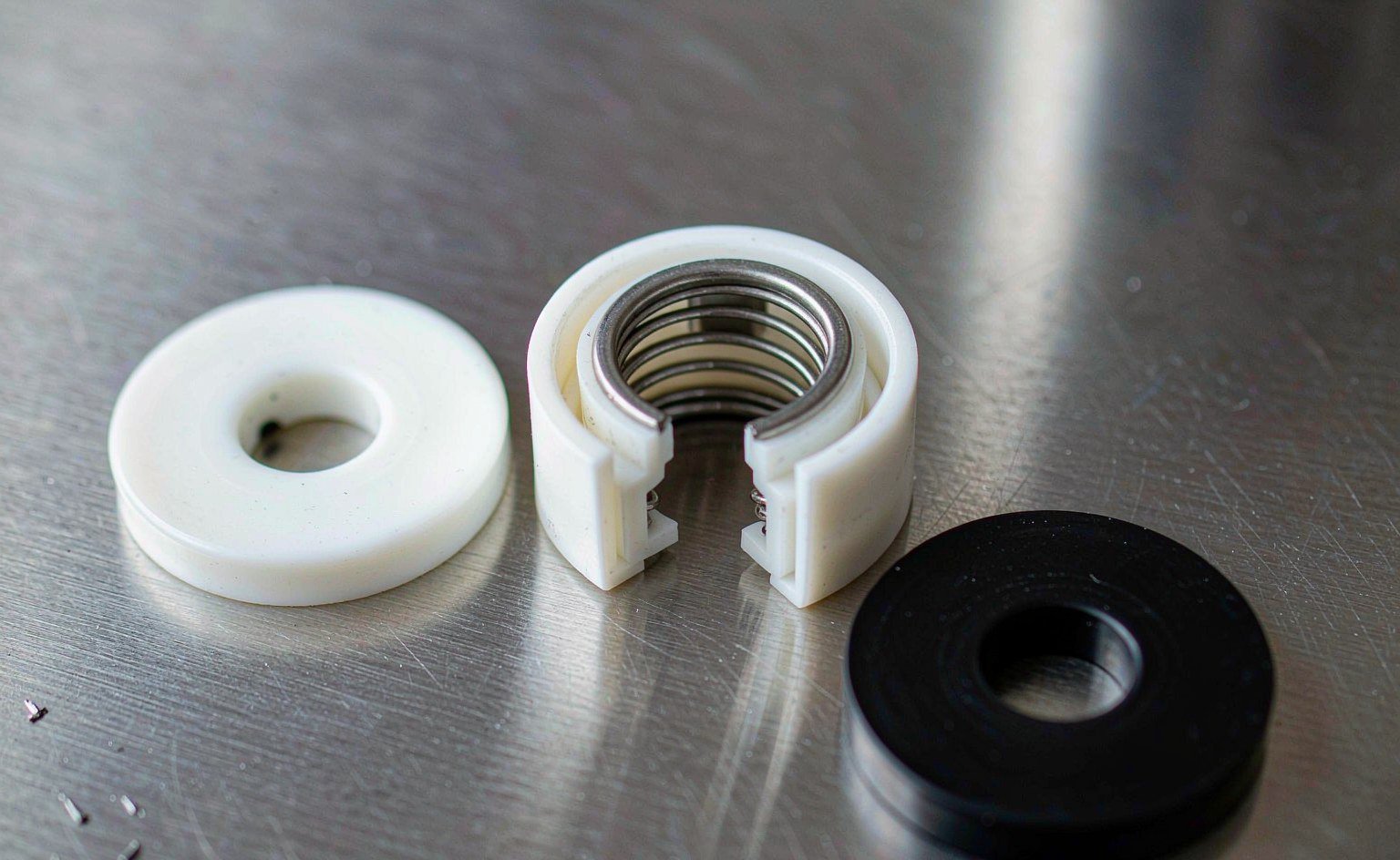
The honest limit of the PTFE family is cold flow. Under sustained compressive stress at temperature, PTFE creeps, and a statically loaded PTFE gasket relaxes enough to leak unless the design compensates — spring energization, live-loading, or a geometry that keeps the PTFE under shear rather than steady compression. Any PTFE sealing position needs that design review; the material will not forgive a bolt-up-and-forget installation.
Hardware Details That Decide Whether the Compound Survives
Specifying the right compound into the wrong gland wastes the premium. FFKM needs more squeeze than FKM to seal reliably — published gland guidance for FFKM runs roughly 20–30% squeeze in static face glands, against the 15–25% common for FKM — and it tolerates less gland fill, so grooves designed for NBR often starve an FFKM ring. When retrofitting an existing tool, verify gland width and depth against FFKM-specific tables rather than assuming the old drawing was compound-neutral.
High-vacuum door and slit-valve positions add a retention problem: with no internal pressure seating the ring, a vertically mounted O-ring can drop out during assembly. Half-dovetail grooves are the usual compromise; full dovetails capture better but cost real machining money. And because FFKM rings in these positions get replaced at every PM, the groove should be detailed for installation by gloved hands — generous lead-in chamfers, no sharp internal corners below R0.2 mm.
Thermal expansion closes the hardware review. An FFKM ring in a 300 °C chamber lid expands more than the gland it sits in; the groove must leave volume for that expansion or the ring shears at the parting line. We have seen more hot-zone FFKM failures from grooves copied from FKM drawings than from compound selection.
| Hardware parameter | FFKM guidance | Common retrofit mistake |
|---|---|---|
| Static face squeeze | 20–30% of cross-section | Reusing 15% FKM squeeze — marginal contact stress at temperature |
| Gland fill | ≤ 85%, target ~75% including thermal swell | Grooves sized for NBR — no room for FFKM expansion |
| Groove corners | R0.2–0.5 mm, no nicks | Sharp corners cutting the ring at every PM change |
| Vacuum retention | Half-dovetail for vertical faces | Open rectangular groove — ring drops out during assembly |
| Installation lubricant | PFPE grease on FFKM | Silicone grease — fine on most rubber, wrong for plasma-adjacent surfaces and a bake-out contaminant |
Wet Processing: Chemistry by Class
Wet benches, cleans and stripping tools sit at lower temperatures but attack with concentrations plasma tools never see. Mapping the chemistry to classes keeps the selection manageable.
HF and buffered oxide etches: FFKM handles them; FKM handles dilute HF but embrittles in concentrated or hot service; natural rubber and EPDM are out. Piranha (H₂SO₄/H₂O₂): FFKM is the only elastomer choice with a real service life; PTFE hardware surrounds it. Hot caustic and SC-1 type cleans: FFKM and EPDM both work chemically, but EPDM’s temperature ceiling and particle behavior usually lose; FFKM wins on cleanliness. Solvents — NMP, acetone, IPA: FFKM resists all three; NBR and FKM swell in NMP and ketones respectively. Photoresist stripper chemistries, including the amine-based families: amines attack FKM hard, which is a classic failure we see in stripped-down accounts; FFKM is the default.
Where temperature stays below about 80 °C and the duty is static, encapsulated FEP seals cut the cost of these positions substantially while keeping the chemical envelope — the jacket does not care about amines or HF. The limit remains mechanical: do not use jacketed seals where the joint cycles or where the seal must bridge surface defects.
PM Intervals, Traceability and What to Do at Change-Out
FFKM seals in process tools are consumables with a schedule, not lifetime parts. The published practice — and what fab equipment engineers enforce — is replacement at every scheduled PM in chamber-critical positions regardless of appearance, because particle-generating degradation is invisible until it is a yield event. Track seal life in cycles, not weeks: a chamber running aggressive cleans consumes seals faster than the same chamber running a gentle recipe, even at identical wall-clock time.
At change-out, three checks take minutes and catch most problems. Measure the removed ring’s cross-section at four points; more than a few percent of set means the gland or the grade needs review. Photograph the ring in place before removal — the wear pattern tells you whether the failure was chemical, thermal or mechanical. And log the compound lot: when a batch underperforms, the lot number is what turns a complaint into a claim.
Incoming inspection closes the loop. For fab-grade parts, verify compound certification against the purchase order, double-bag condition, and freedom from talc and release agents. For CPI-grade parts, add hardness and visual checks. We run the customized products channel for accounts whose chamber positions need non-standard cross-sections or bonded shapes, and those accounts get the same lot traceability as standard parts — if your supplier cannot provide it, the premium you paid for FFKM bought you an unverified polymer.
Qualifying a New Compound Before It Enters the Tool
On a tool worth hundreds of thousands of dollars, the seal qualification budget is trivial, and skipping it is how single-point failures get bought twice. The qualification plan depends on the position, but three tiers cover most cases. For wet-chemical static joints, the test is compatibility plus dimensional: soak witness rings in the actual process chemical at the actual concentration and temperature for 168 hours, then measure volume change (accept below roughly 10%), hardness change and compression set. For hot CPI joints, add compression set at service temperature — a compound that passes immersion at 80 °C can still take a fatal set after 70 hours at 200 °C.
For plasma and vacuum positions, bench testing gets harder because plasma behavior does not translate to any simple soak test. The practical proxies are outgassing data (ASTM E595-style screening for total mass loss and collected volatile condensable materials), published plasma-exposure results for the compound class, and — where the stakes justify it — a trial position on the least critical chamber in the fleet, with the seal inspected at one PM interval before fleet-wide adoption. Suppliers of plasma-grade compounds publish chamber exposure data; ask for it by position type, not by brand brochure.
The last tier is organizational: write the qualification result down with the compound designation, the lot documentation format, the storage rules and the installation lubricant, and attach it to the bill of materials line. Seals get re-sourced under time pressure, and the document that survives that pressure is the one that stops a well-qualified compound from being replaced by a cheaper look-alike three sourcing rounds later.
Sourcing Without Overpaying
FFKM pricing rewards specificity. The expensive mistake is specifying the flagship ultra-clean grade into positions that only need general-purpose chemical resistance; the reliability mistake is the reverse. Map each position to a compound class first, then ask suppliers for their equivalent grade with published compression set and plasma data — not a brand name, the data. Peer-level catalogs from distributors such as Seal Sales and material summaries from specialists such as Fitco Rings are useful for cross-checking which compound class a position actually needs before the quote conversation starts.
Second-source discipline matters because FFKM lead times are long and single-sourced positions stop tools. Qualify at least one equivalent compound per position — same class, published data, traceability — so a supply interruption costs a PO, not a PM delay. For the PTFE-family positions, machining makes second-sourcing faster: filled PTFE and PEEK hardware is made to print, so the qualification burden is dimensional and material certification rather than cure chemistry. Our engineering plastics line supplies that hardware, and the high/low temperature seal range covers the elastomer positions at the temperature edges where standard compounds stop.
Key Takeaways
- Match the compound class to the process, not the brand. Plasma, heat and chemical service each need different FFKM families; a 327 °C datasheet does not make a compound plasma-resistant.
- FFKM seals cleanliness as much as chemistry. Particle generation and outgassing end runs, not leaks; ultra-clean grades and PM-cycle replacement discipline are part of the specification.
- PTFE-family designs cover what elasticity is not needed for. Encapsulated seals cut cost in low-temperature wet chemistry; spring-energized PTFE takes hot, dry and permeation-critical positions — with creep compensated in the design.
- Check the gland before blaming the compound. FFKM needs more squeeze and more gland volume than FKM drawings usually provide; hot-zone failures trace to grooves as often as to chemistry.
- Buy on data and traceability. Compression set, plasma and outgassing data plus lot-level certification separate fab-grade supply from repackaged rubber; second-source one equivalent compound per critical position.
Fab-Grade Seals With the Paperwork to Match
Semiconductor and wet-process seals are the part of our range where documentation carries as much weight as the compound: FFKM O-rings and custom profiles with lot traceability, PTFE and filled-PTFE parts machined and cleaned for the wetted path, and secondary seals in FKM, EPDM and silicone where the chemistry allows. Parts ship bagged per lot with the compound code and cure system on the label.
The checks that separate fab-grade supply from repackaged rubber are measurable: compression set at the tool’s temperature, outgassing and extractables data, particle contribution after cleaning, and a certificate that names the lot rather than the product family. We quote those numbers with the part, and when a requested test is one we cannot support we say so rather than assume it passes.
Send the process chemistry, the tool temperature and the seal drawing to sales@bosssealing.com, and we will come back with the compound, the data pack and a price that reflects the grade actually supplied. Quotes usually within a working day; the engineering review is free of charge, and the contact form reaches the same desk.