
FFKM costs roughly ten to twenty times what FKM costs for the same size, and in most plants the price difference is not the reason to reject it. The reason is usually technical: temperature floor, abrasion, extrusion, lead time, or a maintenance team that has never seen the material before. Once you separate those from the money question, the choice between fluorocarbon and perfluoroelastomer gets much simpler — and a fair number of FFKM specifications turn out to be unnecessary while a few FKM specifications turn out to be indefensible.
This is a comparison written for the person who has to sign the specification and defend it later, not a catalogue page. The numbers below come from published compound data and from quote sheets we see on both sides of the transaction.
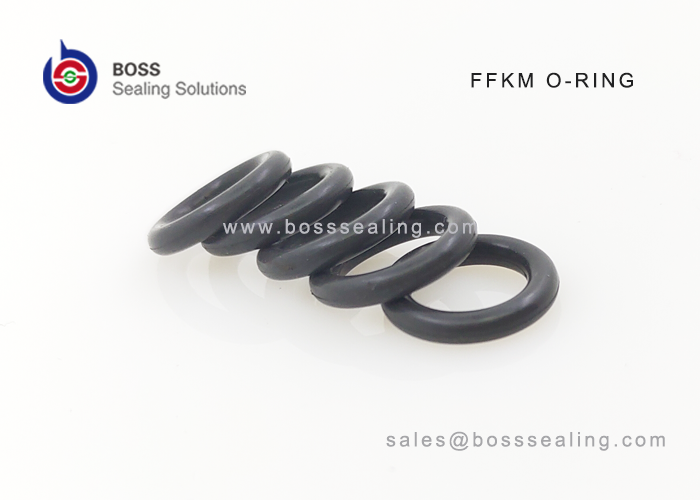
Half a Step in Chemistry, a Different Material in Service
FKM is a copolymer of vinylidene fluoride and hexafluoropropylene, with fluorine content typically between 66% and 70% by weight depending on grade. The carbon backbone still carries hydrogen, and those C–H bonds are the weak point. Oxidising media, amines, ketones and hot steam attack them, and at high temperature the polymer depolymerises from those sites. The published compound data from the major seal houses is consistent on the 200–204 °C continuous limit for standard grades, which is the number to design to regardless of what a single supplier claims.
FFKM replaces essentially all of the hydrogen with fluorine, pushing fluorine content to roughly 72–76% and leaving a fully fluorinated backbone. There is no C–H bond left to attack, which is why the material survives media that dissolve FKM in days. It also raises the thermal ceiling by more than 100 °C, because the bond energy that has to be overcome is higher. Compound suppliers that build their own perfluoroelastomer range, Precision Polymer Engineering among them, publish the media lists and the qualifying test data behind those claims.
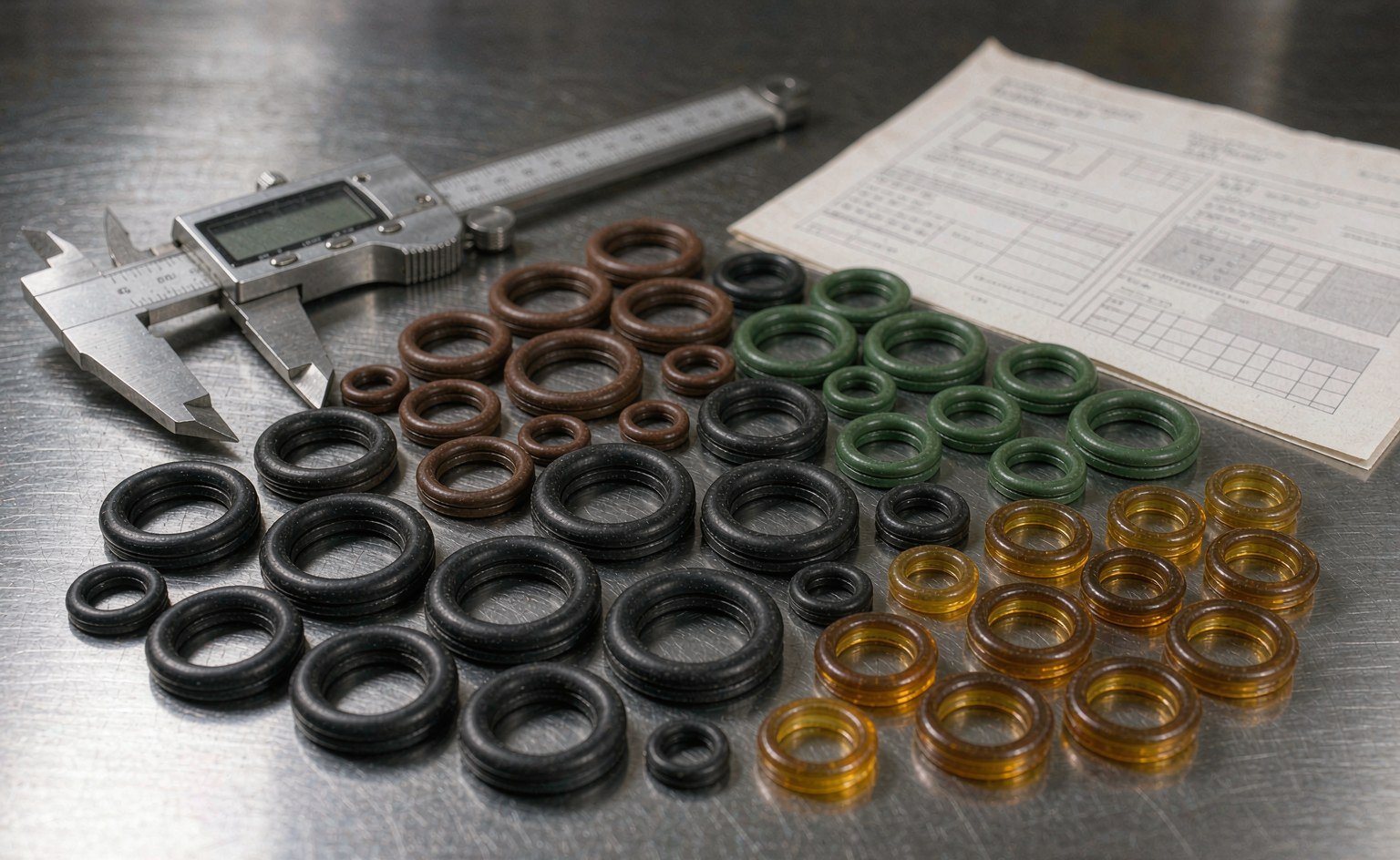
What the chemistry does not buy is mechanical toughness. FFKM compounds are generally lower in tensile strength and worse in abrasion resistance than a good FKM compound. In a rod seal running against a contaminated chrome rod, an FFKM lip can wear faster than FKM even though it costs twenty times more. That single fact explains most of the FFKM failures we see returned for analysis: the material was chosen for the chemistry and then asked to do a mechanical job.
Temperature: 204 °C Is a Real Ceiling, 327 °C Is a Different Class
Standard FKM is rated for continuous service to about 204 °C, with short excursions higher and specific grades — type F, and the peroxide-cured varieties — holding up somewhat better. Above that temperature the material does not fail instantly; it hardens, loses elongation, and its compression set climbs. A seal that was 75 Shore A at installation is 85 Shore A and 40% set after a year at 230 °C, and it stops sealing long before it looks damaged.
FFKM runs to 327 °C continuous in the better grades, with short peaks to about 340 °C. That is not a marketing margin. It is the difference between a seal that survives a bake-out cycle and one that has to be replaced after every one.
Three qualifications matter more than the headline number:
The low end goes the wrong way. Standard FFKM stiffens around −15 to −20 °C, which is worse than a GLT or GFLT FKM grade rated to −40 °C. Some low-temperature FFKM grades reach −40 °C, but they trade high-temperature performance to get there. A specification that says “FFKM, −40 to +320 °C” is asking for a compound that does not exist in one grade.
Continuous means continuous. A 327 °C rating assumes the seal is not also being asked to hold high pressure at that temperature. Tensile strength and modulus fall with heat, extrusion resistance falls with them, and the gap the seal has to bridge becomes the limiting factor rather than the polymer.
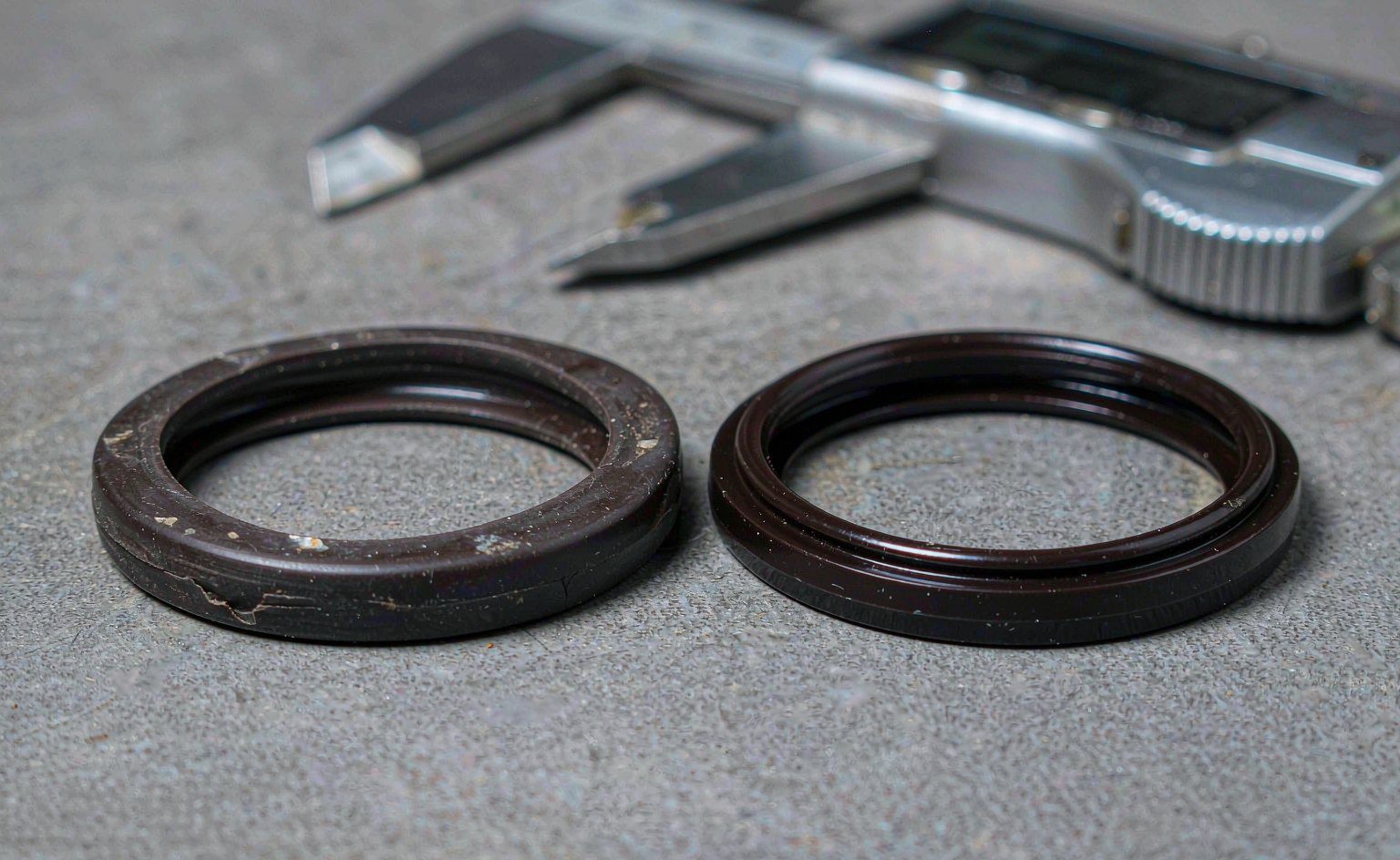
Post-cure is not optional. FFKM parts are post-cured to drive off volatiles and complete crosslinking. An under-cured seal outgasses in a vacuum chamber, takes a permanent set early, and smells faintly of amine when the flange is opened. If a supplier cannot state the post-cure schedule, the compound is not a process-grade one regardless of what the datasheet says.
Four Chemicals That End an FKM Seal
The chemical case for FFKM is easier to state as a list of what FKM cannot do than as a table of what FFKM can. Four media families account for most of the conversions:
| Medium | FKM behaviour | FFKM behaviour | What failure looks like |
|---|---|---|---|
| Ketones and esters (acetone, MEK, ethyl acetate) | Severe swell, softening, loss of strength within days | Minimal swell | Seal grows out of the groove, becomes tacky, tears on removal |
| Amines and ammonia (including many corrosion inhibitors) | Crosslink attack — hardening and cracking rather than swelling | Stable | Hard, brittle seal with surface cracks; leaks at low temperature first |
| Hot steam above about 150 °C | Decomposition, especially with repeated cycling | Resistant | Seal crumbles; black residue in the line |
| Strong bases and caustic at temperature | Attack on the cure system, rapid hardening | Resistant | Seal shrinks and flattens, losing contact stress |
Outside those four, the gap narrows sharply. FKM handles mineral oils, hydraulic fluids, fuels, most dilute acids, glycols, refrigerants and ozone without difficulty, and it does so at a price that lets a plant keep a full size range on the shelf. An FFKM specification for a hydraulic power unit running mineral oil at 70 °C is a specification error, not a premium choice.
Compression Set: The Number That Predicts the Second Year
Seals rarely fail because the polymer dissolved. They fail because the cross-section took a set — the rubber stopped pushing back — and the contact stress dropped below what the pressure needed. Compression set is the laboratory measurement of that, and it separates the two families more cleanly than any other single property.
| Property | FKM (typical) | FFKM (typical) | Why it matters |
|---|---|---|---|
| Compression set, 70 h at 200 °C | 12–25% | 10–20% | Close at 200 °C; the gap opens above 230 °C |
| Compression set, 70 h at 300 °C | Not meaningful — material degrades | 15–30% depending on grade | This is the row that decides high-temperature service |
| Tensile strength | 10–20 MPa | 10–17 MPa | Slightly lower for FFKM; affects extrusion resistance |
| Elongation at break | 150–250% | 100–200% | Lower elongation makes FFKM less forgiving during installation |
| Hardness range available | 60–90 Shore A | 70–90 Shore A | FFKM rarely available soft; a problem for low-load seals |
| Low-temperature limit | −20 °C standard, −40 °C GLT/GFLT | −15 °C standard, −40 °C special grades | FKM wins cold service |
Read the 200 °C row carefully, because it is where most purchasing decisions go wrong in both directions. At 200 °C a good FKM compound and a general-purpose FFKM compound are within a few points of each other. The FFKM premium buys nothing at that temperature unless the medium is one of the four above. At 260–300 °C, the comparison stops being close: FKM has no useful data because it is degrading, while FFKM still returns a measurable set value.
The Cost Question, Done Properly
Twenty times the unit price sounds decisive until it is put next to the cost of opening the equipment. For a common AS568 size, an FKM O-ring costs a couple of dollars and the FFKM equivalent costs tens. The price premium is real, but it is also smaller than the labour to remove a flange, replace a gasket and torque it back up — before any production loss is counted.
| Seal position | FKM unit price | FFKM unit price | Premium | One replacement event* |
|---|---|---|---|---|
| O-ring, 25 mm ID, standard section | $1–2 | $18–30 | ~$20 | $300–500 |
| O-ring, 100 mm ID, standard section | $5–8 | $90–150 | ~$110 | $600–1,200 |
| Custom moulded seal, 250 mm | $40–60 | $700–1,000 | ~$850 | $2,000–4,000 |
*Labour at $85/h plus two hours of lost output at $400/h, excluding product loss and cleanup.
The conclusion from that table is uncomfortable for both sides of the argument. For small seals, the premium is trivial compared with a single event, so the decision should be made on technical grounds alone and cost should not be mentioned in the meeting. For large custom seals, the premium approaches the cost of one event, and the decision becomes a genuine life-cycle calculation: FFKM has to last at least twice as long as FKM to break even.
The variable that actually dominates is failure frequency. If FKM is being replaced every quarter, FFKM pays back immediately even at 250 mm. If FKM is on a five-year PM cycle and coming out intact, FFKM is a 20x premium for a benefit nobody will ever observe — and worse, the plant loses the ability to detect a real process upset, because the seal no longer fails when it should.
Where FFKM Loses
Four situations where the more expensive material is the wrong call:
Cold service. Below −20 °C, standard FFKM is stiffer than standard FKM. Cryogenic and arctic duty belongs to PTFE, UHMWPE or a low-temperature FKM grade, not to a general-purpose perfluoroelastomer.
Abrasion. Slurry, dirty hydraulic oil, rod sealing in a dusty environment. FFKM’s lower elongation and toughness make it wear faster, and the cost per hour of life becomes worse than FKM, not better.
High pressure with a wide gap. FFKM has good extrusion resistance for an elastomer but it is not a substitute for a backup ring. A 90 Shore A FFKM O-ring in a 0.5 mm gap at 400 bar will still nibble. Fix the gap, not the compound — or move to a spring-energized PTFE seal, which handles the same chemistry with a jacket that cannot take a compression set.
Fast turnaround. FFKM is a low-volume material. Standard sizes are stocked by distributors, but custom mouldings run 6–10 weeks and minimum order quantities are real. A plant that needs a seal next week is buying from stock or not at all.
Specifying FFKM So It Cannot Be Substituted
FFKM is the easiest material in the seal business to counterfeit, because the part is black, the size is right and nobody can tell the difference by looking. Three lines on the purchase order close most of that gap:
Name the compound class, not just the polymer. General-purpose, FDA-compliant, plasma-resistant and low-temperature FFKM are different compounds with different cure systems, and they are not interchangeable. A specification that says “FFKM, black, 75 Shore A” will be filled with whatever general-purpose compound is on the shelf.
Reference a standard callout. For aerospace and defence work, AMS 7257 covers perfluoroelastomer seals and gives a common language for compound qualification. For industrial work, an ASTM D2000 line that includes the temperature class and the compression set requirement is enough to make a substitution visible.
Ask for the batch and the post-cure record. A mill certificate that names the compound, the batch and the post-cure cycle is the difference between a traceable part and a black ring.
One commercial note. Because FFKM pricing is volatile and the raw material is supplied by a small number of polymer producers, quotes move. A price held for twelve months on an FFKM part is a signal that the compound may not be what the drawing says. Distributors that carry branded perfluoroelastomer from stock, Darcoid for example, publish the compound grade against each part number, which makes a substitution check possible without a laboratory; the same is true of the cross-reference tools at Seal Sales. Our own high and low temperature seal range is quoted with the compound designation on the face of the offer for exactly this reason.
When FKM Is Simply Right
FKM is the correct answer far more often than the internet suggests. It is right when the medium is a petroleum-derived fluid, the temperature stays under 200 °C, and the seal is a standard size that can be replaced from stock. It is right in hydraulic cylinders, gearboxes, fuel systems, refrigeration, and most pneumatic and general industrial valves. It is also right when the seal is a wear item by design — a rod wiper, a dirt scraper, a guide-adjacent component that is meant to be changed on a schedule.
The standard O-ring and X-ring range in FKM covers those positions at a cost that keeps a full size inventory affordable, and the FKM grade selection guide explains how A, B, F, GLT and GFLT differ when the duty sits near a limit. For applications where a PTFE jacket is the answer instead of a different elastomer, encapsulated seals solve the chemical problem while keeping an elastomer core for the sealing force.
The Verdict
Buy FFKM when one of four things is true: the medium attacks FKM, the temperature is above 230 °C, the seal sits in a vacuum or high-purity process where outgassing is unacceptable, or a single failure costs more than a year of seal purchases. In those cases the price ratio is irrelevant and arguing about it wastes engineering time.
Stay with FKM when the duty is oil, the temperature is under 200 °C, and the failure you are trying to prevent is ordinary wear. A 20x premium on a seal that is not failing buys nothing, and it hides the process signals that tell you when something else in the system has changed.
The decision that matters most is not FKM versus FFKM. It is whether the compound is specified by name, the gap is sized for the pressure, and the installation is clean. A correctly specified FKM seal outperforms a badly specified FFKM one every time — and it does so at a twentieth of the material cost. Readers working through a materials decision at the top of the temperature range may find seals above 200 °C a useful next step, and the semiconductor case is covered in detail in FFKM and PTFE practice for process tools.
FFKM and FKM, Specified So They Cannot Be Substituted
Both compounds sit in our range, and the price gap is exactly why we quote them as named compounds rather than as “fluoroelastomer”: FKM in standard and specialty grades, FFKM where temperature, plasma or solvent duty leaves no alternative. O-rings, X-rings, encapsulated seals, gaskets and custom profiles, with the compound code on the drawing and on the bag.
For FFKM the specification matters more than the material name: cure system, filler package and post-cure decide compression set and outgassing, and two FFKM seals at the same hardness can differ by a factor in service life. We quote the compound code, compression-set data at your temperature, and the lot traceability that lets a substitution be caught at incoming inspection.
Send the duty — temperature, chemistry, cycle count — with the drawing to sales@bosssealing.com, and we will price the FFKM and the FKM option side by side with the data behind each, so the twentyfold question is answered with numbers. Usually within a working day, engineering review free; the contact form works too.