
Some sealing problems defeat profile seals entirely: a 400 mm rod with a badly worn, scored surface, a plunger pump that runs 24/7, a wellhead gland that must be adjusted from outside while the line is live. This is the territory of the chevron seal — the stacked V-ring packing set that has survived in heavy industry for a century precisely because it can be repaired, tightened, and tuned in ways a molded profile seal cannot.
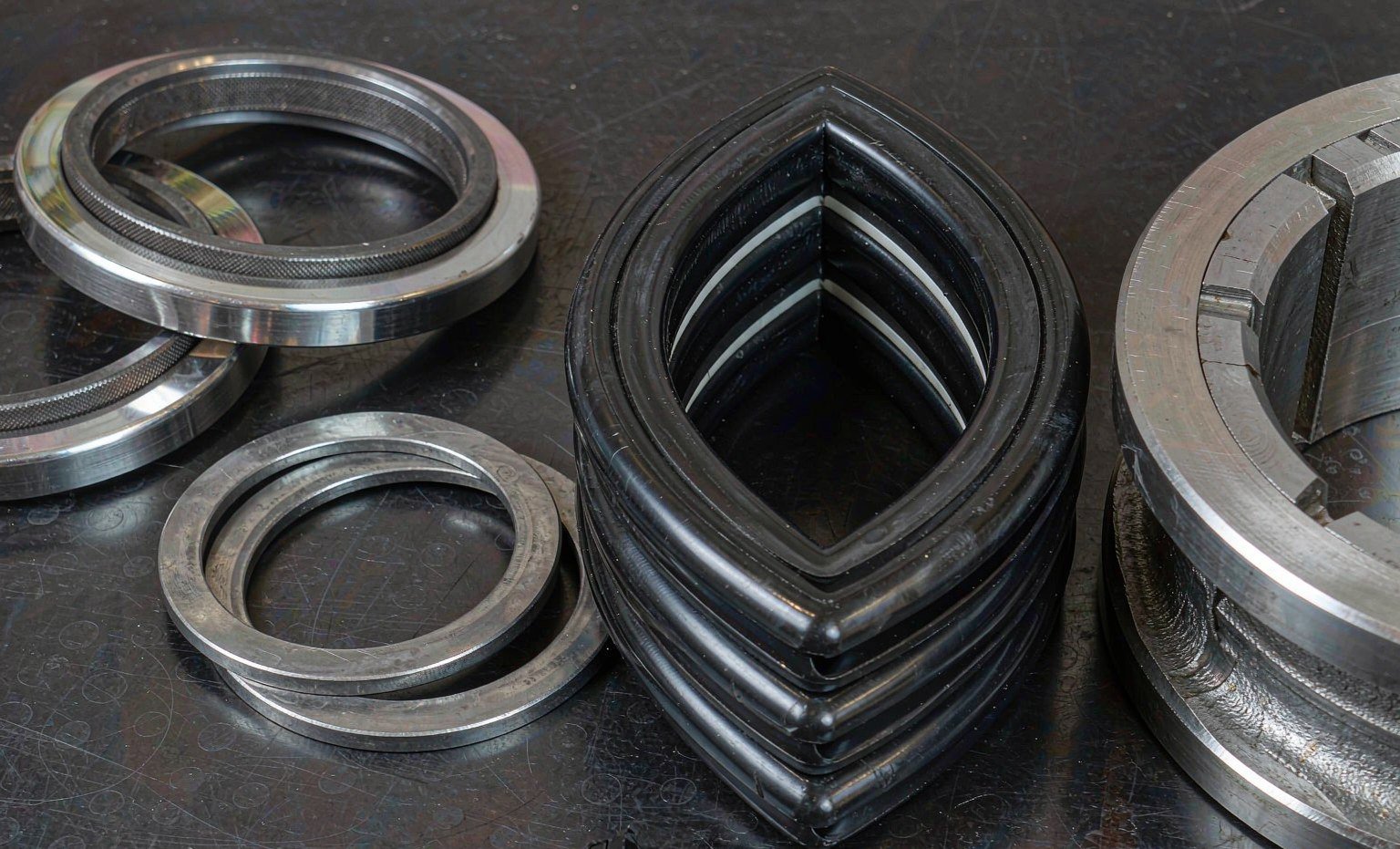
The Anatomy of a V-Packing Set
A chevron set has three kinds of parts, and every one of them has a job. The male adapter (also called the base or bottom adapter) sits at the pressure end of the stack — a solid ring with a conical seat that catches the point of the first V-ring. The female adapter (header, top adapter) closes the other end with a matching internal cone. Between them sit the V-rings themselves: rings whose cross-section is a V pointing toward the pressure side. The same stacking principle is still sold today as block vee packing systems from seal specialists, essentially unchanged from designs used a century ago.
Sets are single-acting. Pressure must arrive from the male-adapter side; installed backwards, the set will leak at a fraction of its rating. For cylinders that pressurize from both directions, two shorter sets are installed face-to-face — one of the reasons chevron stacks are most at home on rod glands and plunger-type pistons, where the pressure side is unambiguous.
The V-rings are usually molded in rubber — NBR or fabric-reinforced compounds in the style pioneered by seal makers such as Hallite 及 Trelleborg — but the same geometry is machined from polyurethane, PTFE composites, or PEEK-filled materials for duties rubber cannot reach. Because V-rings are frequently sold individually (the adapters separately), a set is effectively adjustable at purchase: you buy the ring count your pressure class needs, not a fixed-height cartridge.
| 組件 | Position in Stack | Function | Common Materials |
|---|---|---|---|
| Male adapter (base) | Pressure end | Supports V-ring points, converts pressure to radial lip load | Fabric-reinforced NBR, PTFE, metal-cored |
| V-rings (chevrons) | Center, 2-10+ pieces | Sealing barriers; each lip an independent line of defense | NBR, fabric NBR, FKM, PU, PTFE composite |
| Female adapter (header) | Atmospheric end | Closes the stack, defines lip contact on the bore | Fabric-reinforced NBR, PTFE |
| Back-up / anti-extrusion ring | Behind the set at high pressure | Blocks extrusion into gland clearances above ~400 bar | PEEK, nylon, bronze-filled PTFE |
How Self-Energizing Works in a Stacked V
At zero pressure, the preloaded stack — squeezed axially by the gland — pushes the outer lips of each V-ring lightly against the rod and the gland bore. Contact force is modest and friction stays reasonable.
When pressure arrives, the fluid gets inside each V’s mouth and pushes against the V’s inner walls. The geometry converts that axial pressure into radial expansion: each lip presses harder against the sliding surface exactly in proportion to the pressure trying to leak past it. Leakage is never fighting one lip; it must cross every V-ring in the stack, and each one is re-energized by the same pressure. That is the fundamental difference from a U-cup, where one lip does all the work and one defect means a leak path.
There is a second, underrated benefit: redundancy. A V-ring can be nicked, worn, or split-cut for installation, and the rings behind it still seal — usually with only a barely visible weep. Maintenance teams exploit this deliberately: a leaking chevron gland can often be “bought time” by tightening the gland nut, which compresses the stack further and restores lip contact without stopping production.
Ring Count, Pressure Class and Gland Depth
Ring count is the pressure tuning knob. More rings mean more parallel barriers and more total lip load, at the cost of friction, heat and stack height. Typical practice:
| System Pressure | Typical V-Ring Count | Material Recommendation | 備註 |
|---|---|---|---|
| Up to ~100 bar | 2-3 | NBR 70-90 Shore A | Standard hydraulic duty |
| 100-250 bar | 3-5 | NBR or polyurethane | The most common industrial range |
| 250-400 bar | 5-7 | Fabric-reinforced NBR | Anti-extrusion back-up advised |
| 400-700 bar | 7-9 | PTFE composite or PU | PEEK back-up ring, controlled gap |
| Above 700 bar | 8-10+ | PEEK / filled PTFE | Dual back-ups; validate on the actual hardware |
Gland depth must let the gland compress the assembled stack by roughly 10-15% of its free height when tightened — that preload is what seals at zero pressure. Because compression is adjustable, chevron sets tolerate what profile seals never could: worn rods, bore wear, even modest misalignment. The lips simply ride deeper into contact as parts wear, which is why rebuilders of old presses reach for V-packing when a new U-cup would last weeks on a scored surface.
Speed is the trade-off. The stacked lips generate more drag than any single-lip profile, and practical reciprocating speeds sit around 0.5 m/s. On a slow plunger pump or a press ram that barely matters. On a fast servo cylinder it rules the chevron out entirely — that duty belongs to profile seals, as covered in our rod seal versus piston seal comparison.
Material Options and What Each One Buys
| 材料 | Working Envelope (Typical) | Pressure Ceiling | Best Use |
|---|---|---|---|
| NBR 70-90 Shore A | -40 to +120°C | ~250 bar | Standard mineral-oil hydraulics, lowest cost |
| Fabric-reinforced NBR | -30 to +120°C | ~400 bar | Heavy presses; abrasion and gap tolerance |
| 氟橡膠 | -25 to +200°C | ~300-400 bar | Hot service, phosphate esters, chemicals |
| 聚氨酯 | -40 to +110°C | ~500 bar | Wear-heavy mobile cylinders, long strokes |
| PTFE composite | -100 to +260°C | ~500-700 bar | Chemical media, wide temperature, low friction |
| PEEK / filled PEEK | -60 to +250°C | ~700-1000 bar | Extreme pressure, steam, aggressive media |
PEEK itself is worth a note for extreme duties: material producers such as Victrex document PEEK’s steam and chemical resistance, which is why PEEK V-rings and back-ups appear on high-pressure steam and oilfield equipment where rubber chemistry fails.
Fabric reinforcement deserves a specific mention because it is the classic chevron material. The woven layer gives the V-ring dimensional stability at the thin tip, resists nibbling in large extrusion gaps, and lets the ring survive installation damage that would doom an unreinforced lip. When a client sends us a worn press cylinder for reseal, fabric-reinforced NBR with a raised ring count is still the most frequent recommendation we make.
Installation and Field Adjustment
Installation order matters more than skill: male adapter first with its cone facing the pressure, then V-rings one by one with points toward pressure, then the female adapter. Rings must not be twisted during stacking — the same discipline as O-ring installation. Large-diameter sets can be installed split-cut (rings cut at an angle and sprung over the rod), a major advantage on equipment where pulling the gland off is a crane job.
Adjustment is the ongoing work. The gland nut is tightened evenly — star pattern, not sequentially down one side — until the stack reaches design height, then backed to running compression. In service, a slow weep at the atmospheric end is the standard signal to re-tighten by a fraction of a turn. Over-tightening is the classic mistake: crushing the stack raises friction dramatically, runs the lips hot, and wears the rod surface — one of the more avoidable entries in our catalog of hydraulic seal failure causes. The set should weep very slightly rather than run bone dry and hot; a visible film means the lips are lubricated, which is what actually extends life.
When a chevron gland finally disassembles, inspect in this order: adapter cones for wear and cracking, first V-ring (the pressure-side one wears first — if it is intact, count the set as healthy), and the back-up ring clearance. Replacement sets are typically ordered as complete kits with the correct ring count for the pressure class — standard rod and piston seal ranges carry the common profiles, and the same logic we describe in our hydraulic seal kit ordering guide applies to sizing the set against the worn hardware.
Where Chevron Sets Still Win — and Where They Do Not
Choose a chevron set when the cylinder is large-bore (V-sets run from a few millimeters to beyond 1,500 mm diameter, beyond any practical molded profile), when the rod or bore is imperfect, when pressure spikes and shock loads rule out single-lip designs, or when field adjustment and split installation matter more than friction efficiency. Presses, jacks, plunger pumps, wellhead and valve stem packing are the classic homes of the technology.
Choose profile seals when speed, friction, or compactness govern: servo cylinders, mobile equipment with high stroke rates, anything where energy loss at the seal shows up in the duty cycle. Both technologies are widely stocked by industrial distributors such as ERIKS, so it is usually possible to trial both on the same equipment before committing. The two technologies are complements, not competitors — the failure is choosing one for the other’s job.
結論
A chevron V-packing set is the rare sealing technology that is deliberately adjustable: pressure class is set by ring count, leakage behavior by gland compression, and service life by material choice. That adjustability is exactly why it survives on heavy, slow, high-pressure equipment where nothing else tolerates wear, shock and field repair. Get the orientation, the ring count, and the compression right — and resist the urge to over-tighten — and a V-set will outlive several cycles of the profile seals around it.