
There is a family of seals that keeps working where rubber gives up: at −196 °C in a cryogenic pump, in a 10⁻⁶ mbar vacuum chamber, in chemical media that dissolve every elastomer in the catalogue, and on rotary shafts spinning too fast for a conventional lip. The component is a spring-energized lip seal — a U-shaped polymer jacket with a precision metal spring inside it. The jacket supplies chemical resistance and low friction; the spring supplies the contact force that rubber would normally get from its own elasticity.
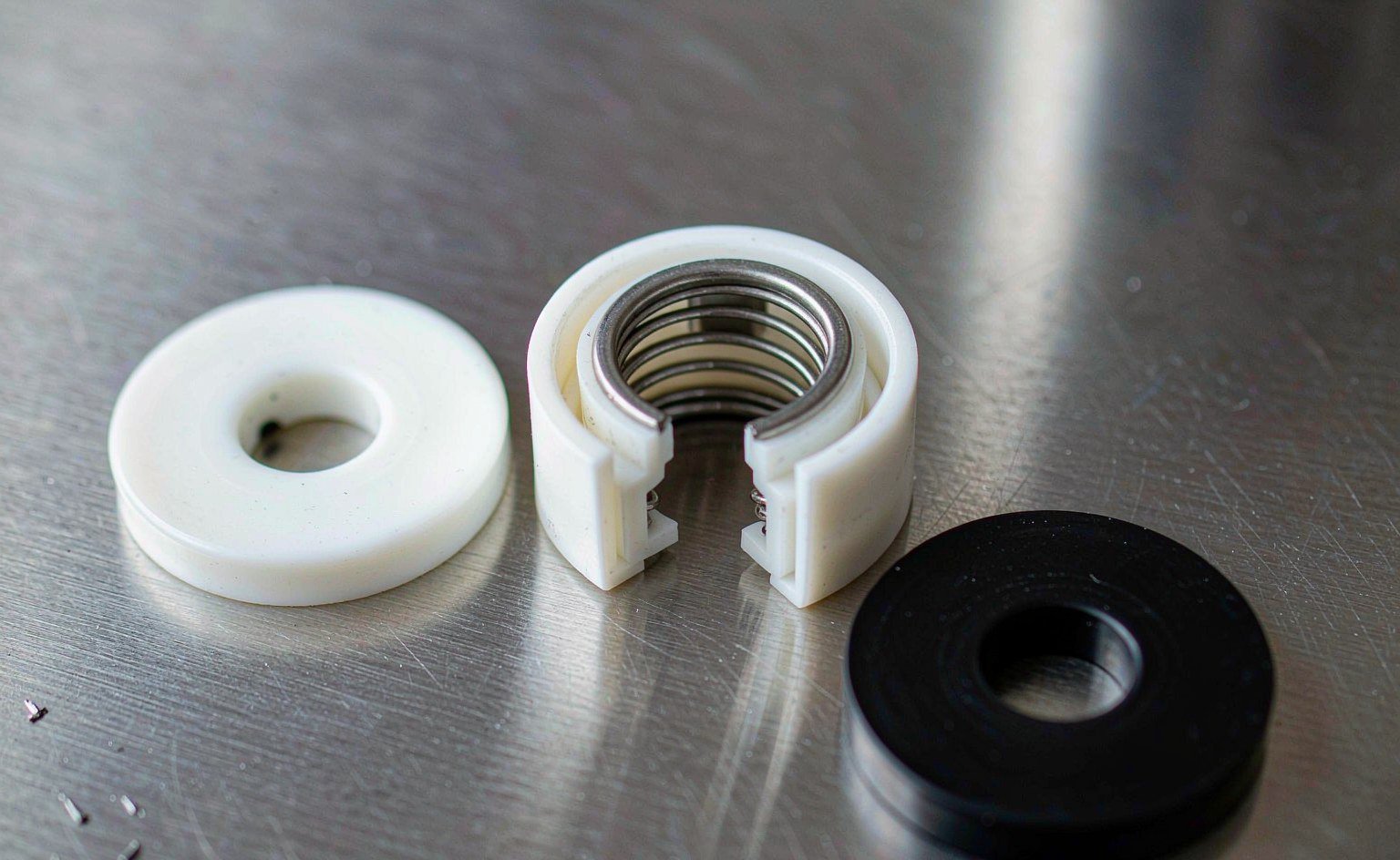
This article explains how the design works, what the three spring geometries actually do differently, and how we match jacket material, spring type and spring alloy to the service conditions when a customer sends us an application instead of a part number.
How the Design Works
The jacket is machined or moulded from PTFE, UHMWPE or another polymer into a U-profile. The heel of the U holds a metal spring compressed between the two lips. Installed, the spring presses the lips against the rod, bore or face even with zero system pressure — that is the fundamental difference from a conventional O-ring, which depends entirely on squeeze.
When pressure rises, the medium enters the U and pushes the lips harder against the counter-surfaces. The seal therefore tightens under load instead of extruding. And because the spring carries the sustained load rather than the polymer’s stress relaxation behavior, the contact force stays close to constant over a long service life — the jacket can wear, the shaft can drift out of round, the housing can be eccentric, and the seal keeps following without losing contact. Compression set, the failure mode that kills elastomer seals during long dwell periods, is almost a non-issue here.
Sizing is different too: spring-energized seals are made to the hardware, never to a dash number. The gland dimensions, the counter-surface diameter and finish, the pressure direction and the speed all feed the profile drawing. Our Vari-Seal spring-energized range is quoted from the application data for exactly that reason.
The Three Spring Geometries
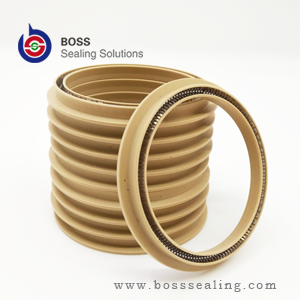
The spring decides the load curve, the deflection range the seal can absorb, and the friction it costs. Three geometries cover nearly every application, and manufacturers name them consistently:
- Canted coil (slant coil) — coils set at an angle to the spring axis. Each coil deflects independently, which produces a flat, nearly constant load curve over a wide deflection range. That means predictable friction and torque, forgiving behavior on eccentric or out-of-round shafts, and strong resistance to compression set. It is the standard choice for rotary and oscillating duty, and the same geometry doubles as an EMI shield or electrical connector in other industries.
- Cantilever V (finger spring) — a V-shaped ribbon with a linear load curve: force rises with deflection. The load concentrates at the front edge of the lip, giving positive wiping action, which is why cantilever-energized profiles also work as scrapers in gritty environments. Moderate load, wide deflection, effective in reciprocating rods and pistons and in large-diameter face seals where it must follow machining tolerances.
- Helical (wound ribbon) — the highest unit load with the smallest deflection range. It produces tight, reliable sealing where contact force matters more than friction: static face seals, cryogenic valves, slow or intermittent motion. Manufacturers generally restrict helical-energized profiles to static or very slow dynamic service — Parker’s published guidance puts them below roughly 150 sfpm (0.76 m/s) on sliding surfaces.
| Spring type | Load curve | Deflection range | Friction | Best suited to |
|---|---|---|---|---|
| Canted coil | Flat, nearly constant | Wide | Low, predictable | Rotary and oscillating shafts; low-torque drives; long dwell |
| Cantilever V | Linear (rises with deflection) | Wide | Moderate | Reciprocating rods and pistons; face seals; exclusion/scraping duty |
| Helical | Steep, high load | Small | High at speed | Static face seals; cryogenic valves; slow or infrequent motion |
A useful shortcut when reading a competitor’s drawing or a maker’s datasheet: name the motion and the spring follows. Rotary points to canted coil, reciprocating to cantilever, static or cryogenic face sealing to helical. Specialist makers such as Bal Seal, whose canted-coil spring started the product category, publish load curves per spring size, and the reputable makers all follow the same three-geometry taxonomy described in Trelleborg’s and other manufacturers’ sealing handbooks.
Jacket Materials: What the Lips Are Made Of
The spring solves mechanical retention; the jacket solves chemistry and temperature. Four material families cover most requests we see:
| Jacket material | Continuous temp range | Wear | Chemical resistance | Typical role |
|---|---|---|---|---|
| Virgin PTFE | ≈ −200 to +260 °C | Modest — creep-prone | Nearly universal (pH 0–14) | Chemical, purity, food contact, low-load static duty |
| Filled PTFE (glass, carbon, bronze, graphite, Ekonol) | ≈ −190 to +290 °C | Good to excellent; creep resistance improved | Broad; filler-dependent limits | Dynamic duty, higher pressure, rotary shafts |
| UHMWPE | ≈ −200 to +80 °C | Outstanding — several times virgin PTFE | Weak acids/bases, most solvents; not strong oxidizers | Abrasive slurry-adjacent duty, water, low-pressure hydraulics |
| PEEK | ≈ −70 to +250 °C (higher short-term) | Excellent; stiff | Broad incl. hot steam and many solvents | High pressure, high temperature, extrusion-critical glands |
Two practical notes from the factory floor. First, filled PTFE exists because virgin PTFE creeps — under sustained load at temperature, virgin PTFE cold-flows, and fillers (25–40% by weight in typical grades) are what hold the lip geometry over years. Second, the jacket and the counter-surface are a pair: a stiff PEEK jacket against a soft aluminium bore will machine the bore, while filled PTFE against hardened steel with Ra 0.2–0.4 µm will run for years. Tell us the counter-surface material and finish, not just the medium.
Where the Design Wins — and Where It Does Not
Spring-energized seals earn their price premium in five zones where elastomer O-rings fail outright:
- Cryogenic service — below about −60 °C most elastomers go glassy and crack. PTFE and UHMWPE jackets stay functional to roughly −200 °C, and the spring restores the contact force that thermal contraction would otherwise remove.
- Vacuum — elastomers outgas and permeate. PTFE jackets with canted-coil springs are standard on chamber doors, motion feedthroughs and gas panels.
- Aggressive chemistry — media that attack every elastomer (hot amines, strong oxidizers, HF-containing streams) leave PTFE and PEEK indifferent. Our earlier PTFE encapsulated O-ring guide covers the same chemistry logic for static glands.
- High pressure — pressure-energization means the seal tightens as pressure rises; with a PEEK jacket and proper anti-extrusion support these profiles hold well beyond O-ring limits.
- Speed — filled-PTFE lips with canted-coil energizers run on rotary shafts where elastomer lips would burn.
The honest trade-offs: a spring-energized seal is not a drop-in for an O-ring gland. The housing must be sized to the profile’s working deflection, the lip direction must match the pressure side on single-acting designs, and installation needs lead-in chamfers and dedicated tools because PTFE jackets do not stretch and recover like rubber. Closed glands may require stretching and resizing tools specific to the profile. Retrofitting one into a gland cut for an O-ring is a hardware redesign, not a swap — we send a section drawing with every quotation so the machine shop sees the complete gland specification before cutting metal.
| Application | Spring | Jacket | Note |
|---|---|---|---|
| Cryogenic pump/valve (−196 °C) | Helical or cantilever | Virgin or filled PTFE | Spring alloy must stay elastic at temperature |
| Vacuum chamber / semiconductor | Canted coil | Virgin PTFE | Low outgassing; cleanliness over load |
| Rotary shaft, high speed | Canted coil | Filled PTFE (carbon/bronze) | Counter-surface finish 0.2–0.4 µm Ra |
| Reciprocating rod, abrasive media | Cantilever V | Filled PTFE | Wiping lip front edge; pair with a wiper |
| High-pressure hydraulic/gas | Cantilever or helical | PEEK or filled PTFE | Anti-extrusion back-up on the low-pressure side |
| Chemical process / CIP equipment | Canted coil or helical | Virgin PTFE | Spring alloy chosen for the cleaning chemistry |
The Spring Alloy Is Part of the Specification
Most failures blamed on “the PTFE seal” originate in the spring — corrosion, relaxation or fatigue of the wrong alloy. Stainless steel (301, 304, 17-7 PH) is the default for general-purpose and cryogenic duty. Hastelloy C handles aggressively corrosive media. Elgiloy (cobalt-chromium-nickel) combines fatigue resistance with corrosion resistance for hot, salt-laden or offshore service, and Inconel covers severe heat. The medium that reaches the spring — not the medium the jacket sees — decides the alloy, because capillary action wicks process fluid into the spring cavity over time. Specify the alloy explicitly on the RFQ; “spring steel” is not an answer for a chlorine stream.
For buyers building a specification from scratch, our spring-energized seal selection guide walks the full decision tree, and our high/low temperature seal range lists the stock jackets and alloys per temperature band. Distributor-side references such as Darcoid and Seal Sales are useful for cross-referencing part-numbering conventions between makers before you commit to a drawing.
FAQ
Is a spring-energized lip seal the same as an encapsulated O-ring?
No. An encapsulated O-ring is a hollow FEP/PFA jacket over an elastomer core, meant for static glands; it deforms like an O-ring. A spring-energized seal has a solid machined jacket and a metal spring, handles dynamic motion and far higher pressures, and is made to the hardware print. Both exist because rubber cannot survive the chemistry or temperature — see our comparison of encapsulated seals for the static case.
Why did my spring-energized seal leak from day one when the same part worked last year?
Check the gland before the seal. The most common causes are a deepened or re-cut gland that changed spring deflection, a counter-surface that was re-machined out of spec, and installation damage to a lip from a sharp port edge. The spring only compensates within its deflection range; a groove 0.2 mm too deep can remove most of it.
Can I use one spring-energized seal for pressure from both sides?
Only if the profile is a symmetric double-acting design. Single-acting profiles have a defined pressure side, and mounting one backward makes it pump or leak. Opposed single-acting seals are the conventional answer for bi-directional duty, but that changes gland volume and assembly space — get the section drawing before modifying the housing.
How much pressure can these seals take?
It depends on the jacket, the profile, the anti-extrusion support and the gland — there is no single published figure, and any supplier who quotes one number without asking about the extrusion gap and the counter-surface is guessing. Filled-PTFE jackets with PEEK back-ups serve well into the thousands of bar; virgin PTFE without support does not. Send the duty cycle and let the profile drawing answer it.
Jacket, Spring and Gland as One Part
Spring-energized seals are specified as an assembly, so we quote them that way: PTFE and filled-PTFE jackets in the profiles described here, PEEK back-up rings behind them, and canted-coil, cantilever or helical springs in the alloy the duty requires — 301 or 316 stainless as standard, Elgiloy or Hastelloy where corrosion or temperature rules the stainless grades out.
What changes the answer is usually not the jacket but the hardware: the extrusion gap behind the lip, the counterface finish the jacket runs against, and whether the gland has room for the spring’s travel. We check all three against the drawing, because a filled-PTFE jacket pushed past its gap limit fails in a way that reads like a material problem and is not.
Send the seal drawing, the pressure, temperature and medium to sales@bosssealing.com, and we will return a proposed jacket compound, spring alloy and back-up arrangement with price and lead time — normally inside a day, review included. Or use the contact form.