
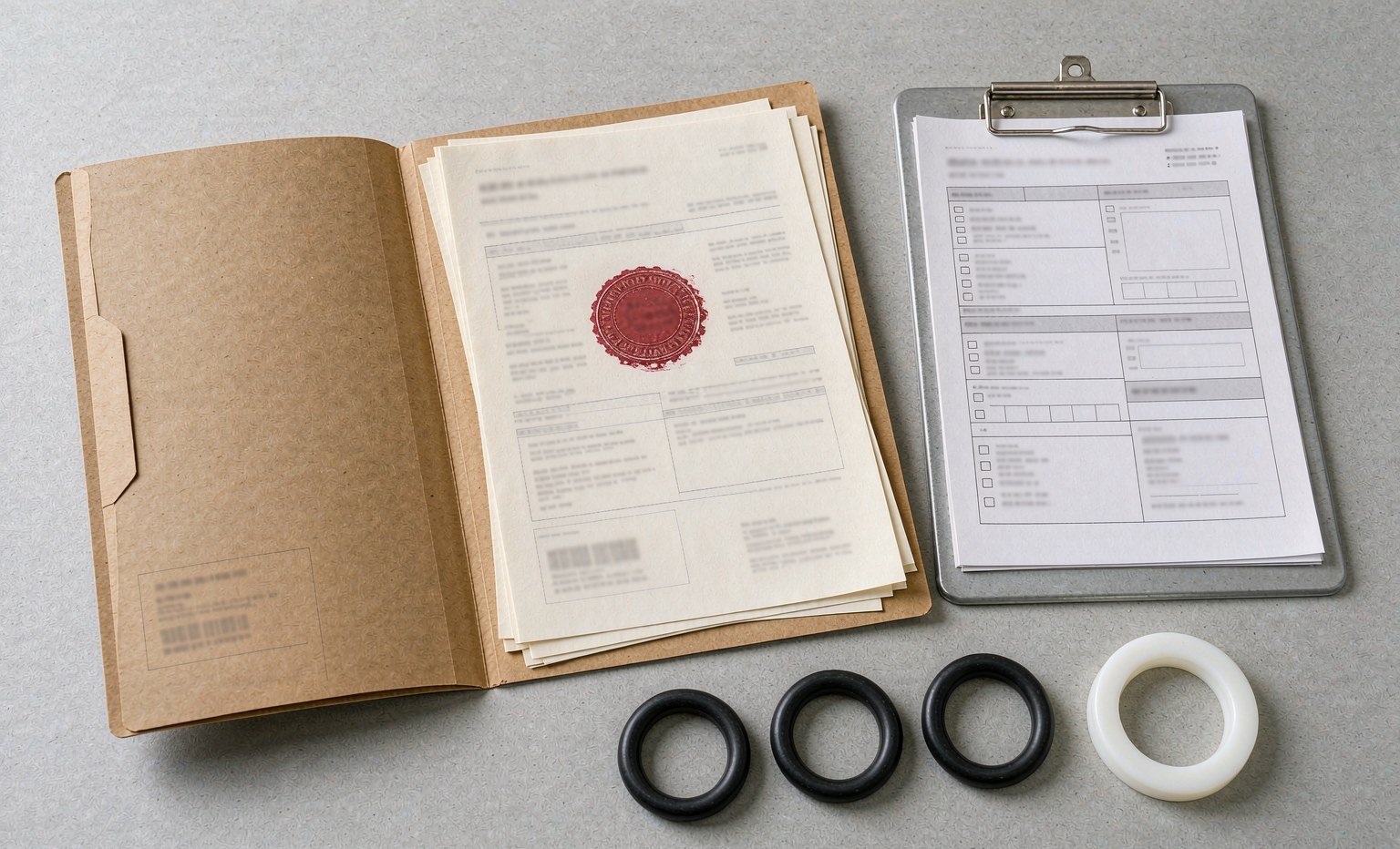
A supplier sends a PDF with a blue seal on it and the words ISO 9001:2015 across the top. The buyer files it, the shipment clears, and eighteen months later an end customer asks for the certificate that covers the specific compound in the seals they bought — and nobody can produce it.
Certificates are the weakest link in seal sourcing because they are easy to copy, easy to misread, and almost never checked. The check takes five minutes and needs no cooperation from the supplier. What follows is the short list of certifications that actually change what a seal can be sold into, what each one covers, and how to confirm it exists.
Why Certificates Behave Differently for Seals
A seal is a compound, a shape, and a cure. Compliance attaches to the first and third, not the second. A factory can hold a valid ISO 9001 certificate and still ship a batch cured with the wrong accelerator; it can hold an FDA declaration for an EPDM sheet compound and mold your part from a different compound with the same hardness and colour.
That is the structural problem: most seal paperwork is issued at the material level, while the buyer purchases at the part level. The certificates below are worth having, but each one has a scope, and the scope is the part that gets skipped.
| Certification | What it covers | Issued by | Typical validity |
|---|---|---|---|
| ISO 9001:2015 | Quality management system at a named site | Accredited certification body | 3 years, annual surveillance |
| IATF 16949:2016 | Automotive quality system, automotive production sites only | IATF-recognised certification body | 3 years, annual surveillance |
| NSF/ANSI 51 | Materials and finishes for commercial food equipment | NSF International | Annual listing renewal |
| NSF/ANSI 61 (and CAN 61) | Health effects of components in contact with drinking water | NSF International | Annual listing renewal |
| WRAS | UK water fittings in contact with public mains water | WRAS (tested to regulation) | 5 years, subject to change control |
| KTW-BWGL | German drinking-water contact, elastomers under Annex D | DVGW, KIWA, or equivalent | 5 years |
| FDA 21 CFR 177.2600 | Repeated-use rubber articles in food contact | Compound maker’s own declaration | No expiry — tied to formulation |
1. ISO 9001:2015 — A System Certificate, Not a Product Certificate
ISO 9001 certifies that a site runs a documented, repeatable management system. It does not certify that any particular part meets any particular specification. A factory can be fully compliant with ISO 9001 while changing a cure accelerator, provided the change is documented and routed through its own process.
That is not a reason to skip it. It is a reason to read the scope. The certificate names the legal entity, the site address, and the activities covered. A certificate covering “trading of rubber products” is a different document from one covering “manufacture of molded and machined sealing components”, and buyers regularly file the first while believing they have the second.
ISO 9001 certificates run on a three-year cycle with surveillance audits in years one and two. A certificate that is valid until 2028 but whose last surveillance was eighteen months ago is technically out of compliance and can be withdrawn at the next audit. Ask for the date of the most recent surveillance, not just the expiry date.
2. IATF 16949:2016 — Read the Eligibility Rule First
IATF 16949 is the automotive quality standard, built on the structure of ISO 9001:2015 and administered by the International Automotive Task Force. It adds automotive-specific requirements around product approval, change control, and contingency planning, and automotive buyers treat it as a gate.
The rule that surprises importers is eligibility. Certification applies to manufacturing sites producing production, service, or accessory parts, and eligibility generally requires a supply relationship with an IATF-recognised vehicle manufacturer. A factory that has only ever served the aftermarket is screened out at the eligibility stage — which means a pure aftermarket seal supplier holding an IATF certificate is a reason to ask more questions, not fewer: which site, which product line, and through which customer?
For a seal trader selling into industrial maintenance, demanding IATF 16949 filters out good suppliers rather than bad ones. For a Tier 2 automotive program, it is mandatory and the certificate must cover the site that molds the part. The same logic applies to ISO 13485 for medical and AS9100 for aerospace: the standard has to match the market the part is sold into.
3. NSF/ANSI 51 and 61 — Food Equipment and Drinking Water Are Different Standards
These two are constantly confused, and using the wrong one is a compliance failure rather than a paperwork slip.
NSF/ANSI 51 covers food equipment materials: the plastics, sealants, gaskets, valves, and finishes used in commercial foodservice equipment. Certification involves a formulary review against US FDA requirements plus extraction testing. It is the standard for a gasket in a beverage dispenser or a mixer.
NSF/ANSI 61 covers drinking water system components and evaluates the chemical contaminants and impurities a material can impart to drinking water. It is based on US EPA and Health Canada requirements and is the standard for a gasket in a water treatment manifold or a municipal valve.
A seal can need both — a coffee machine that also draws potable water sits in both worlds — and NSF offers bundled certification for exactly that case. What it cannot do is substitute one for the other. A “food grade” gasket without a cited standard is not certified to anything.
Both are listings rather than one-time certificates: the product appears in NSF’s public listing with a specific trade name and designation, and the listing is renewed annually. That makes verification easy — search the listing by the compound or product name the supplier claims, not by the certificate number on the PDF.
4. WRAS and KTW-BWGL — Two European Drinking Water Routes
Europe does not have a single drinking-water approval, which is why a seal that is legal in Manchester may not be legal in Munich.
WRAS is the UK scheme. Any water fitting in contact with the public mains supply has to comply with the water supply regulations in England and Wales, or the Scottish byelaws, and WRAS approval demonstrates that compliance through material safety testing plus mechanical testing of the fitting. WRAS approvals run on a five-year cycle with change-control obligations: if the compound or the manufacturing site changes, the approval does not automatically follow.
KTW-BWGL is the German route, issued under the Federal Environment Agency (UBA) framework and certified by bodies such as DVGW and KIWA. The transition here matters for anyone holding older paperwork: the previous elastomer guideline (ELL) expired at the end of 2021, its requirements were transferred into KTW-BWGL Annex D in March 2022, and test reports issued under the old ELL and W270 schemes were usable only until 1 March 2025.
In practice that means an EPDM drinking-water certificate dated 2019 is no longer evidence of anything in Germany, even though the PDF still looks official. KTW-BWGL certification takes roughly five to six months and is valid for five years. If your supplier’s German approval predates 2022, ask which scheme it sits under.
The EU-level rule sits above all of this: materials in contact with drinking water fall under the Drinking Water Directive and the revised minimum hygiene requirements adopted in 2024, while food contact falls under Regulation (EC) 1935/2004. The European Commission’s food contact materials pages are the reference for the food side; WRAS and DVGW publish their own approval directories.
5. FDA 21 CFR 177.2600 and the Declaration of Compliance
21 CFR 177.2600 is the US rule for repeated-use rubber articles in food contact. It sets an ingredient allow-list and extraction limits, and it is the basis most “food grade” claims rest on.
Two things about it are routinely misstated. First, the FDA does not approve compounds. The regulation is satisfied by the compound maker’s own declaration that the formulation and extraction results meet the rule — the document is a self-certification, and its value depends entirely on the laboratory work behind it. Second, the declaration belongs to the compound, not to the part. A molder that buys a compliant compound and then adds a non-compliant mold release agent has a non-compliant part with a compliant paper trail.
On the EU side, Regulation (EC) 1935/2004 sets the framework and requires a declaration of compliance; rubber food-contact materials are covered by national rules and Council of Europe resolutions rather than a single harmonised measure, which is why German, French, and Italian buyers often ask for different documents for the same gasket.
Pharmaceutical buyers add USP Class VI (biological reactivity) and sometimes ISO 10993-5 and -10 reports. These are test reports, not certificates, and they apply to a specific compound and a specific test laboratory.
The Five-Minute Verification Routine
None of this requires the supplier’s cooperation beyond sending the document. The checks below are public.
| Step | What to collect | Where to check | What a pass looks like |
|---|---|---|---|
| 1. Identity | Legal entity name, site address, certificate number, issuing body, expiry date | Compare against the invoice and shipping documents | Name and address match the factory that ships |
| 2. Issuer accreditation | Certification body name and accreditation number | IAF CertSearch | Body appears, accredited for the standard and the sector |
| 3. Certificate status | Certificate number | The certification body’s own public register | Status active, scope matches the products you buy |
| 4. Surveillance | Date of last surveillance audit | Ask the supplier, cross-check with the register | Within the last 12 months |
| 5. Product listing | Trade name or compound designation used in the listing | NSF listing, WRAS directory, DVGW/KIWA register | The exact compound or product appears, not just the material family |
Steps one to four take about ninety seconds per certificate. Step five is where most claims fail, because the listing is usually for a compound the supplier buys rather than a part it makes — and that is fine, provided the supplier can show the purchase trail from that compound to your batch.
Where Certificates Fail in Practice
The failures we see in incoming inspection are rarely forged documents. They are scope mismatches and stale approvals.
A certificate covers the trading entity while a different factory molds the part. A certificate covers molded parts while the part you bought is machined from sheet. A food-contact declaration is valid for a black EPDM compound and the parts arrived in a red compound with the same hardness. A WRAS approval was issued to a compound that has since changed supplier. A KTW certificate predates the 2022 scheme change.
Each of these is invisible on the PDF and visible in the supply chain. The fix is to tie the certificate to the purchase order: name the compound designation on the PO, require the certificate of conformance to quote that designation and the lot number, and re-verify whenever the compound or the site changes.
The Bottom Line
Five documents cover most of what a seal importer needs to prove: a verifiable ISO 9001 certificate with a scope that matches the process, IATF 16949 or ISO 13485 only where the market actually requires it, NSF/ANSI 51 or 61 depending on whether the part meets food or drinking water, WRAS or KTW-BWGL for Europe, and a compound-level FDA or EU declaration with the extraction data behind it.
None of them prove that the part in the box was made from that compound. That is what the certificate of conformance, the lot number, and the purchase-order reference are for — and it is why the paperwork should be specified at the RFQ stage rather than collected after the first rejection.
If you are building a documentation package for a market we already supply, tell us the standard number and the destination and we will tell you what the compound can carry. The O-ring and X-ring range and the rubber seals range both list the compound families available, and the high and low temperature seal range covers the FFKM and FEPM grades that most compliance-driven inquiries end up needing. For the material side of the food-contact question, the food-grade seal materials guide maps FDA and EU 10/2011 requirements onto specific elastomers.
For benchmark documentation practices, ERIKS’s sealing technical manual shows how a European distributor structures compound data for buyers, and it is a useful model for what to ask a supplier to provide.
The Paperwork Behind the Part
A certificate is worth what the process behind it can prove, so we keep the document set where buyers can reach it: ISO 9001:2015 system certificate, material certificates traceable to compound batch, FDA 21 CFR 177.2600 and EU 10/2011 declarations for food-contact grades, RoHS and REACH statements, and dimensional reports on request. For drinking-water projects we supply the compound documentation the WRAS or KTW-BWGL route requires — and we say plainly when the paper in hand does not cover the grade being quoted.
What we will not do is attach a certificate to a compound it was never issued for. If a drawing calls for NSF/ANSI 51 supply or an IATF 16949 chain and our documentation stops short of it, you hear that before the order rather than after the audit.
Tell us the market, the application and the standard your buyer will audit against, and we will send the document pack for the grade we propose — before you commit to a purchase order. Write to sales@bosssealing.com or use the contact form; documentation questions usually come back the same working day.