
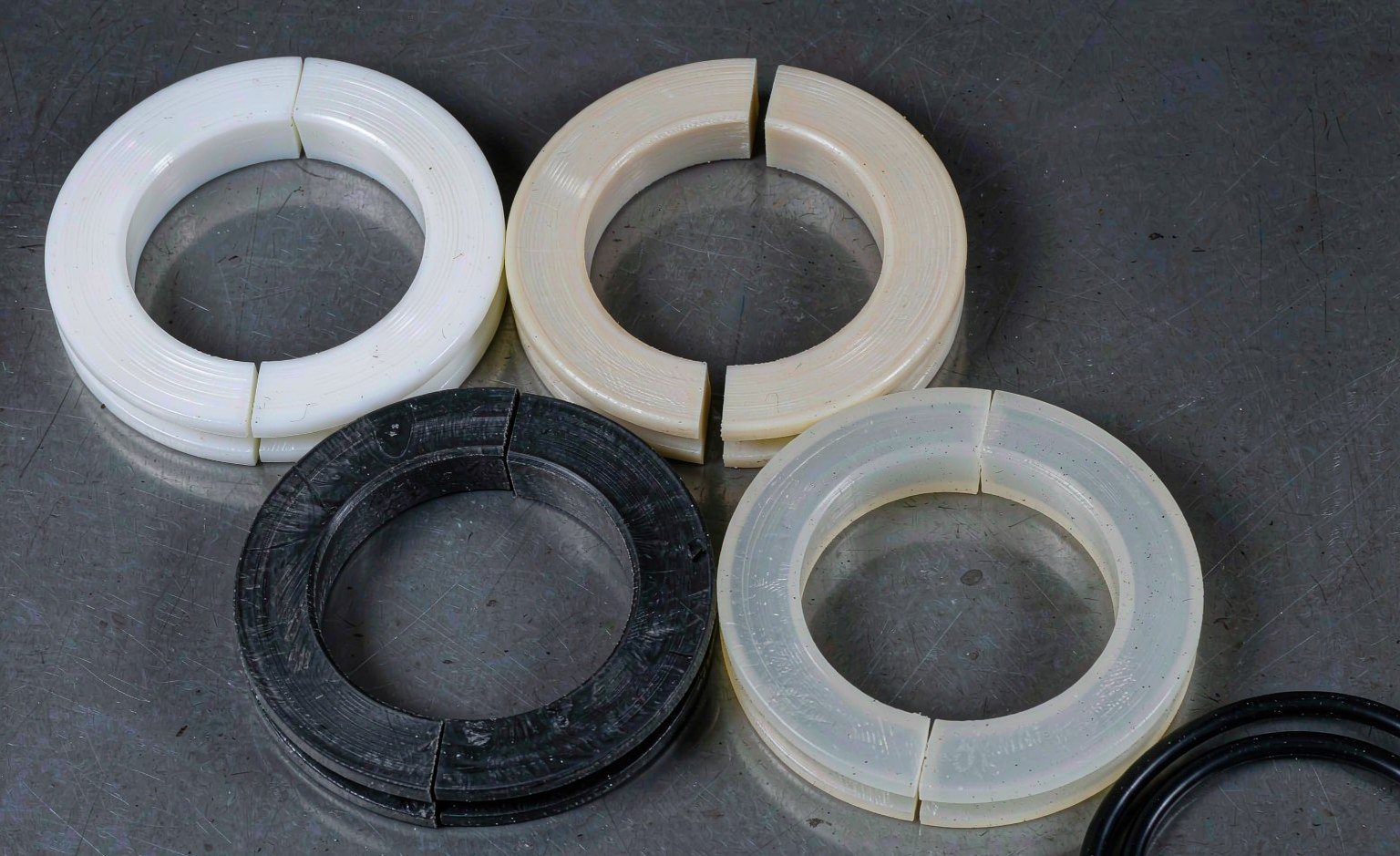
Every hydraulic engineer eventually meets the same failure photo: an O-ring chewed into a spiral of shavings, nibbled flat on one side, packed into a clearance gap it was never meant to enter. The gland was fine, the O-ring compound was fine — what was missing was the back-up ring, or the back-up ring installed was the wrong polymer for the pressure. This article compares the two polymers that dominate high-pressure anti-extrusion duty, PTFE and PEEK, and gives a concrete selection rule by pressure band.
The Job in One Sentence: Close the Extrusion Gap
An O-ring under pressure behaves like a quasi-fluid: it flows toward every low-pressure escape route. The hardware clearance between the seal groove and the opposing surface is exactly such a route. Past a pressure that depends on the O-ring hardness, the temperature, and the gap width, the elastomer begins to extrude into the gap, and each pressure cycle shaves a little more material away until the seal nibbles through.
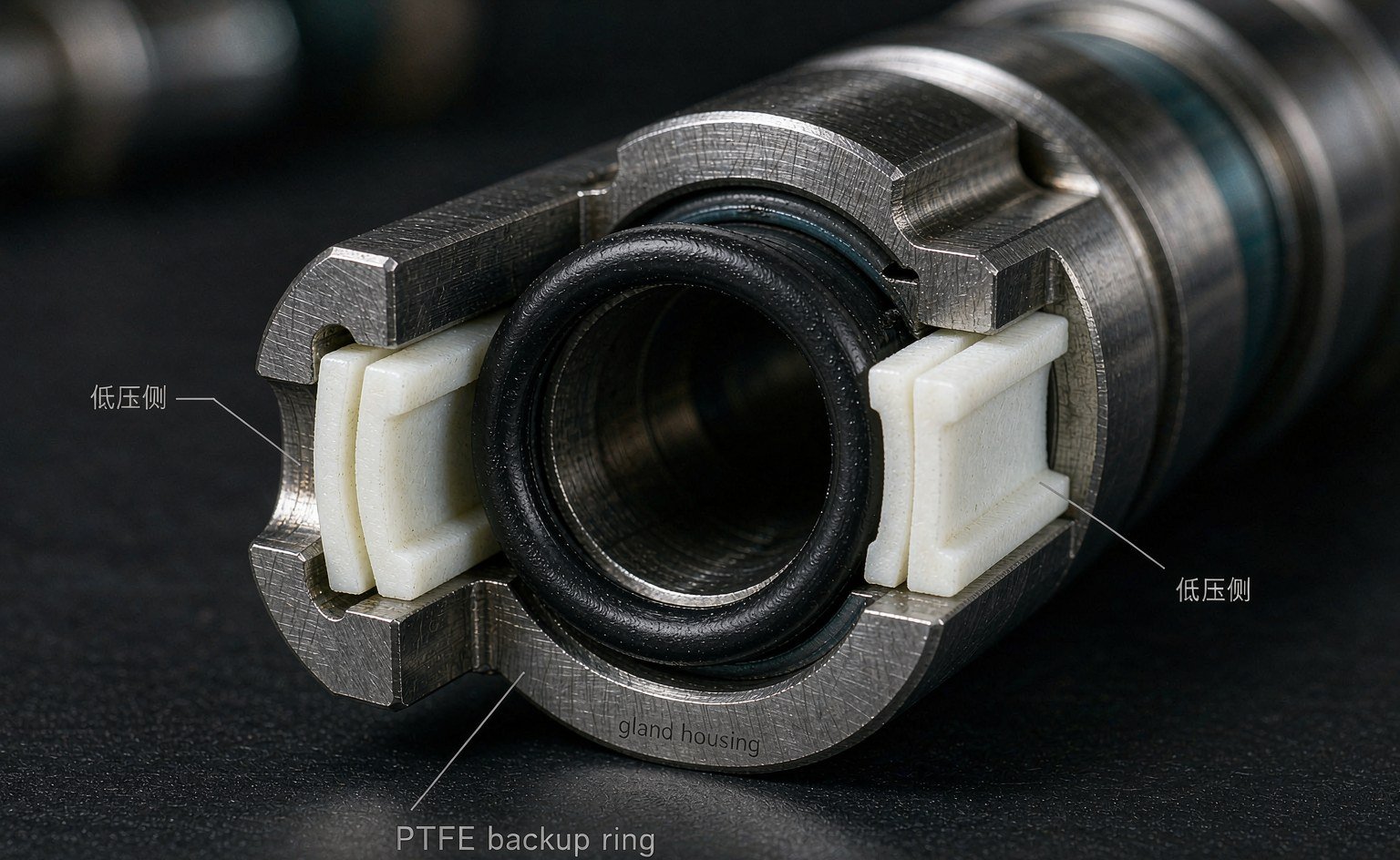
A back-up ring is a rigid, non-elastomeric ring placed on the low-pressure side of the O-ring (one ring for one-sided pressure, two rings for pressure from both sides). It bridges the gap, so the O-ring has nowhere to flow. The fundamentals — geometry, single vs. double configurations, and when you need one — are laid out in our article what is a back-up ring, and the failure physics in our guide to extrusion and gap analysis at high pressure.
The ring itself does not seal. It carries load. That distinction drives every material decision in the rest of this article.
The Pressure Ceiling Is Set by the Polymer, Not the Shape
Scarf-cut, half-split, or solid — geometry affects installation and gap coverage, but the load-bearing limit comes from the polymer’s stiffness and its resistance to cold flow. The industry-accepted working limits are consistent across polymer seal suppliers:
| Back-up ring material | Max working pressure (psi) | Max working pressure (bar) | Max temperature |
|---|---|---|---|
| Virgin PTFE | ~3,600 | ~250 | ~300°C (575°F) |
| Filled PTFE (glass, carbon, bronze) | ~5,800 | ~400 | ~260–300°C |
| PEEK (unfilled and filled) | ~20,000 | ~1,380 | ~260°C (500°F) |
These figures trace back through the polymer sealing industry — for example, Advanced EMC Technologies’ published PTFE/PEEK/nylon back-up ring guide and the technical FAQ from Kintek’s PEEK back-up ring limits page both document the same pressure bands. Read them as design limits with reasonable safety margin, not as failure thresholds: a virgin PTFE ring at 260 bar may survive days or weeks, but it will cold-flow and lose its function.
Temperature splits the decision differently than pressure does. PTFE holds a slightly higher ultimate temperature ceiling than PEEK and stays chemically inert to nearly everything, while PEEK keeps its mechanical strength far closer to its own limit — it stays stiff and load-bearing at temperatures where PTFE has long since crept. When a specialist PEEK supplier such as Victrex or a processing house like Ensinger Plastics publishes creep and heat-deflection curves for the two polymers side by side, the divergence is unmistakable.
Cold Flow vs. High Modulus: The Structural Difference
The whole comparison reduces to one material behavior: cold flow.
PTFE is a superb seal surface and chemically inert, but as a load-bearing element it is a poor structure. Under sustained compressive load, PTFE molecules slowly rearrange and the part deforms permanently — even at room temperature, and faster as temperature climbs. A virgin PTFE back-up ring that sits against a pulsing 200 bar line for months will gradually flatten, open its scarf joint, or flow into the gap it was supposed to bridge. Fillers fix part of this: glass, carbon, and bronze particles stiffen the matrix and cut creep substantially, which is why filled PTFE rates roughly 60% higher in pressure than virgin material. Filler choices and their effects are summarized in our engineering plastics range, where we machine these polymers daily.
PEEK has the opposite character. It is a semi-crystalline, high-modulus engineering plastic: stiff, hard, and highly resistant to creep and extrusion. Unfilled PEEK already outperforms any PTFE grade in load-bearing; carbon-fiber-filled PEEK raises stiffness further for shock-loaded service. The trade-offs are price (several times filled PTFE per part), brittleness during installation (a solid PEEK ring cannot be stretched into a gland the way a PTFE ring can — it must be split or the design must accommodate assembly), and a narrower chemical window: concentrated sulfuric acid and some halogenated solvents at high temperature attack PEEK, while PTFE ignores both.
Head-to-Head Comparison
| Property | Virgin PTFE | Filled PTFE | PEEK |
|---|---|---|---|
| Working pressure | ~250 bar | ~400 bar | ~1,380 bar |
| Continuous temperature | to ~300°C | to ~260–300°C | to ~260°C |
| Friction | Extremely low (µ ≈ 0.05–0.10) | Low, filler-dependent | Low, higher than PTFE |
| Cold flow / creep | High — the main weakness | Moderate — fillers help | Very low |
| Chemical resistance | Near-universal inertness | Still excellent | Excellent except conc. sulfuric acid, some halogenated media at heat |
| Installation | Can be stretched / scarf-cut installs easily | Similar, slightly stiffer | Rigid — needs split ring or split-groove design |
| Machining | Easy, soft material | Easy, abrasive fillers wear tools | Requires rigid setups, carbide tooling |
| Relative cost per part | Low | Low–moderate | High (several × filled PTFE) |
| Typical use | Low–medium pressure, cryogenic, chemical | Medium–high pressure general hydraulic | High pressure, shock loads, oilfield, aerospace |
One nuance engineers miss: friction. In slow-motion or oscillating glands, a PTFE back-up ring slides against hardware with almost no stick-slip, while PEEK’s higher friction can contribute to stiction in servo cylinders. If your gland oscillates gently at high precision, that alone can decide the material.
Choosing by Operating Envelope
Map your system onto the pressure bands and the choice is usually unambiguous:
| Operating condition | Recommended back-up ring | Reasoning |
|---|---|---|
| ≤250 bar, wide temperature, any media | Virgin PTFE | Cheapest, chemically inert, easy install; creep irrelevant below its pressure limit |
| 250–400 bar steady hydraulic | Filled PTFE (glass or carbon) | Filled grades carry the extra pressure at modest cost |
| 400–1,000 bar, or pressure spikes and shock | PEEK, unfilled | Cold flow eliminated; survives cyclic overload that flows PTFE |
| 1,000+ bar (intensifiers, test benches, injection) | Carbon-filled PEEK + tight gap control | Max extrusion support; check hardware gap at pressure |
| Cryogenic or >250°C service | Virgin PTFE (or filled, per pressure) | PTFE’s temperature envelope exceeds PEEK’s usable range in sealing duty |
| Concentrated acids / strong solvents at heat | PTFE family | PEEK’s narrow chemical window excludes it |
Three installation notes that protect whichever polymer you pick:
- Respect the gap. The ring’s job is bridging clearance, but clearance still matters: the O-ring’s extrusion exposure, ring and all, scales with gap width. At 1,000 psi and above (anti-extrusion rings commonly specified from ~100–150 bar upward), tighten radial clearances per your O-ring supplier’s gap tables, and remember that at high temperature the gap grows as hardware expands.
- Match ring orientation to pressure direction. A single ring goes on the low-pressure side of the O-ring. Installed on the wrong side, it does nothing — and this is the most common assembly error we see in teardowns.
- Solid vs. scarf. Solid rings give full 360° support but need installation clearance; scarf-cut rings install through small openings and forgive tolerance stack-up, at slightly reduced gap coverage at the joint. PEEK rings are almost always split or scarf-cut because the material will not stretch.
For a full treatment of the remaining polymer candidates (nylon 6/6, UHMWPE) and their temperature limits, see our companion article on back-up ring material selection, or browse the standard parts in our gaskets, washers and back-up rings category. Custom gland dimensions are routine work for us — PEEK and filled-PTFE rings turn around quickly in our machine shop, as covered under our PEEK sealing components service. Buyers comparing full supplier capability can also check the product lines at Precision Polymer Engineering.
FAQ
Can I use two virgin PTFE rings instead of one PEEK ring to reach higher pressure?
Two rings on both sides of the O-ring handle bidirectional pressure, but they do not double the pressure rating. Extrusion resistance is set by the ring material at the gap; stacking rings does not raise the per-material ceiling. For pressures past ~400 bar, move to filled PTFE or PEEK.
Do I need a back-up ring below 250 bar?
Not always — standard O-ring glands with tight radial clearance (per ISO 3601-style gap tables) seal without rings well past 100 bar at moderate temperature. A ring becomes worthwhile when gaps are large, temperatures are high, pressure spikes are present, or the gland oscillates. The rule of thumb many designers use: consider rings from ~100–150 bar, and treat them as mandatory past ~250 bar unless clearances are very tight.
Why does my PTFE back-up ring keep flattening?
Classic cold flow. Either the working pressure exceeds the material’s band (virgin PTFE past ~250 bar), the temperature is high enough to accelerate creep, or the ring carries load continuously without pressure pulsing to relax it. Switch to filled PTFE or PEEK, and check the gap — an oversized gap forces the ring to carry more load than it should.
Is PEEK worth the price for a standard 210 bar hydraulic cylinder?
No. Filled or even virgin PTFE comfortably covers 210 bar at hydraulic fluid temperatures, at a fraction of the cost. PEEK earns its premium in intensifiers, high-pressure test equipment, injection molding, oilfield tools, and anywhere pressures or spikes go past what filled PTFE tolerates — or where the chemical environment demands PTFE but the pressure demands PEEK-like stiffness, which is when a filled-PEEK gland design beats everything else.
Both Rings, Cut to the Same Groove
PTFE and PEEK back-up rings are both machined here, so the choice between them can be made on the duty rather than on what a distributor happens to stock: filled PTFE in glass, carbon, graphite and bronze grades for the wide middle of the pressure range, carbon-filled PEEK where modulus and extrusion resistance decide, and hybrid arrangements where a soft ring faces the elastomer and a hard one faces the gap.
On the drawing we care about four things: the gap the ring has to close, the pressure profile including spikes, the temperature at the ring rather than at the port, and whether the ring is solid, split or scarfed. A split angle cut for the wrong installation direction turns a PEEK ring into a leak path, so we cut to the direction the piston actually moves.
Send the groove dimensions, the pressure envelope and the fluid, and we will quote both materials so the cost of the upgrade sits next to the cost of staying with PTFE. Price and lead time within a working day; the engineering review is free — sales@bosssealing.com or the contact form.