
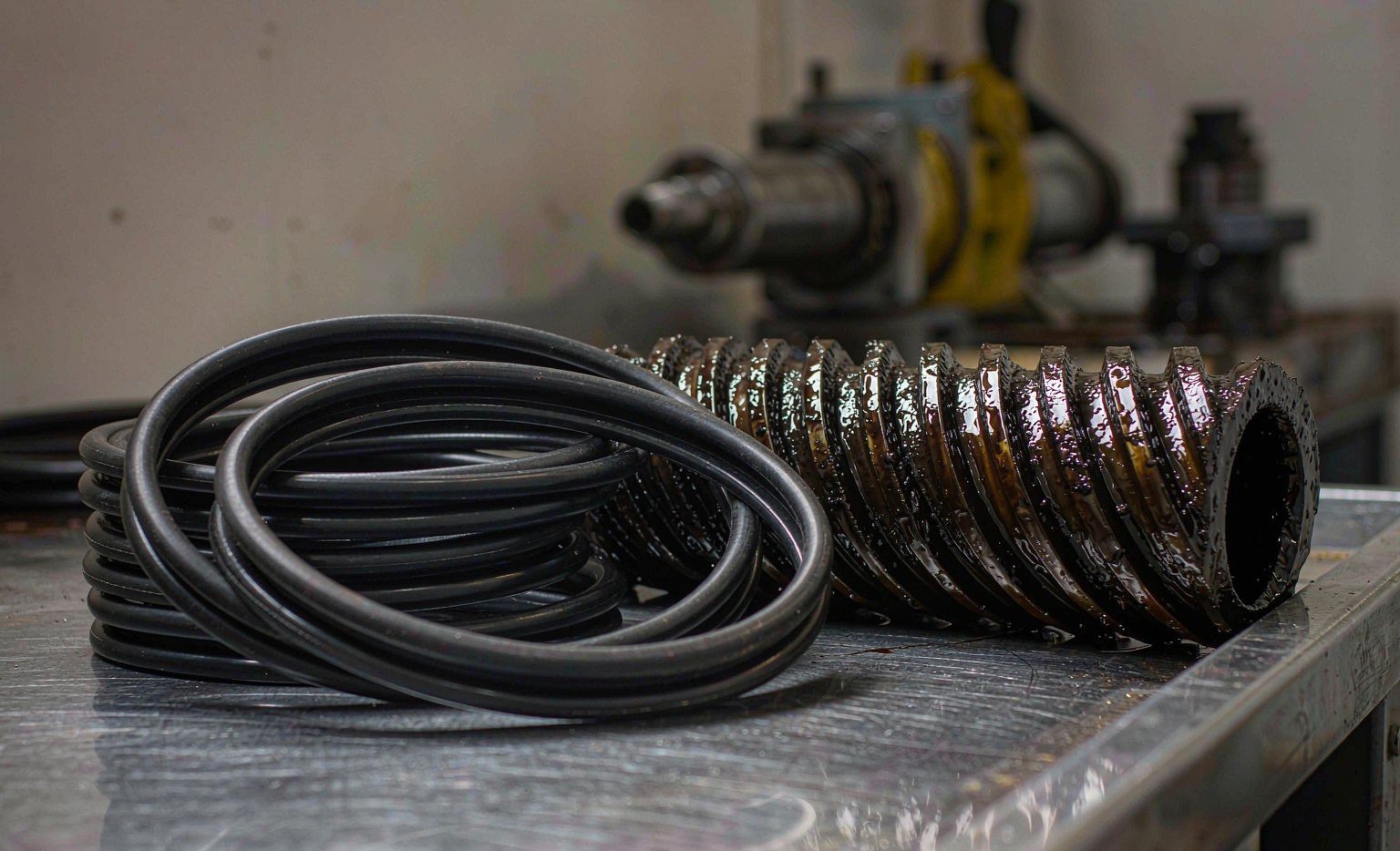
NBR has carried oil sealing for eighty years, and for most of that time it was the only rational answer. It still is, below about 100°C. Above that line — hot engine bays, downhole tools, compressors near motors — standard nitrile hardens, cracks, and gives up early, and the fix is not a better NBR compound. It is a different polymer: hydrogenated nitrile, HNBR.
This article covers what hydrogenation actually does to the polymer, where the temperature ceiling moves, why oilfield qualification tests treat the two materials differently, what changed in automotive power transmission, and how to judge whether the 2–4× material premium pays for itself in your application.
For the basic chemistry comparison between the two materials, we have a short older overview of the difference between NBR and HNBR; here we go deeper into the engineering consequences.
What Hydrogenation Actually Changes
NBR is a copolymer of acrylonitrile and butadiene. The acrylonitrile units deliver oil resistance; the butadiene units deliver flexibility — but a portion of them stay chemically unsaturated, carrying carbon–carbon double bonds. Those double bonds are the weak point. Oxygen, ozone, and heat attack them, which is why NBR cracks around ozone sources like electric motors and ages quickly in hot oil.
Hydrogenation saturates those double bonds by adding hydrogen across them — typically 95% or more of the original unsaturation is removed, while the acrylonitrile content stays in its usual 17–50% window. Producers such as Zeon, which makes the Zetpol line of HNBR, control the residual unsaturation deliberately, because a small amount is still needed for peroxide sulfur crosslinking during vulcanization.
The consequences show up in three places: the polymer no longer degrades by ozone attack, its heat aging improves dramatically, and its dynamic flex life extends severalfold. Oil resistance barely changes — the nitrile groups that repel oil were never touched.
The Temperature Ceiling: Where NBR Stops Working
The headline numbers first, then the fine print.
| Property | NBR | HNBR |
|---|---|---|
| Continuous service temperature | ~100°C (up to ~108°C for premium grades) | ~150°C (short peaks to ~165°C) |
| Ozone / weather resistance | Poor — cracks near motors and outdoors | Excellent — saturated backbone |
| Tensile strength | ~10–25 MPa | ~15–35 MPa |
| Compression set at heat | Moderate | Good to excellent (peroxide-cured grades best) |
| Dynamic flex / fatigue life | Moderate | Very high |
| Abrasion resistance | Good | Very good |
| Sour gas (H₂S) tolerance | Poor | Good, with qualified compounds |
| Typical material cost | Baseline | Roughly 2–4× NBR |
The fine print matters. NBR’s practical ceiling is not the 120°C some catalogs quote in short-term columns; sustained service at 100–110°C already shows hardening and set. HNBR holds useful properties at 150°C continuous in oil, and its aging curves at 135°C look like NBR’s at 85°C — which is why a seal that fails yearly in NBR can run for years in HNBR on the same machine.
Independent seal suppliers comparing the two families on heat, ozone and sour-gas duty reach the same conclusion; a representative comparison is published by Anlin Technology’s HNBR/FFKM application guide.
Oilfield Duty: RGD, Sour Gas and Qualification Standards
Oilfield sealing kills NBR three ways, and HNBR answers all three.
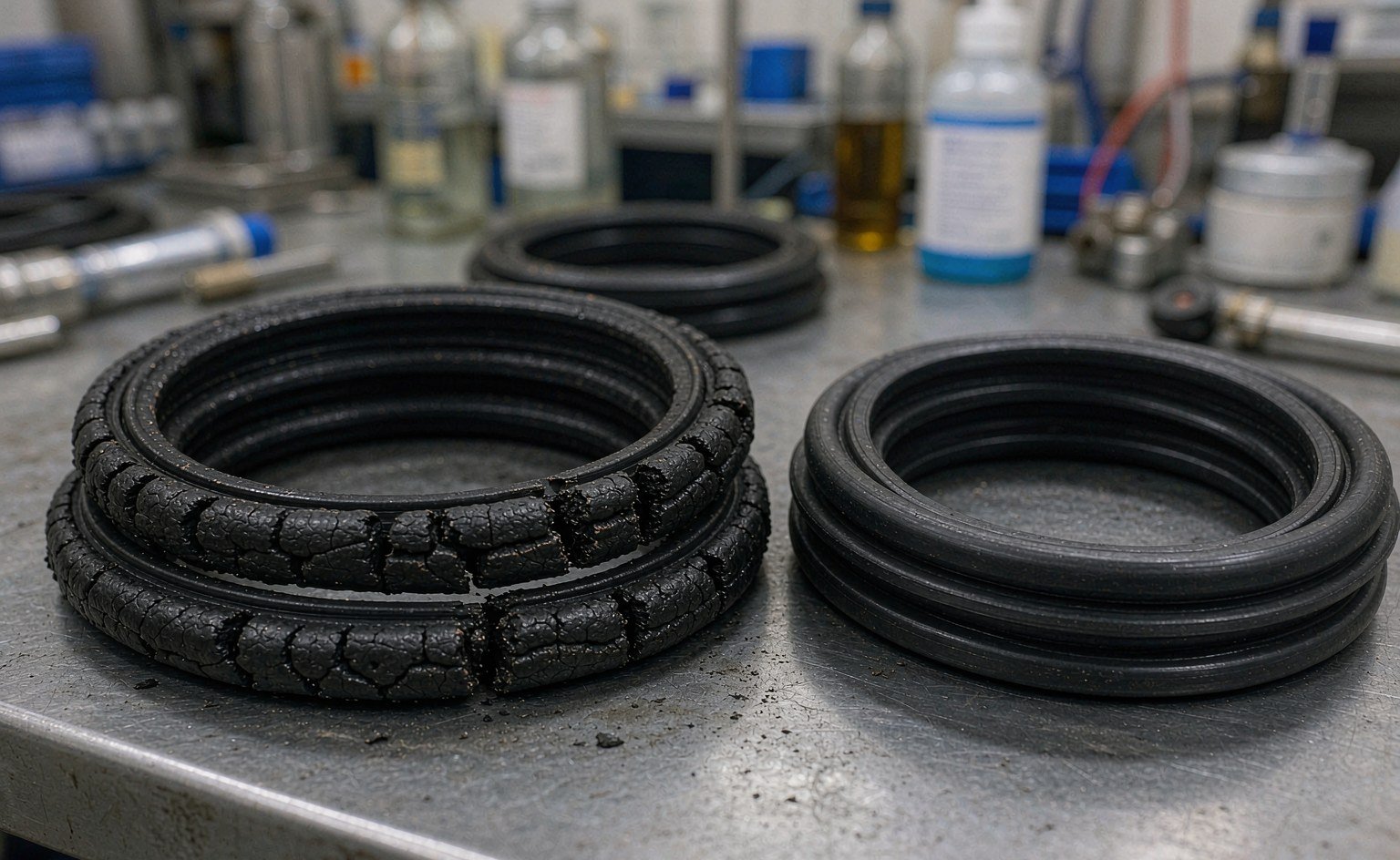
Rapid gas decompression (RGD). Downhole tools and high-pressure gas equipment absorb dissolved gas during long pressurization. When pressure releases suddenly, the gas expands inside the elastomer faster than it can diffuse out, blistering and splitting the seal from within — the damage pattern is called explosive decompression. Saturated-backbone compounds with high crosslink density resist it far better. Testing follows NORSOK M-710 and NACE TM0187 protocols, and compounds are qualified per grade, not per family.
Sour gas. Wells with hydrogen sulfide demand materials qualified under NACE MR0175 / ISO 15156. NBR’s unsaturated backbone is vulnerable to the sulfur environment; qualified HNBR compounds with the right cure system and carbon black package are a standard, economical choice for sour service at moderate temperatures — and the step up from HNBR is usually to FFKM, at a very different price.
Standards context. Wellhead and downhole equipment is specified under API 6A, and elastomer qualification slots into that framework. Distributors and seal houses serving the oil patch publish application notes on the same lines — see for example the hydraulic and oilfield sealing coverage from Trelleborg’s hydraulic seal solutions and the technical library at Precision Polymer Engineering.
| Oilfield sealing point | Why NBR struggles | What qualified HNBR buys |
|---|---|---|
| Packer elements | Hot crude + gas, long static soak | Low swell in crude, heat to 150°C |
| Drill motor / MWD seals | RGD on connection, mud abrasion | RGD-qualified compounds, high tensile |
| Wellhead valve stems | Sour gas, outdoor ozone | NACE MR0175-compatible grades |
| Swab / valve rubber parts | Impact, H₂S, hot water | Abrasion + sour gas + set resistance |
| Compressor seals near gas | Gas absorption + decompression cycles | Blister-resistant saturated backbone |
Our broader survey of downhole and surface challenges is in the oilfield sealing solutions guide, and RGD-prone gas service also appears in our HNBR vs FKM material comparison when temperatures push past HNBR’s ceiling.
Automotive Duty: Timing Belts and the Hot Engine Bay
Automotive applications tell the same story through fatigue instead of chemistry.
Timing belts. A timing belt tooth flexes millions of times in an engine’s life, in an underhood environment that cycles from cold start to full heat soak. NBR-backed belts hardened and lost teeth within months in hot engines; HNBR-backed belts last the life of the vehicle. That single application changed the HNBR market — a large share of global HNBR output goes into power transmission belts, and once an OEM specifies it, the compound also spreads to the adjacent components.
Underhood elastomers. Turbocharger charge lines sit near 150°C in oil mist. Power steering seals run hot ATF. A/C compressor shaft seals run in PAG oil and refrigerant, cycling with the compressor clutch. Valve stem seals flex at rocker-arm frequency. Each of these kills ordinary NBR at 100°C-plus; each is a natural HNBR application. Component buyers keep NBR for static, cool, protected locations — fuel system gaskets, general purpose O-rings — and upgrade wherever heat, motion, or ozone meet.
Not All HNBR Is the Same: Compound Variables Buyers Should Specify
Writing “HNBR” on a drawing is not a specification. Four compound variables change how the material behaves, and a buyer who names them gets quotes that actually compare:
Acrylonitrile content (ACN). Within the usual 17–50% window, higher ACN means better oil and fuel resistance but worse low-temperature flexibility. Standard mid-range compounds sit around 34–36%; low-ACN grades exist for cold-climate equipment, high-ACN grades for hot crude and fuel contact. Name the low-temperature requirement explicitly if the equipment winters outdoors.
Hydrogenation level. More saturation means better heat and ozone aging. Anything below roughly 90% saturation starts drifting back toward NBR behavior in hot service — this is the cheapest place for a compounder to save money, so it is worth asking for the iodine value on the data sheet.
Cure system. Peroxide-cured HNBR gives the best compression set and heat aging, and is the right default for dynamic and high-temperature duty. Sulfur-donor cures cost less and bond better in some bonded-part applications. The two cure systems are not interchangeable on a failure-prone part.
Hardness. HNBR spans roughly 50–90 Shore A. Higher hardness buys extrusion and abrasion resistance; lower hardness buys sealing conformity on worn hardware. Most sealing compounds land at 70 Shore A, which is the safe default when a drawing is silent.
Add RGD qualification (NORSOK M-710 style) as a fifth variable where gas service applies, and a “HNBR 70 A, peroxide cure, M-710 qualified” callout replaces three rounds of quote clarification. When you send an RFQ to us or to any seal maker, those five lines are the difference between a compound matched to the duty and a compound that merely matches the polymer name.
The Cost Math: When the Upgrade Pays
HNBR compounds typically cost 2–4× the equivalent NBR. Whether that is expensive depends entirely on the failure cost of the part it replaces:
| Situation | Stay with NBR | Upgrade to HNBR |
|---|---|---|
| Media temperature | Consistently below ~90–100°C | Above 100°C, or cycling to 120°C+ |
| Part function | Static, protected, low duty | Dynamic flex, abrasion, or pulsing pressure |
| Environment | Indoor, no ozone sources | Near motors, outdoors, UV exposure |
| Failure consequence | Minor — quick maintenance swap | Downtime, warranty claim, or well intervention |
| Gas service | Low pressure, slow cycling | RGD-prone or sour service |
The calculation changes once you price failure instead of material. A seal that costs $2 more but doubles replacement interval on a machine that costs $500 per hour of downtime is not an upgrade — it is a correction. Oilfield operators learned this first, which is why HNBR is now the default elastomer across most mid-range downhole and wellhead sealing. Automotive OEMs learned it through warranty statistics. Industrial users get the same benefit more quietly: fewer emergency stops, longer maintenance intervals, less inventory churn on the same part number.
For product buyers assembling kits and spare-part sets, the practical note is straightforward: standard O-ring and X-ring lines are available in both NBR and HNBR compounds, and hydraulic seal kits can be specified with HNBR elastomers where the cylinder runs hot. Distributors serving hot-climate markets — the Gulf, Southeast Asia, equatorial Africa — find HNBR variants reduce their highest-frequency warranty lines.
Where sourcing flexibility matters more than unit price, peer suppliers such as Darcoid carry both families and publish grade-level data, which helps when a distributor needs to match an incumbent compound before quoting an alternative.
The Bottom Line
Hydrogenation removes NBR’s one structural weakness — the double bonds — without touching the oil resistance that made NBR the industry default. The result moves the working ceiling from about 100°C to about 150°C, adds ozone and sour-gas tolerance, and extends dynamic life severalfold, at 2–4× the material cost. Above 100°C, in motion, near ozone, or in qualified gas service, HNBR is not the premium option; it is the correct option. Below that line, in static and protected duty, NBR still wins on cost and always will.
HNBR and NBR, Specified to the Compound
Both sides of this comparison are routine supply: NBR in nitrile grades for the moderate band, HNBR in partially and fully saturated grades where temperature, ozone and sour service decide. They are held and molded as O-rings, X-rings, bonded washers, gaskets and custom profiles, with compound, hardness and any RGD or sour-gas qualification written on the drawing rather than left to whoever picks the stock.
The variable most buyers miss is that HNBR is a family, not a grade. Acrylonitrile content sets oil resistance, residual double bond sets the temperature ceiling, and the cure system sets compression set after ageing — three numbers that move price and service life in opposite directions. We quote them explicitly so a substitution cannot be made quietly.
Send the application temperature, the oil or gas specification and the seal drawing to sales@bosssealing.com, and you will get a compound recommendation with the property data behind it, plus price and lead time, normally within a day. The contact form works equally well, and the engineering review costs nothing.