
A quotation for PTFE wear rings or backup rings rarely lists a single price for “PTFE”. It lists three: virgin, a glass-filled grade, and something with bronze or carbon in it, and the price difference between them can run several times over. That spread exists because unfilled PTFE carries a defect every seal engineer learns early: it creeps under load and wears out fast in sliding contact. Fillers fix both problems — but each filler fixes them differently, and each one takes something away.
This guide compares the five filler families we compound and machine most often — glass fiber, carbon and graphite, bronze, molybdenum disulfide (MoS₂), and polyimide (PI) — with real datasheet numbers, the trade-offs that never make it onto the data sheet, and a selection table you can apply directly to seals, backup rings, guide elements and bearings.
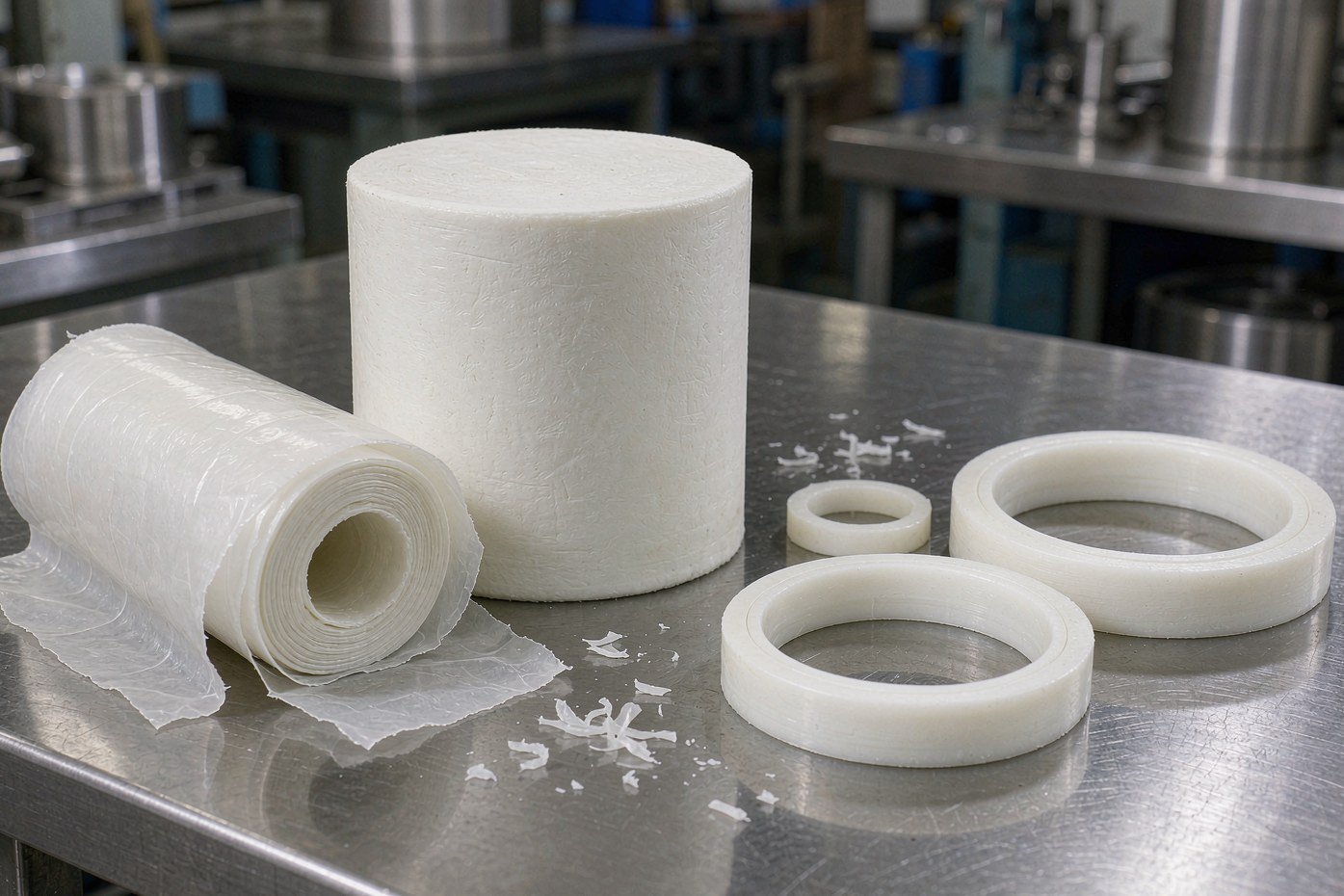
What a Filler Changes — and What It Costs You
Virgin PTFE has the lowest coefficient of friction of almost any solid polymer (typically 0.04–0.10 on steel, per published engineering property tables), outstanding chemical resistance against nearly everything short of molten alkali metals, and a service window from roughly -200 °C to +260 °C. It also has two weaknesses that matter in sealing work: severe cold flow (creep under sustained load) and poor wear resistance in dynamic contact. A virgin PTFE backup ring squeezed in a hot, high-pressure gland will slowly thin out and let the soft elastomer behind it extrude; a virgin PTFE bearing under side load will gouge and wear within weeks.
Fillers attack both weaknesses. They raise compressive strength, cut permanent deformation under load by factors of three to eight, and multiply wear life — published tribology work reports wear-rate reductions of several orders of magnitude when the right filler and percentage are selected (Wear journal study on filled PTFE composites). Thermal conductivity rises as well, which matters more than most buyers expect: a seal that moves frictional heat into the metal hardware runs cooler and lasts longer than one that traps heat at the sliding interface. The same creep problem, handled differently, is why some chemical services skip elastomers entirely and use a PTFE encapsulated O-ring — the jacket carries the chemistry while a steel spring carries the load.
The cost side is rarely discussed in buying meetings. Every filler lowers chemical resistance somewhere, most fillers make the compound electrically conductive, and several make it abrasive to soft counterfaces like aluminum or bronze. Filled PTFE also loses elongation — it is stiffer and harder, which changes how a machined ring takes up tolerance and how it should be installed. The trick is not “add filler”. It is matching the filler to the chemistry and the counterface.
Glass Fiber: The Default Choice, With Two Blind Spots
Glass fiber is the most common PTFE filler worldwide, typically compounded at 5–25 wt% with 15%, 20% and 25% grades as the standard offerings. It delivers the best value per point of improvement: compressive strength roughly doubles, creep under sustained load drops measurably, wear resistance climbs dramatically, and the compound keeps almost all of PTFE’s chemical inertness. For backup rings, valve seats, gaskets and guide elements in corrosive media, glass-filled PTFE is usually the first grade we quote.
Blind spot one: glass fiber does not lubricate. A glass-filled compound actually runs with a slightly higher dynamic friction coefficient than virgin PTFE — published data shows roughly 0.07 against 0.05 for virgin on steel — and at high sliding speeds glass-only compounds can lose their transfer film and wear badly. Tribology research on chopped-fiber PTFE composites has shown glass fiber alone performing poorly as an anti-wear addition at 3 m/s, while a hybrid compound combining glass with MoS₂ achieved the best overall result. If your part runs fast or dry, glass alone is not the answer — and where loads climb past what any PTFE compound carries, PEEK is the usual step up, which we cover in detail in our guide to PEEK-ôfdichtingskomponinten.
Blind spot two: chemistry. The glass itself is not chemically inert — it is attacked by strong alkalis and by hydrofluoric acid, and hot concentrated caustic will etch the fibers out of the matrix over time. For a valve seat in 98% sulfuric acid, glass-filled PTFE is superb; for a sealing element wetted by hot concentrated sodium hydroxide, it is the wrong choice and the fibers will eventually bloom at the surface.

Carbon and Graphite: Wear, Heat, and Static Control
Carbon-filled PTFE — carbon powder at roughly 15–35 wt%, often blended with 5–15% graphite — is the grade we reach for when a part must run wet, hot, or both. Carbon raises compressive strength more than glass does at equal loading in many datasheets, it is chemically inert (unlike glass), and it works especially well in water and water-based fluids where glass-filled compounds sometimes show higher wear. Thermal conductivity roughly triples versus virgin PTFE, pulling frictional heat out of the sliding interface and into the hardware.
Graphite deserves its own sentence: it is the friction reducer of the family. Carbon-graphite blends hold a dynamic friction coefficient around 0.06 while adding lubricity that glass cannot provide, which is why they dominate dry-running piston rings and compressor rings.
The trade-offs are electrical and cosmetic. Carbon and graphite make the compound conductive — a filled PTFE insulator is no longer an insulator, with volume resistivity dropping from beyond 10¹⁵ Ω·cm to around 10⁴–10⁹ depending on the blend. Anywhere the part must isolate, or where static dissipation is a hazard rather than a benefit, carbon is excluded. Carbon- and graphite-filled compounds can also polish or micro-abrade softer counterfaces, and graphite can leave gray marks on stainless hardware that some food and pharmaceutical customers refuse to accept. For those industries we quote glass instead.
Bronze: Maximum Load, Maximum Heat Removal
Bronze powder at 40–60 wt% is the heavyweight option. Datasheet numbers tell the story: compressive strength at 1% deformation reaches roughly 10–11 MPa against 4.5 MPa for virgin PTFE, permanent deformation under sustained load drops from about 8% to around 1%, and thermal conductivity rises above 0.7 W/m·K — roughly triple the glass-filled grades and close to the best you can buy in a PTFE family compound. Shore D hardness climbs to 66–68 and density rises to about 3.1–3.9 g/cm³ depending on bronze content, so a bronze-filled ring weighs nearly twice its glass-filled equivalent.
That combination — highest PV capability, best heat removal, lowest permanent set — makes bronze-filled PTFE the default for hydraulic guide rings and wear bands, high-load thrust washers, and sliding elements under sustained side load. In a hydraulic cylinder bore running 250 bar with an aggressive duty cycle, a bronze-filled guide ring simply outlives every polymer alternative we have tested.
The cost is chemical. Metal particles lose the inertness that justifies PTFE in the first place: bronze-filled compounds are attacked by acids and corrode in hot water, and electrolytic effects appear where the compound sits wetted between dissimilar metals. Bronze-filled parts also conduct, like carbon. Our rule of thumb: bronze for load, glass for chemistry, and never bronze where the media or the washdown can reach the metal.
MoS₂ and Polyimide: Small Percentages, Narrow Jobs
Molybdenum disulfide enters the compound at around 5 wt% and does one job: it lubricates dry contact. On its own, MoS₂ improves anti-wear behavior at low sliding speeds but can fail at 3 m/s — which is why it almost always travels with a structural filler. The classic pairings are 15% glass + 5% MoS₂ and 40% bronze + 3% MoS₂: the glass or bronze carries the load, the MoS₂ keeps the friction coefficient low and stabilizes the transfer film. Hybrid research compounds combining carbon fiber, glass and MoS₂ have reached PV limits of 9.5 MPa·m/s at 1 m/s and 15 MPa·m/s at 2 m/s — figures virgin PTFE cannot approach at any speed. One chemical caution: MoS₂ grades should stay away from hot concentrated sulfuric acid.
Polyimide-filled PTFE, typically near 15 wt%, is the premium organo-filled grade. It delivers the lowest wear rates in unlubricated running of any compound we machine, keeps the friction coefficient down, holds tensile strength higher than the inorganic-filled grades, and — uniquely among the anti-wear fillers — does not shed abrasive particles that score a soft counterface. That last point decides shaft finish life in long-running servo cylinders and compressor rings: a PI-filled bearing is gentler on the mating surface than glass or carbon over millions of cycles. The trade-off is price; PI-filled compounds cost several times more than glass-filled material, so we quote them where dry running or counterface protection justifies it.
The Numbers Side by Side
The table below compiles typical published datasheet values (in the style of the Foresight compounded-PTFE datasheet and its peers) for the four workhorse grades. Actual values vary with filler grade, particle size and processing, so treat them as design-guide magnitudes rather than guaranteed limits — sealing specialists such as Trelleborg and stock-shape converters like Professional Plastics publish their own grade tables, and numbers shift by 10–20% between them.
| Eigenskip | Suver PTFE | 25% Glass | 25% Carbon | 60% Bronze |
|---|---|---|---|---|
| Density (g/cm³) | 2.17 | 2.23 | 2.18 | 3.10 |
| Tensile strength (MPa) | 30 | 16 | 15 | 14 |
| Elongation at break (%) | 300 | 260 | 180 | 100 |
| Compressive strength, 1% def. (MPa) | 4.5 | 7.0 | 10.0 | 10.5 |
| Permanent deformation under 14 N/mm², 24 h (%) | 8.0 | 5.0 | 3.0 | 1.0 |
| Hardness (Shore D) | 55 | 63 | 65 | 66 |
| Dynamic friction coefficient vs steel | 0.05 | 0.07 | 0.06 | 0.06 |
| Thermal conductivity (W/m·K) | 0.23 | 0.43 | 0.64 | 0.74 |
| Linear thermal expansion 25–100 °C (×10⁻⁵/K) | 11.6 | 10.0 | 9.5 | 9.5 |
| Volume resistivity (Ω·cm) | >10¹⁵ | >10¹⁵ | ~10⁴ | ~10⁷ |
Twa rigen fertsjinje in twadde blik fan elkenien dy't sealen spesifisearret. Permaninte deformaasje is de kjeldstreammetrik dy't backup-ringen en spring-energized jassen yn hjitte glanden dea docht — de brûnzen kwaliteit hâldt acht kear better as virgin. En thermyske geleiding ferklearret in falpatroan dat wy elke moanne sjogge: deselde partgeometrije rint mjitber koeler yn koalstof of brûns, wat elke thermysk oandreaune degradaasjemodus yn 'e oanbuorjende elastomeer-energizer fertraget.
PV-limiten: Wêr't folde PTFE syn priis fertsjinnet
Druk-snelheid (PV) limyt is it ienige meast brûkbere getal foar glidende sliïtdielen, en it is wêr't filler-seleksje him daliks werombetellet. Publisearre wearden foar deselde ferbiningsfamyljes op in stielen tsjinoerflak:
| Glidsnelheid | Suver PTFE | 25% Glass | 25% Carbon | 60% Bronze |
|---|---|---|---|---|
| 0,05 m/s | 0.04 | 0.37 | 0.37 | 0.55 |
| 0,5 m/s | 0.07 | 0.48 | 0.46 | 0.68 |
| 5,0 m/s | 0.10 | 0.59 | 0.55 | 1.02 |
Lês de earste rige nochris: by lege snelheid fermannichfâldigje glês en koalstof de feilige PV mei sawat in faktor njoggen oer virgin PTFE, en brûns mei hast fjirtjin. By 5 m/s berikt de brûnzen kwaliteit in PV-limyt fan tolve kear it ûnfolde materiaal. Oerset yn sealtaal: in virgin PTFE-liedring dy't in oere ûnder sydbelesting oerlibbet, wurdt in brûnsfolde ring dy't it weropbou-ynterval fan 'e masine oerlibbet.
PV-limiten ferklearje ek wêrom't fillerkar yn flugge apparatuer mear de snelheid as de druk folget. Glêsfolde ferbinings ferlieze har foardiel by hege glidsnelheid, om't it glês it PTFE-oerdrachtsfilm hindert — dit is itselde effekt dat de tribology-literatuer foar glês-allinnich-ferbinings by 3 m/s rapportearret. Boppe sawat 1–2 m/s yn droech of grinslubrisearre rin, stjoere wy klanten nei koalstof-grafyt- of PI-kwaliteiten, en hâlde glês foar stadiger, heger belêste posysjes lykas backup-ringen en klepsealen.
Folsleine eigenskipfergelykings oer folle mear kwaliteiten — 25% glês mei 5% grafyt, 35% koalstof, 40% brûns mei 3% MoS₂, 30% glês-spesifikaasjekwaliteiten, sels 50% RVS-folde PTFE foar klepsealen — binne publisearre yn leveransiersdatablêden lykas de ERIKS-datablêd foar folde PTFE, en de getallen hjirboppe binne út dy famylje fan gegevens helle. As de PV-berekkening fan in klant tusken twa kwaliteiten falt, offerearje wy beide oan en lit in koarte sliïttest it besljochtsje; in testbanktest fan twa wiken kostet minder as ien ferkearde pallet ringen.
Gewichtsprosint, folumeprosint en wêrom't deselde “25%” oars gedraacht
Ferbiningsspesifikaasjes jouwe it fillergehalte yn gewicht, mar sliït- en wriuwingsgedrach folget folume — en de twa divergje wyld ôfhinklik fan fillerdichtheid. Glêsfezel by 2,5 g/cm³ is mar in bytsje tichter as de PTFE-matriks by 2,2, dus 25 gew.% glês beslacht sawat 23% fan it folume fan 'e ferbining: de fezels ferriede har wier troch it grutste part fan 'e matriks. Brûns by sawat 8,8 g/cm³ is fjouwer kear tichter as PTFE, dus sels in ferbining mei 60 gew.% brûns is mar sawat 25% brûns yn folume — de brûnzen dieltsjes foarmje isolearre lêst-dragende eilannen, gjin ferbûn skelet.
Dêrom hâldt brûnsfolde PTFE mear fan PTFE syn wriuwingsgedrach as syn Shore-hurdheid suggerearret, en dêrom ferheget it opfieren fan it brûnsgehalte fan 40% nei 60% yn gewicht de lêstkapasiteit sûnder de ring yn metaal te feroarjen. It is ek wêrom't de ’40% brûns“-ferbinings fan twa leveransiers oars kinne gedrage: dieltsjegrutteferdieling en brûnslegearingskomposysje feroarje hoe ticht dy eilannen pakke. As wy in fersyk foar krúsleveransierfergelyk krije, freegje wy om folumebelesting- en dieltsjegruttegegevens, net allinnich it gewichtsprosint op ”e foarside fan it datablêd.
Foar de keaper is de praktyske konklúzje ienfâldich: fergelykje ferbinings op mjitten eigenskippen — drukkrêft, deformaasje ûnder lêst, PV-limyt, wriuwing — ynstee fan op it fillerprosint. Twa glêsferbinings fan 25 gew.% fan ferskate fezelleveransiers ferskille geregeldwei 10–20% yn sliïtfaak, en it datablêdprosint allinnich sil net sjen litte hokker jo krije.
Wat fillerkar betsjut foar bewurking, tolerânsjes en levertiid
Folde PTFE komt by de masjinewinkel as in kompresje-sintere billet, buis of skive blêd, en de filler rydt by elke stap mei. Glêsfezel is de abrasive: it ferkoart de libbensdoer fan it ark mjitber, wat te sjen is yn 'e bewurkingskosten by tinwandige dielen en djippe groeven. Brûns- en koalstoffillers snije sêfter mar belêstje oars — folde ferbinings binne stiverder en hawwe legere thermyske útsetting as virgin PTFE, dus se hâlde strakkere diameters en bliuwe rûnder nei bewurking. Dat is in stil foardiel by backup-ring- en glandsealwurk: in folde PTFE-ring bewurke ta in opjûne tolerânsje bliuwt by dy dimensje oer in breder temperatuerberik as in virgin ring soe dwaan.
Sinterjen en krimp ferskille ek. Folde ferbinings krimpe minder by it sinterjen en kuolje mei minder ferfoarming, wat de opbringst by grutte-diameterbillets ferbetteret en de kromming ferminderet dy't by lang skive blêd ta útskot twingt. Neat hjirfan feroaret wat de keaper bestelt, mar it ferklearret twa offertes foar deselde “geometrije”: in folde ferbining kin goedkeaper te finishjen wêze, ek al kostet it grûnmateriaal mear.
Levertiid folget de beskikberens fan 'e ferbining mear as de bewurkingstiid. Glês-, koalstof- en brûnsferbinings yn 'e standertbelestings binne foarriedartikelen by de measte konvertearders; PI-folde en spesjale MoS₂-hybriden wurde op bestelling makke en kinne wiken tafoegje oan in earste artikel. Plan pilotbestellingen dêrop — it meunster fan in eksoatyske ferbining duorret langer as de produksjerin dy't derop folget. Foar routinebestellingen oer ús technyske plestik assortimint, de standert folde ferbinings bewege har op itselde skema as virgin PTFE-foarriedfoarmen.
De ferbining by it part passe
De seleksjetabel hjirûnder kondinsearret hoe't wy offerearje. It giet út fan bewurke dielen út foarriedbuis en billet; getten hege-folume-dielen folgje deselde logika mei beskikberens fan 'e ferbining as ekstra beheining. Al dizze ferbinings wurde yn-hûs produsearre en bewurke njonken ús oare produkten fan technyske plestik.
| Tapassing | Earste-keus ferbining | Wêrom't it hjir wint | Wat te mijen |
|---|---|---|---|
| Hydraulyske liedringen en sliïtbanden | 40% brûns + 3% MoS₂, of 15% glês + 5% MoS₂ | Hegste PV, bêste waarmteôffier, lege wriuwing op 'e honde boarring | Virgin PTFE (krûp); glês-allinnich by hege stangensnelheid |
| Backup-ringen / anty-ekstrúzje-ringen | 25% glês, of brûns wêr't it medium skjinne oalje is | Drukkrêft en kontrolearre krûp yn 'e gland | Brûns yn hjit wetter, soer of bytende tsjinst |
| Droechrinnende suiger- en kompressorringen | 25% koalstof-grafyt, of PI-folde foar lange libbensdoer | Lege wriuwing sûnder oaljefilm; sêft foar de silinderwand | Glês-allinnich (oerdrachtsfilm brekt by snelheid) |
| Gemyske klepsealen en sealen yn agressive media | 15–25% glês | Hâldt PTFE syn gemyske ynertens útsein alkali/HF | Brûns, RVS-folde, koalstof (flekken) |
| Spring-energized sealjassen yn sliïtkrityske tsjinst | 25% glês of 25% koalstof neffens medium | Kontrolearre krûp by de jaslip; jasmateriaal past by de springkwaliteit — sjoch ús rige spring-energisearre sealen | Unfolde jas wêr't drukwikseljen faak is |
| Elektrysk gefoelige posysjes (isolaasje, gjin statyske lading) | 15–25% glass only | Only mainstream filler family that stays insulating | Carbon, graphite, bronze — all conductive |
| Food and pharmaceutical contact | Compliant glass-filled grades | Inorganic, inert, no gray staining risk on hardware | Graphite blends (staining); unverified PI grades |
One more selection rule from the workshop: always pair the compound with the elastomer that energizes or backs it. A bronze-filled PTFE ring running hot in a 90 °C oil sump will conduct heat into an NBR O-ring energizer and age it faster; in that position an FKM energizer, or a carbon-filled ring with better heat routing, changes the failure mode entirely. Compound selection is a system decision, not a line item.
Questions Buyers Ask About Filled PTFE
Is filled PTFE still chemically inert? The PTFE matrix is; the filler is not. Glass loses alkali and HF resistance, bronze loses acid and hot-water resistance, carbon and graphite survive most media but conduct. We always screen the filler against the customer’s full chemical list, not just the headline media. Where the chemistry rules out every filler, unfilled PTFE designs — such as the encapsulated O-ring constructions — keep the inertness and solve wear mechanically.
Why does my filled ring cost more than I expected? Filled compounds are compression-sintered billets machined to size, and fillers raise tooling wear and cutting time — bronze above 50 wt% is notably hard on tooling. The price usually tracks machining difficulty more than raw material cost.
Can I substitute glass-filled for bronze-filled guide rings? At low rod speeds and moderate side load, yes. At high cycle rates the glass grade runs hotter and wears the bore faster; we would check PV first and usually recommend the glass + MoS₂ hybrid instead of a straight swap.
Which filler for a static backup ring behind a polyurethane rod seal? 25% glass in clean hydraulic oil, bronze only if the cylinder sees heavy shock loads and the oil stays clean and dry. Check the chemical list if the system runs water-glycol fluid — that excludes bronze.
Does filler content improve low-temperature performance? No — the glass transition behavior of PTFE stays the same, and filled compounds stay flexible to roughly -200 °C like virgin material. Fillers improve the hot end of the envelope (creep, deformation), not the cold end. For deep-cold service the deciding factors are spring energizer design and jacket material choice, not filler loading.
How do I verify what I actually received? Density is the fastest cross-check: every filler family has a distinctive density band, so a two-minute weight-and-volume measurement on a sampled ring catches a mislabeled compound before it enters production. Add a Shore D reading and you have a compound identity check that costs almost nothing per batch.