
A quotation for PTFE wear rings or backup rings rarely lists a single price for “PTFE”. It lists three: virgin, a glass-filled grade, and something with bronze or carbon in it, and the price difference between them can run several times over. That spread exists because unfilled PTFE carries a defect every seal engineer learns early: it creeps under load and wears out fast in sliding contact. Fillers fix both problems — but each filler fixes them differently, and each one takes something away.
This guide compares the five filler families we compound and machine most often — glass fiber, carbon and graphite, bronze, molybdenum disulfide (MoS₂), and polyimide (PI) — with real datasheet numbers, the trade-offs that never make it onto the data sheet, and a selection table you can apply directly to seals, backup rings, guide elements and bearings.
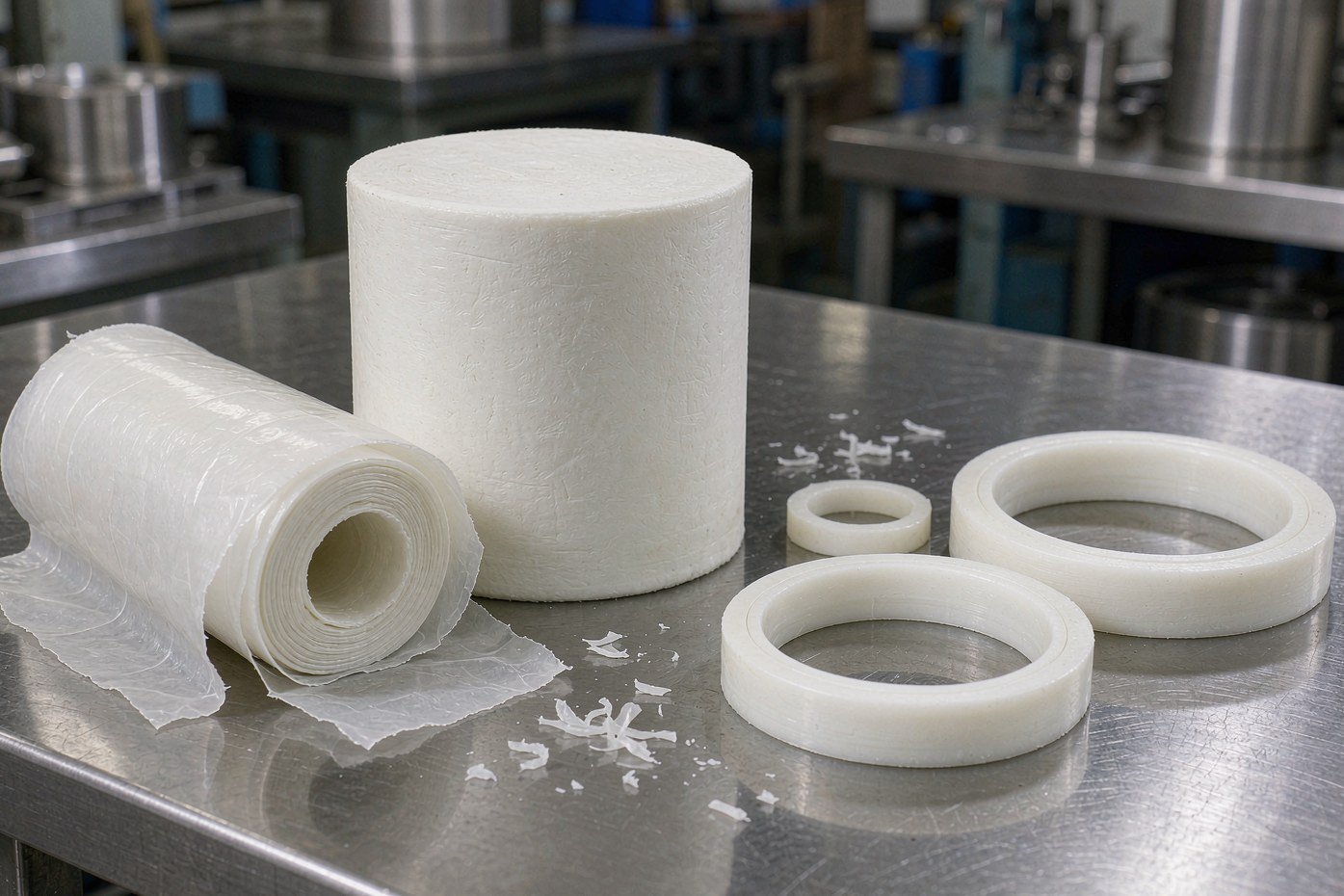
What a Filler Changes — and What It Costs You
Virgin PTFE has the lowest coefficient of friction of almost any solid polymer (typically 0.04–0.10 on steel, per published engineering property tables), outstanding chemical resistance against nearly everything short of molten alkali metals, and a service window from roughly -200 °C to +260 °C. It also has two weaknesses that matter in sealing work: severe cold flow (creep under sustained load) and poor wear resistance in dynamic contact. A virgin PTFE backup ring squeezed in a hot, high-pressure gland will slowly thin out and let the soft elastomer behind it extrude; a virgin PTFE bearing under side load will gouge and wear within weeks.
Fillers attack both weaknesses. They raise compressive strength, cut permanent deformation under load by factors of three to eight, and multiply wear life — published tribology work reports wear-rate reductions of several orders of magnitude when the right filler and percentage are selected (Wear journal study on filled PTFE composites). Thermal conductivity rises as well, which matters more than most buyers expect: a seal that moves frictional heat into the metal hardware runs cooler and lasts longer than one that traps heat at the sliding interface. The same creep problem, handled differently, is why some chemical services skip elastomers entirely and use a PTFE encapsulated O-ring — the jacket carries the chemistry while a steel spring carries the load.
The cost side is rarely discussed in buying meetings. Every filler lowers chemical resistance somewhere, most fillers make the compound electrically conductive, and several make it abrasive to soft counterfaces like aluminum or bronze. Filled PTFE also loses elongation — it is stiffer and harder, which changes how a machined ring takes up tolerance and how it should be installed. The trick is not “add filler”. It is matching the filler to the chemistry and the counterface.
Glass Fiber: The Default Choice, With Two Blind Spots
Glass fiber is the most common PTFE filler worldwide, typically compounded at 5–25 wt% with 15%, 20% and 25% grades as the standard offerings. It delivers the best value per point of improvement: compressive strength roughly doubles, creep under sustained load drops measurably, wear resistance climbs dramatically, and the compound keeps almost all of PTFE’s chemical inertness. For backup rings, valve seats, gaskets and guide elements in corrosive media, glass-filled PTFE is usually the first grade we quote.
Blind spot one: glass fiber does not lubricate. A glass-filled compound actually runs with a slightly higher dynamic friction coefficient than virgin PTFE — published data shows roughly 0.07 against 0.05 for virgin on steel — and at high sliding speeds glass-only compounds can lose their transfer film and wear badly. Tribology research on chopped-fiber PTFE composites has shown glass fiber alone performing poorly as an anti-wear addition at 3 m/s, while a hybrid compound combining glass with MoS₂ achieved the best overall result. If your part runs fast or dry, glass alone is not the answer — and where loads climb past what any PTFE compound carries, PEEK is the usual step up, which we cover in detail in our guide to PEEK sealing components.
Blind spot two: chemistry. The glass itself is not chemically inert — it is attacked by strong alkalis and by hydrofluoric acid, and hot concentrated caustic will etch the fibers out of the matrix over time. For a valve seat in 98% sulfuric acid, glass-filled PTFE is superb; for a sealing element wetted by hot concentrated sodium hydroxide, it is the wrong choice and the fibers will eventually bloom at the surface.

Carbon and Graphite: Wear, Heat, and Static Control
Carbon-filled PTFE — carbon powder at roughly 15–35 wt%, often blended with 5–15% graphite — is the grade we reach for when a part must run wet, hot, or both. Carbon raises compressive strength more than glass does at equal loading in many datasheets, it is chemically inert (unlike glass), and it works especially well in water and water-based fluids where glass-filled compounds sometimes show higher wear. Thermal conductivity roughly triples versus virgin PTFE, pulling frictional heat out of the sliding interface and into the hardware.
Graphite deserves its own sentence: it is the friction reducer of the family. Carbon-graphite blends hold a dynamic friction coefficient around 0.06 while adding lubricity that glass cannot provide, which is why they dominate dry-running piston rings and compressor rings.
The trade-offs are electrical and cosmetic. Carbon and graphite make the compound conductive — a filled PTFE insulator is no longer an insulator, with volume resistivity dropping from beyond 10¹⁵ Ω·cm to around 10⁴–10⁹ depending on the blend. Anywhere the part must isolate, or where static dissipation is a hazard rather than a benefit, carbon is excluded. Carbon- and graphite-filled compounds can also polish or micro-abrade softer counterfaces, and graphite can leave gray marks on stainless hardware that some food and pharmaceutical customers refuse to accept. For those industries we quote glass instead.
Bronze: Maximum Load, Maximum Heat Removal
Bronze powder at 40–60 wt% is the heavyweight option. Datasheet numbers tell the story: compressive strength at 1% deformation reaches roughly 10–11 MPa against 4.5 MPa for virgin PTFE, permanent deformation under sustained load drops from about 8% to around 1%, and thermal conductivity rises above 0.7 W/m·K — roughly triple the glass-filled grades and close to the best you can buy in a PTFE family compound. Shore D hardness climbs to 66–68 and density rises to about 3.1–3.9 g/cm³ depending on bronze content, so a bronze-filled ring weighs nearly twice its glass-filled equivalent.
That combination — highest PV capability, best heat removal, lowest permanent set — makes bronze-filled PTFE the default for hydraulic guide rings and wear bands, high-load thrust washers, and sliding elements under sustained side load. In a hydraulic cylinder bore running 250 bar with an aggressive duty cycle, a bronze-filled guide ring simply outlives every polymer alternative we have tested.
The cost is chemical. Metal particles lose the inertness that justifies PTFE in the first place: bronze-filled compounds are attacked by acids and corrode in hot water, and electrolytic effects appear where the compound sits wetted between dissimilar metals. Bronze-filled parts also conduct, like carbon. Our rule of thumb: bronze for load, glass for chemistry, and never bronze where the media or the washdown can reach the metal.
MoS₂ and Polyimide: Small Percentages, Narrow Jobs
Molybdenum disulfide enters the compound at around 5 wt% and does one job: it lubricates dry contact. On its own, MoS₂ improves anti-wear behavior at low sliding speeds but can fail at 3 m/s — which is why it almost always travels with a structural filler. The classic pairings are 15% glass + 5% MoS₂ and 40% bronze + 3% MoS₂: the glass or bronze carries the load, the MoS₂ keeps the friction coefficient low and stabilizes the transfer film. Hybrid research compounds combining carbon fiber, glass and MoS₂ have reached PV limits of 9.5 MPa·m/s at 1 m/s and 15 MPa·m/s at 2 m/s — figures virgin PTFE cannot approach at any speed. One chemical caution: MoS₂ grades should stay away from hot concentrated sulfuric acid.
Polyimide-filled PTFE, typically near 15 wt%, is the premium organo-filled grade. It delivers the lowest wear rates in unlubricated running of any compound we machine, keeps the friction coefficient down, holds tensile strength higher than the inorganic-filled grades, and — uniquely among the anti-wear fillers — does not shed abrasive particles that score a soft counterface. That last point decides shaft finish life in long-running servo cylinders and compressor rings: a PI-filled bearing is gentler on the mating surface than glass or carbon over millions of cycles. The trade-off is price; PI-filled compounds cost several times more than glass-filled material, so we quote them where dry running or counterface protection justifies it.
The Numbers Side by Side
The table below compiles typical published datasheet values (in the style of the Foresight compounded-PTFE datasheet and its peers) for the four workhorse grades. Actual values vary with filler grade, particle size and processing, so treat them as design-guide magnitudes rather than guaranteed limits — sealing specialists such as Trelleborg and stock-shape converters like Professional Plastics publish their own grade tables, and numbers shift by 10–20% between them.
| Property | Virgin PTFE | 25% Glass | 25% Carbon | 60% Bronze |
|---|---|---|---|---|
| Density (g/cm³) | 2.17 | 2.23 | 2.18 | 3.10 |
| Tensile strength (MPa) | 30 | 16 | 15 | 14 |
| Elongation at break (%) | 300 | 260 | 180 | 100 |
| Compressive strength, 1% def. (MPa) | 4.5 | 7.0 | 10.0 | 10.5 |
| Permanent deformation under 14 N/mm², 24 h (%) | 8.0 | 5.0 | 3.0 | 1.0 |
| Hardness (Shore D) | 55 | 63 | 65 | 66 |
| Dynamic friction coefficient vs steel | 0.05 | 0.07 | 0.06 | 0.06 |
| Thermal conductivity (W/m·K) | 0.23 | 0.43 | 0.64 | 0.74 |
| Linear thermal expansion 25–100 °C (×10⁻⁵/K) | 11.6 | 10.0 | 9.5 | 9.5 |
| Volume resistivity (Ω·cm) | >10¹⁵ | >10¹⁵ | ~10⁴ | ~10⁷ |
Two rows deserve a second look from anyone specifying seals. Permanent deformation is the cold-flow metric that kills backup rings and spring-energized jackets in hot glands — the bronze grade holds eight times better than virgin. And thermal conductivity explains a failure pattern we see every month: the same part geometry runs measurably cooler in carbon or bronze, which slows every thermally driven degradation mode in the neighboring elastomer energizer.
PV Limits: Where Filled PTFE Earns Its Price
Pressure-velocity (PV) limit is the single most useful number for sliding wear parts, and it is where filler selection pays for itself immediately. Published values for the same compound families on a steel counterface:
| Sliding speed | Virgin PTFE | 25% Glass | 25% Carbon | 60% Bronze |
|---|---|---|---|---|
| 0.05 m/s | 0.04 | 0.37 | 0.37 | 0.55 |
| 0.5 m/s | 0.07 | 0.48 | 0.46 | 0.68 |
| 5.0 m/s | 0.10 | 0.59 | 0.55 | 1.02 |
Read the first row again: at low speed, glass and carbon multiply the safe PV by roughly a factor of nine over virgin PTFE, and bronze by nearly fourteen. At 5 m/s the bronze grade reaches a PV limit twelve times the unfilled material. Translated into sealing language: a virgin PTFE guide ring that survives an hour under side load becomes a bronze-filled ring that survives the rebuild interval of the machine.
PV limits also explain why filler choice tracks speed more than pressure in fast equipment. Glass-filled compounds lose their advantage at high sliding speed because the glass interferes with the PTFE transfer film — this is the same effect the tribology literature reports for glass-only compounds at 3 m/s. Above roughly 1–2 m/s in dry or boundary-lubricated running, we push customers toward carbon-graphite or PI grades, and reserve glass for slower, higher-load positions such as backup rings and valve seats.
Full property comparisons across many more grades — 25% glass with 5% graphite, 35% carbon, 40% bronze with 3% MoS₂, 30% glass specification grades, even 50% stainless-steel-filled PTFE for valve seats — are published in supplier datasheets such as the ERIKS filled PTFE datasheet, and the numbers above are drawn from that family of data. When a customer’s PV calculation lands between two grades, we quote both and let a short wear trial settle it; a two-week bench test costs less than one wrong pallet of rings.
Weight Percent, Volume Percent and Why the Same “25%” Behaves Differently
Compound specifications quote filler content by weight, but wear and friction behavior follows volume — and the two diverge wildly depending on filler density. Glass fiber at 2.5 g/cm³ is only slightly denser than the PTFE matrix at 2.2, so 25 wt% glass occupies about 23% of the compound’s volume: the fibers genuinely interlock through most of the matrix. Bronze at roughly 8.8 g/cm³ is four times denser than PTFE, so even a 60 wt% bronze compound is only about 25% bronze by volume — the bronze particles form isolated load-bearing islands, not a connected skeleton.
This is why bronze-filled PTFE keeps more of PTFE’s friction behavior than its Shore hardness suggests, and why pushing bronze content from 40% to 60% by weight raises load capacity without turning the ring into a metal. It is also why two suppliers’ “40% bronze” compounds can behave differently: particle size distribution and bronze alloy composition change how densely those islands pack. When we receive a cross-supply comparison request, we ask for volume loading and particle size data, not just the weight percentage on the front page of the datasheet.
For the buyer, the practical takeaway is simple: compare compounds on measured properties — compressive strength, deformation under load, PV limit, friction — rather than on the filler percentage. Two 25 wt% glass compounds from different fiber suppliers routinely differ by 10–20% in wear factor, and the datasheet percentage alone will not reveal which one you are getting.
What Filler Choice Means for Machining, Tolerances and Lead Time
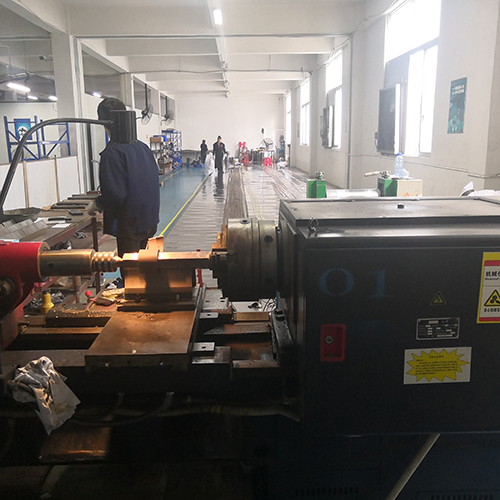
Filled PTFE reaches the machine shop as a compression-sintered billet, tube or skived sheet, and the filler rides along through every step. Glass fiber is the abrasive one: it shortens tool life measurably, which shows up in machining cost on thin-wall parts and deep grooves. Bronze and carbon fillers cut more gently but load differently — filled compounds are stiffer and lower in thermal expansion than virgin PTFE, so they hold tighter diameters and stay rounder after machining. That is a quiet benefit in backup ring and gland seal work: a filled PTFE ring machined to a given tolerance stays at that dimension across a wider temperature range than a virgin ring would.
Sintering and shrinkage differ too. Filled compounds shrink less during sintering and cool with less distortion, which improves yield on large-diameter billets and reduces the warpage that forces scrap on long skived film. None of this changes what the buyer orders, but it explains two quotes for the “same” geometry: a filled compound can be cheaper to finish even though its raw material costs more.
Lead time tracks compound availability more than machining time. Glass, carbon and bronze compounds in the standard loadings are stock items at most converters; PI-filled and specialty MoS₂ hybrids are made-to-order and can add weeks to a first article. Plan pilot orders accordingly — the sample of an exotic compound takes longer than the production run that follows it. For routine orders across our engineering plastics range, the standard filled compounds move on the same schedule as virgin PTFE stock shapes.
Matching the Compound to the Part
The selection table below condenses how we quote. It assumes machined parts from stock tube and billet; molded high-volume parts follow the same logic with compound availability as the extra constraint. All of these compounds are produced and machined in-house alongside our other engineering plastics products.
| Application | First-choice compound | Why it wins here | What to avoid |
|---|---|---|---|
| Hydraulic guide rings and wear bands | 40% bronze + 3% MoS₂, or 15% glass + 5% MoS₂ | Highest PV, best heat removal, low friction on the honed bore | Virgin PTFE (creep); glass-only at high rod speed |
| Backup rings / anti-extrusion rings | 25% glass, or bronze where the media is clean oil | Compressive strength and controlled creep in the gland | Bronze in hot water, acid or caustic service |
| Dry-running piston and compressor rings | 25% carbon-graphite, or PI-filled for long life | Low friction without oil film; gentle on the cylinder wall | Glass-only (transfer film breakdown at speed) |
| Chemical valve seats and seats in aggressive media | 15–25% glass | Keeps PTFE’s chemical inertness except alkali/HF | Bronze, stainless-steel filled, carbon (staining) |
| Spring-energized seal jackets in wear-critical service | 25% glass or 25% carbon per media | Controlled creep at the jacket lip; jacket material pairs with the spring grade — see our spring-energized seal range | Unfilled jacket where pressure cycling is frequent |
| Electrically sensitive positions (isolation, no static) | 15–25% glass only | Only mainstream filler family that stays insulating | Carbon, graphite, bronze — all conductive |
| Food and pharmaceutical contact | Compliant glass-filled grades | Inorganic, inert, no gray staining risk on hardware | Graphite blends (staining); unverified PI grades |
One more selection rule from the workshop: always pair the compound with the elastomer that energizes or backs it. A bronze-filled PTFE ring running hot in a 90 °C oil sump will conduct heat into an NBR O-ring energizer and age it faster; in that position an FKM energizer, or a carbon-filled ring with better heat routing, changes the failure mode entirely. Compound selection is a system decision, not a line item.
Questions Buyers Ask About Filled PTFE
Is filled PTFE still chemically inert? The PTFE matrix is; the filler is not. Glass loses alkali and HF resistance, bronze loses acid and hot-water resistance, carbon and graphite survive most media but conduct. We always screen the filler against the customer’s full chemical list, not just the headline media. Where the chemistry rules out every filler, unfilled PTFE designs — such as the encapsulated O-ring constructions — keep the inertness and solve wear mechanically.
Why does my filled ring cost more than I expected? Filled compounds are compression-sintered billets machined to size, and fillers raise tooling wear and cutting time — bronze above 50 wt% is notably hard on tooling. The price usually tracks machining difficulty more than raw material cost.
Can I substitute glass-filled for bronze-filled guide rings? At low rod speeds and moderate side load, yes. At high cycle rates the glass grade runs hotter and wears the bore faster; we would check PV first and usually recommend the glass + MoS₂ hybrid instead of a straight swap.
Which filler for a static backup ring behind a polyurethane rod seal? 25% glass in clean hydraulic oil, bronze only if the cylinder sees heavy shock loads and the oil stays clean and dry. Check the chemical list if the system runs water-glycol fluid — that excludes bronze.
Does filler content improve low-temperature performance? No — the glass transition behavior of PTFE stays the same, and filled compounds stay flexible to roughly -200 °C like virgin material. Fillers improve the hot end of the envelope (creep, deformation), not the cold end. For deep-cold service the deciding factors are spring energizer design and jacket material choice, not filler loading.
How do I verify what I actually received? Density is the fastest cross-check: every filler family has a distinctive density band, so a two-minute weight-and-volume measurement on a sampled ring catches a mislabeled compound before it enters production. Add a Shore D reading and you have a compound identity check that costs almost nothing per batch.