
Two suppliers quote the same line item: FKM, 75 Shore A, black. One part seals a hydraulic power unit at 120 °C for four years. The other cracks in half during a cold-start test at -28 °C, or swells 18% in a phosphate ester and weeps at the rod. Both parts are, technically, FKM. The difference is which polymer in the family the compounder used, how it was cured, and whether anyone wrote those two facts on the drawing.
“FKM” is a designation from ASTM D1418, not a recipe. Inside it sit at least seven commercially distinct polymer types, each with its own fluorine content, its own glass transition temperature, and its own response to steam, bases, ketones and cold. A purchasing spec that says only “FKM 75” hands the decision to whoever mixes the batch — and the cheapest legal answer is usually FKM A.
This guide walks through the grades you will actually be quoted: A, B, F, G (GF), GLT, GFLT and ETP. It covers the numbers that separate them, the service conditions where each one earns its price, and the three lines you should add to a purchase order so the next batch behaves like the first one.
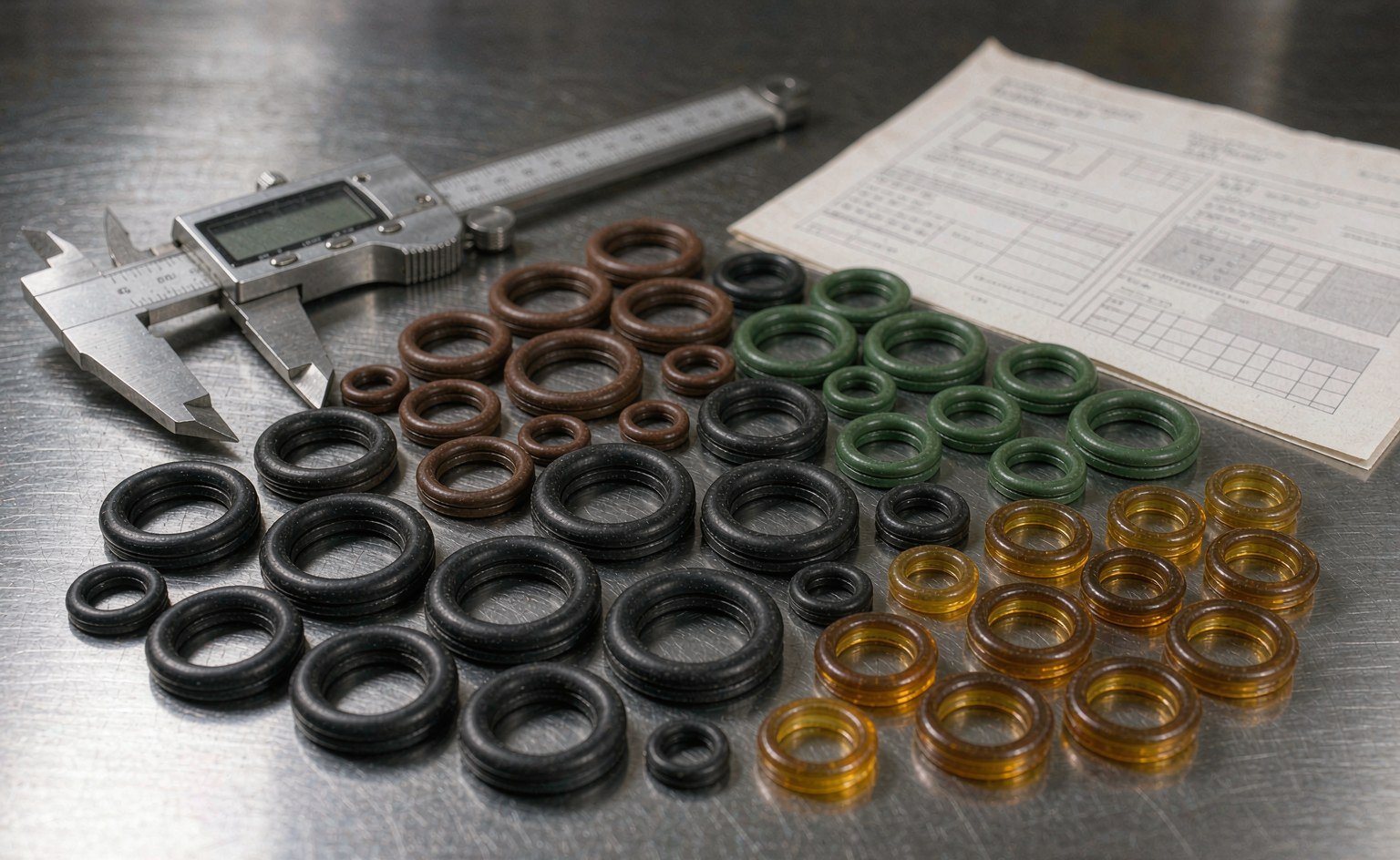
Why “FKM” Is a Family and Not a Compound
Fluoroelastomers are built from vinylidene fluoride (VF2) copolymerised with hexafluoropropylene (HFP), and sometimes with tetrafluoroethylene (TFE) as a third monomer. The ratio of those monomers sets the fluorine content by weight, and fluorine content is the single strongest predictor of chemical resistance. More fluorine means fewer hydrogen atoms available for attack, lower permeability, and better resistance to solvents, acids and oxidising media. The material comparison data published by major seal manufacturers shows the same pattern across every polymer family.
Three other variables ride along with that ratio, and they matter just as much in service:
- Cure system. Bisphenol-cured (ionic) compounds dominate general sealing. Peroxide-cured compounds give lower compression set, better steam and hot-water resistance, and better resistance to amines and bases, at the cost of some process complexity and a shorter scorch window.
- Low-temperature modifiers. Push the glass transition down and the polymer chain needs more flexibility — which usually means less fluorine. GLT grades carry roughly 64% fluorine against 70% for an F grade. Cold flexibility is bought with chemical resistance.
- Fillers and post-cure. The same polymer cured and post-cured differently can differ by 10 points of compression set. This is where a good compounder separates from a broker with a drum of polymer.
The practical consequence: grade selection is a four-way trade between chemical resistance, low-temperature flexibility, compression set and price. You cannot maximise all four. The engineering work is deciding which one your application can afford to lose.
The Grades You Will Actually Be Quoted
Most of the world’s FKM supply is described with the type letters that originated with DuPont’s Viton line and are now used generically across Solvay, Zeon, 3M and the Chinese polymer producers. Suppliers quote them inconsistently, but the temperature and fluorine figures below are stable across datasheets.
| Grade | Fluorine (% wt) | Service range (static) | TR-10 | Typical cure | Where it earns its place | Cost band |
|---|---|---|---|---|---|---|
| A (dipolymer) | 66 | -26 to 225 °C | -17 °C | Bisphenol | Mineral oil, hydraulic oil, grease, general industrial | 1.0x |
| B (terpolymer) | 68.5 | -24 to 225 °C | -14 °C | Bisphenol | Better fluid resistance with easier moulding and extrusion | 1.1x |
| F (terpolymer) | 70 | -17 to 225 °C | -7 °C | Bisphenol | Aromatic fuels, solvents, low permeability | 1.2x |
| G / GF | 70 | -16 to 225 °C | -6 °C | Peroxide or bisphenol | Acids, hot water, steam, amine-containing lubricants | 1.3x |
| GLT | 64 | -40 to 225 °C | -30 °C | Bisphenol | Cold climate, aviation fuel, outdoor hydraulics | 1.6x |
| GFLT | 66.5 | -34 to 225 °C | -24 °C | Peroxide | Cold start plus base/additive resistance, methanol fuels | 1.9x |
| ETP (highly fluorinated) | Above 70 | -21 to 225 °C | -11 °C | Peroxide | Strong acids, caustic, ketones, amines — short of FFKM | 4-6x |
Two notes on that table. The 225 °C ceiling is a continuous-service number for a well-formulated 70-80 Shore A compound; it is not a licence to run at 225 °C with a 90 Shore A part in a thin section. And the cost bands are indicative only — they move with polymer availability, and the gap between A and GFLT narrows sharply when a mould already exists for the part.
A: still the default, for good reasons
Standard FKM A seals mineral hydraulic oil at 120 °C for years, holds its compression set in air ovens, resists ozone and weathering indefinitely, and costs less than anything else in the family. For a cylinder rod seal running standard ISO VG 46 oil at 80 °C, A is not a compromise — it is the correct answer, and specifying GFLT there simply moves money from your pocket to the compounder’s.
Where A breaks down is predictable. Steam above roughly 150 °C attacks the polymer through dehydrofluorination, and the seal hardens and cracks. Amines — present in some EP gear oils, in many greases and in almost all coolant packages — crosslink the polymer and turn a soft ring into a brittle one. Low-molecular-weight ketones and esters (MEK, ethyl acetate, acetone) swell it severely. Glycol brake fluid is out. Ammonia and amine-based refrigerants attack it. And below about -20 °C it stops behaving like an elastomer at all.
The Low-Temperature Problem, and What TR-10 Really Tells You
Test reports love to quote a “low temperature” that means the point where a test piece stops cracking under a specific impact. That number is useful for shipping, not for sealing. The figure that predicts whether a seal will follow a rod at -35 °C is TR-10: the temperature at which a stretched specimen, cooled and then warmed, recovers only 10% of its original elongation.
TR-10 is close to the temperature at which the material stops acting like a spring. An A-type compound with TR-10 of -17 °C will sit in a cylinder at -25 °C and look fine — until the rod moves. Static sealing at low temperature is far more forgiving than dynamic sealing, because the ring only has to hold contact stress, not recover shape after each stroke.
| Grade | Catalogue low limit | TR-10 | Static sealing at -30 °C | Dynamic rod sealing at -30 °C |
|---|---|---|---|---|
| A (66% F) | -26 °C | -17 °C | Marginal; leaks on pressure cycling | Not recommended |
| F (70% F) | -17 °C | -7 °C | Fails | Fails |
| GLT (64% F) | -40 °C | -30 °C | Works with low compression set | Works below 0.5 m/s |
| GFLT (66.5% F) | -34 °C | -24 °C | Works | Works below 0.3 m/s |
| ETP | -21 °C | -11 °C | Marginal below -20 °C | Not recommended |
The trade is visible in the fluorine column. Dropping from 70% to 64% fluorine buys you 23 °C of cold flexibility and costs you solvent resistance. GLT swells more in aromatic fuel than F does, and noticeably more in aggressive ester-based fluids. If your application is a cold-climate excavator running mineral oil, that trade is free. If it is a fuel system with 30% aromatics, it is not.
Bases, Amines and Ketones: The ETP Case
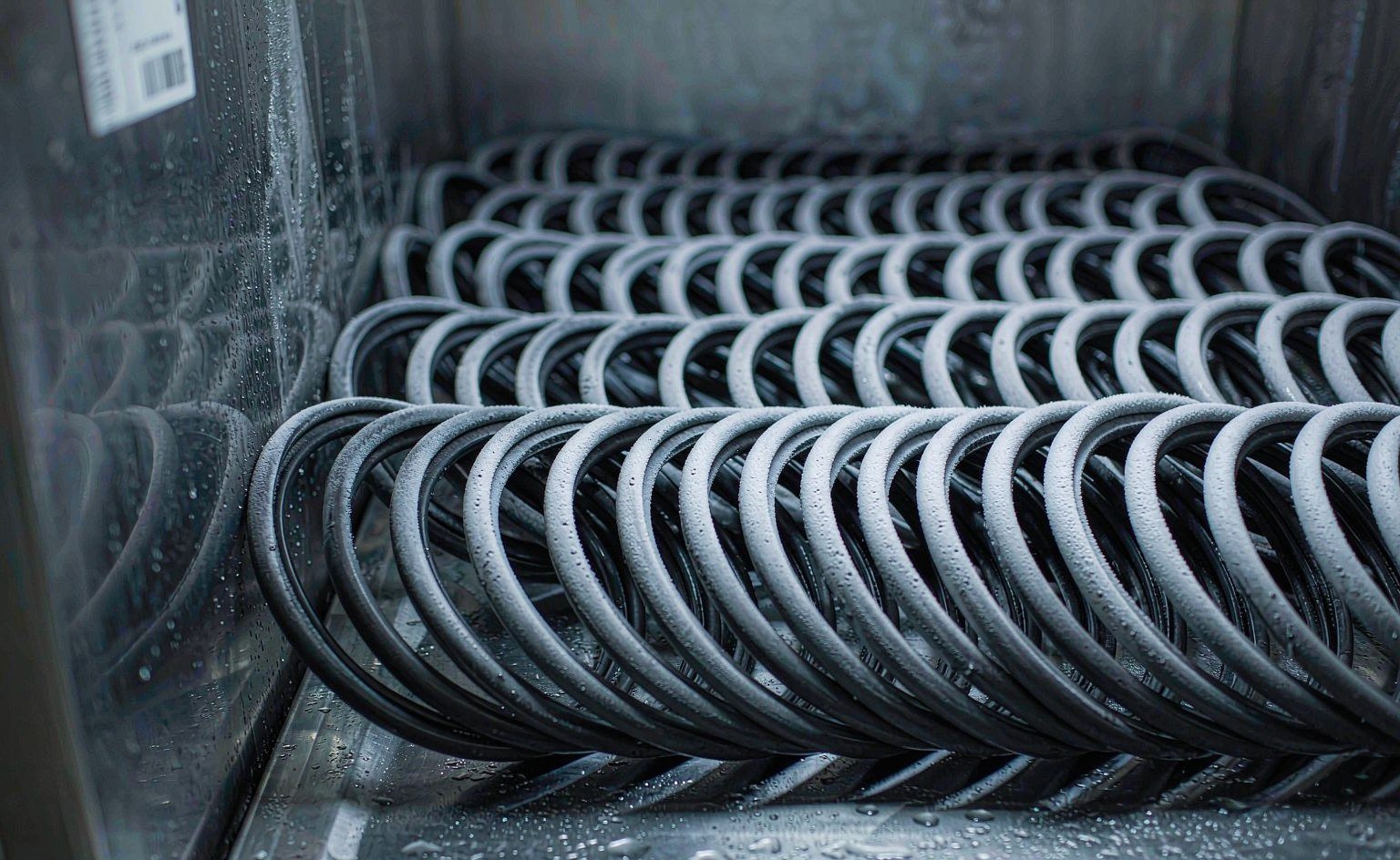
Highly fluorinated grades exist because a large part of process industry sealing is not oil at all. Caustic soda, potassium hydroxide, nitric acid, MEK, MEK-peroxide mixtures, amine-based corrosion inhibitors and refinery streams at 180 °C will destroy standard FKM in weeks. Perfluoroelastomer (FFKM) handles them but costs several times more and is often a 12-week lead item.
ETP sits between the two. It is a highly fluorinated, peroxide-cured polymer with a 225 °C ceiling and mechanical properties close to standard FKM: a typical 78 Shore A compound shows around 17.9 MPa tensile, 145-170% elongation, and — the number that matters for a static gasket — 19% compression set after 22 hours at 200 °C, rising to 42% after 70 hours at the same temperature. Those figures come from a published ETP compound datasheet and are representative of the grade rather than of one supplier.
Immersion data from the same compound family shows the shape of the performance: +0.3% volume change in 45% potassium hydroxide after 70 hours at 70 °C, +1.7% in water after 168 hours at 100 °C, +9.7% in 70% nitric acid. Those are excellent numbers for a non-perfluoroelastomer.
Then the caveat that suppliers tend to leave out: the same compound swells roughly 25% in MEK after 168 hours at room temperature. Ketones remain a compromise even at ETP. If your process stream is a low-molecular-weight ketone at temperature, ETP will slow the failure, not prevent it. Go to FFKM or change the seal geometry to a PTFE-encapsulated design.
| Medium | A | F | GF | GFLT | ETP |
|---|---|---|---|---|---|
| Mineral hydraulic oil | 極佳 | 極佳 | 極佳 | 極佳 | 極佳 |
| HFD phosphate ester | 差 | Fair | Fair | 良好 | 良好 |
| Aromatic fuel, 30% aromatics | Fair | 良好 | 良好 | 良好 | 良好 |
| Saturated steam, 180 °C | 差 | 差 | Fair | Fair | 良好 |
| 45% KOH, 70 °C | 差 | 差 | Fair | 良好 | 極佳 |
| 70% nitric acid | 差 | 差 | Fair | Fair | 良好 |
| MEK, 168 h | 差 | 差 | 差 | Fair | Fair |
| Glycol brake fluid | 差 | 差 | 差 | 差 | 差 |
Cure System: The Hidden Variable Behind Compression Set
Two compounds can carry the same polymer, the same hardness and the same colour, and still differ by 15 points of compression set at 200 °C, because one is bisphenol-cured and the other peroxide-cured. The crosslink chemistry decides how much of the imposed deformation the network keeps after the load comes off.
Bisphenol cure builds carbon-oxygen crosslinks through a nucleophilic substitution reaction. It processes easily, tolerates a wide range of fillers, and gives the familiar 15-30% set at 200 °C after 70 hours. Peroxide cure builds direct carbon-carbon bonds with higher bond energy, and typically lands at 10-20% under the same conditions. Peroxide cure is also what makes FKM survive steam, hot water and base exposure — the same chemistry that resists dehydrofluorination.
The catch is processing. Peroxide-cured FKM needs a co-agent, scorches faster, bonds poorly to some substrates, and is less forgiving in transfer moulding of complex profiles. A moulder with a large bisphenol portfolio will often quote bisphenol simply because that is what the presses are set up for. If your specification needs peroxide cure, say so on the drawing, not in an email.
Post-cure is the second lever. A two-stage bake — typically 150 °C for several hours, then a ramp to 200-230 °C — drives off volatiles and completes the crosslink network. Shops that skip it, or shorten it to save oven time, ship parts with 5-10 points more set than the datasheet implies, and the difference only shows up after six months in the field.
Specifying a Grade So It Survives the Next Purchase Order
The failure mode in FKM sourcing is rarely a bad compound. It is a good compound that nobody described. A drawing that reads “O-ring, FKM, 75 Shore A, 45 x 3.5” is an invitation to substitute A for GLT on the second order, because nothing in the document says otherwise.
Four items close that gap:
- Name the grade family, not just the material. “FKM type GLT per ASTM D2000, 75 ± 5 Shore A” is enforceable. “FKM” is not. If you cannot name the grade, name the two service conditions that drive it — minimum ambient and the aggressive medium — and let the compounder propose.
- State the test temperature for compression set. A set figure without a temperature is meaningless. Write “≤ 25% after 70 h at 200 °C, ASTM D395 Method B” and you have a number a lab can check.
- Require the TR-10 or the low-temperature brittle point. One number, one test, and it catches the substitution that matters most in cold climates.
- Ask for the cure system in writing. “Peroxide cured” on the certificate of conformance is the only way to know that the steam resistance you tested in the prototype is still there in production.
For a cross-check on the material side, ASTM D2000 line callouts encode hardness, tensile, tear, heat ageing and compression set in a single string, and the standard itself is the reference most OEM quality departments will accept without argument. It is worth reading once properly rather than copying a callout from an old drawing. The same applies to the generic grade descriptions published in the seal industry’s material libraries, which are a faster sanity check than a supplier’s own brochure.
The Cost Ladder: Where Paying More Stops Working
Grade upgrades follow a steep curve. Moving from A to B or F adds roughly 10-20% to compound cost and buys specific fluid resistance. Moving to GLT or GFLT adds 60-90%. ETP sits at four to six times A. FFKM can be an order of magnitude above that, with lead times to match.
The engineering question is not “which is best” but “what is the cheapest grade that survives the service condition with margin”. A few practical rules we apply when quoting:
- Mineral oil or grease below 150 °C, no cold requirement: A. Do not upgrade.
- Mineral oil with cold start below -25 °C: GLT. This is the single most common upgrade in mobile hydraulics.
- Water-glycol, HFD or steam below 180 °C: G or GF, peroxide cured.
- Caustic, nitric acid, amine packages: ETP, unless the concentration and temperature push you to FFKM.
- Ketones at temperature: no FKM grade is the answer. Switch material class.
One cost item that buyers consistently underestimate is the cost of a wrong substitution discovered in the field. A seal that costs 0.40 USD and fails at month eight takes a 40,000 USD cylinder out of service, plus crane time and downtime. The grade discussion is cheap compared with that invoice, and it takes thirty minutes. Distributor price lists and trade commentary are a useful early signal when grade pricing starts to move, because polymer tightness hits the specialty grades first.
If you are comparing FKM against nitrile for an oil-side application, the decision often turns on temperature and additive package rather than price — our HNBR vs FKM comparison covers that trade in detail, including where HNBR beats both.
What This Looks Like in a Real Gland
Most FKM parts we mould are not single seals in isolation. A hydraulic cylinder rod gland typically stacks a rod seal, a wiper and an O-ring or backup ring, and those three parts may not want the same grade. A GLT rod seal paired with an A-type static O-ring is a sensible cost decision: the dynamic element needs the cold flexibility, the static element only needs to hold pressure in a groove that never moves.
Conversely, a single-grade bill of materials is often a sign that nobody thought about it. If a customer sends us a seal kit drawing with one material note across seven parts, we usually ask which parts see the highest temperature and which see the coldest start, then quote two grades instead of one. The price difference is small; the service life difference is not.
Where FKM is the wrong class entirely — cryogenic service, abrasive slurry, or continuous steam above 200 °C — the answer usually involves spring-energized PTFE seals or an encapsulated O-ring, both of which sidestep the elastomer’s temperature floor rather than fighting it. For high-temperature work in the 200-300 °C band, our 高低溫密封件系列 covers the grades and profiles that hold up.
Three Selections That Went Wrong
Abstract grade tables are easy to read and hard to apply. Three cases from our own quotation files show where the decision usually breaks.
A snow-plough cylinder in Quebec. The OEM specified FKM 80 Shore A for a rod seal and a wiper, ran it for two winters, and replaced the whole gland each spring. The oil was standard mineral hydraulic fluid at 60 °C; nothing about the fluid demanded a high-fluorine polymer. The failure was cold start at -32 °C, where the A-type compound had a TR-10 of -17 °C and simply could not recover fast enough behind the rod. Switching to GLT at the same hardness ended the annual rebuild. Cost increase: about 60% on a part that sold for under a dollar.
A chemical dosing pump in Thailand. The customer was sealing 30% sodium hydroxide at 50 °C with a standard FKM A diaphragm-backed O-ring and seeing 3 mm of swell and hardening within six weeks. The compounder had quoted “FKM” and delivered A because the drawing said “FKM”. A GFLT compound held the same duty for over a year; ETP would have been better still, but the pump’s groove geometry limited the available hardness range and GFLT was the only grade that could be moulded to the required section at the time. The lesson was not the grade — it was that the drawing allowed the substitution in the first place.
A hydraulic press in Italy. Here the upgrade went the other way. A maintenance team had standardised on GFLT across every seal in the plant because one application needed it, and was paying nearly double for rod seals in a 70 °C press circuit running mineral oil. Reverting the low-temperature parts to A cut the seal spend by 40% with no change in service life. Standardisation is a procurement virtue and an engineering trap; the two need to be separated by machine, not by plant.
In all three cases the technical answer was available in a grade table. What was missing was a specification that described the actual service condition, and a buyer willing to ask what polymer was in the box.
重點摘要
- FKM is a family, not a compound. Seven polymer types share the designation and differ by up to 23 °C in cold flexibility and by a factor of six in price.
- Fluorine content drives chemical resistance; TR-10 drives cold behaviour. A 66% F dipolymer and a 64% F GLT grade are not interchangeable in either direction.
- The 225 °C ceiling applies to all standard grades. Exceeding it needs FFKM or a non-elastomer design, not a different FKM letter.
- Peroxide cure buys steam, water and base resistance, and 5-10 points of compression set. Specify it explicitly if you need it.
- ETP is a bridge to FFKM, not a replacement. Excellent against caustic and nitric acid, still only fair against low-molecular-weight ketones.
- Write the grade, the set test temperature and the cure system on the drawing. Everything else is a verbal promise that the next batch will be the same.