
Sourcing O-rings from Asia is not a gamble on quality — it is a gamble on specification. The factories that mold to aerospace and automotive programs will happily run your order to the same discipline, provided the purchase order tells them what discipline means. The ones that ship problems are rarely incompetent; they are answering a question that was too vague to fail.
Ten questions separate the two outcomes. Each one has an answer that costs the supplier nothing to give and a non-answer that tells you what the next two years will look like. We supply these parts for a living, so this list doubles as the questions we expect from a buyer who knows the trade.
The Ten Questions
1. What exactly is the material callout, beyond the polymer name?
“FKM 75 Shore A” is a starting point, not a specification. Ask for the ASTM D2000 line callout or the equivalent internal compound code, plus the grade behind it — a standard FKM and a GLT-type low-temperature grade behave differently below -10 °C. A supplier who answers with a compound code, a datasheet and a batch-linked certificate knows what they are selling. One who answers “high quality FKM” does not.
2. Which tolerance class and quality grade will the parts be made to?
Size plus tolerance class plus surface grade plus compound is the full designation, and short POs that leave out two of the four are how “almost fits” shipments happen. Under ISO 3601-1 the ring is either Class A or Class B; under ISO 3601-3 the surface is grade N, S or CS. Ask which, and ask that both appear on the drawing and the inspection sheet. Our ISO 3601 explainer covers how the designation code is built.
3. How will the batch be sampled, and to what AQL?
This is the question most buyers never ask, and it determines what “inspection” means. A supplier who samples to ISO 2859-1 General Level II at AQL 1.0 for critical characteristics, and 2.5 for major, is running a real plan. One who “checks 10 pieces” is running an opinion. Ask for the sampling plan in writing before the first order, not after the first complaint.
4. What does the certificate of analysis actually contain?
A COA with measured values — hardness on three points, tensile and elongation, compression set, specific gravity, and the batch numbers for compound and cure — is a document you can audit against. A certificate that states only “conforms” is a piece of paper with a stamp. Ask to see a sample COA from a previous order, which is harder to fabricate than a promise.
5. Who owns the mold, and what happens if we leave?
Tooling is the quiet lock-in of this industry. Ask whether the mold is dedicated to your part, who holds title, whether it can be transferred, and what the amortization terms are. A supplier who amortizes tooling in the piece price should say so up front; one who charges a tooling fee and then claims ownership has created a problem you will discover at the worst possible moment. Related economics — when a machined part beats a molded one — sit in our comparison of molded and machined seals.
6. What is the change notification process?
Compound source, cure system, mold, manufacturing site and process are all things that can change without changing the part number, and any of them can move compression set by 20%. Ask for a written commitment that none of these changes ship without prior notification and re-approval. This single clause prevents more field failures than any inspection step.
7. Can you trace a delivered ring back to the compound batch?
Traceability is what makes a failure investigation possible. The chain is compound batch, mixing batch, cure batch, shipment lot — four links, all recorded on the carton label. Ask to see a label from a recent shipment and confirm the numbers on it reconcile with the COA. If they do not, the paperwork is decorative.
8. What is the real lead time, and what drives it?
Quoted lead time is usually production time, not delivery time. Ask separately for material availability, molding queue, post-cure and inspection time, and transit. For a standard size held in stock, the honest answer is days; for a new mold, it is weeks plus sample approval. A supplier who quotes the same lead time for both is not quoting from a schedule.
9. How are the parts packed, labeled and protected in transit?
O-rings are light, and freight is charged by volume, which creates constant pressure to compress the packaging. Crushed cartons mean deformed rings; rings stored in a hot container for six weeks mean aged compound. Ask for the packing method, the inner bag material, the label content and whether the cartons are rated for the stack height used. Our article on ISO 2230 storage rules explains what six weeks in a hot container does to shelf life.
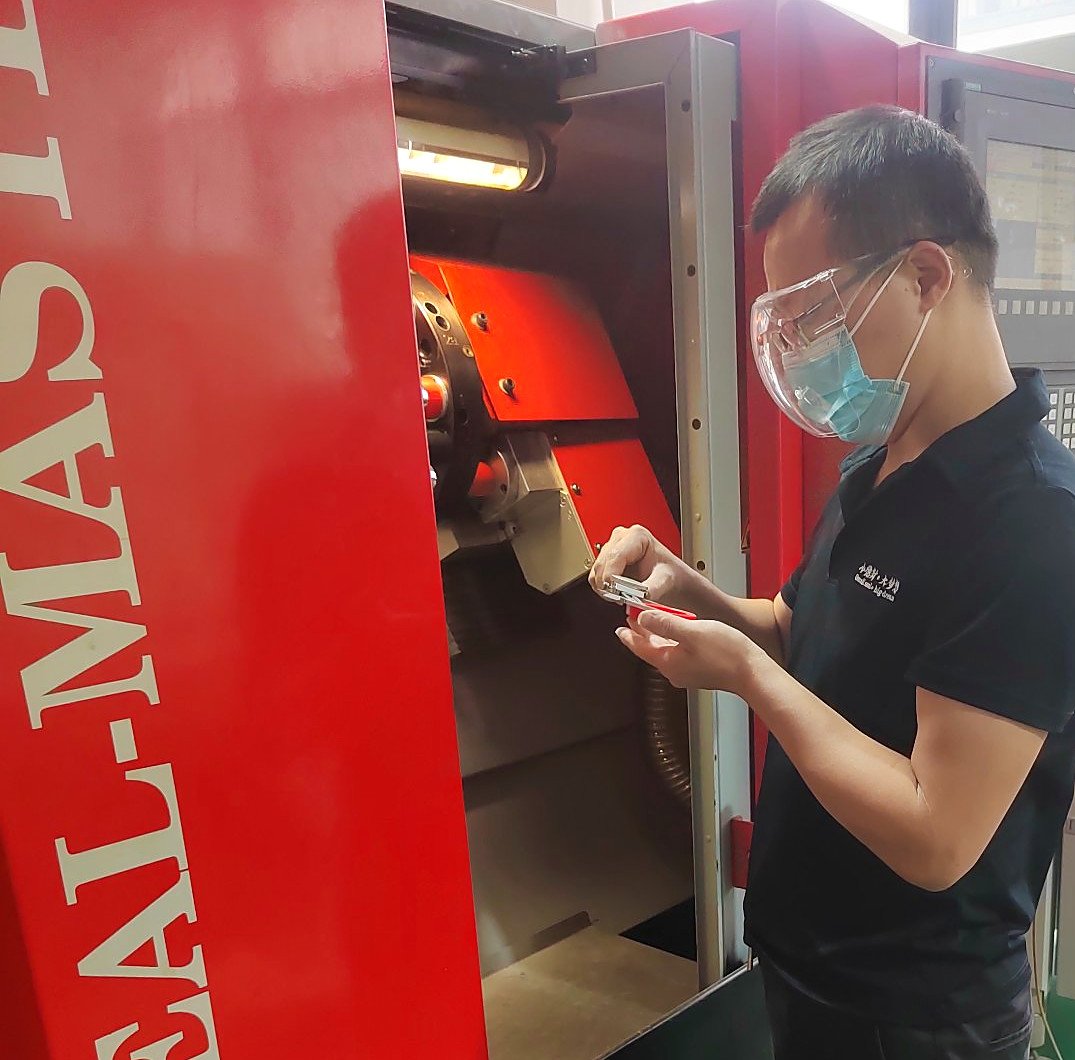
10. Who measures the part on their side, and with what?
The last question is the one that reveals the factory. Ask what instrument measures cross-section — a low-force micrometer, an optical comparator, a profile projector — and what the calibration interval is. Ask whether hardness is read on the finished ring or on a molded button. A supplier who can describe their measurement method in detail has a quality system; one who describes their equipment list has a catalog. The measurement discipline itself is covered in our guide to measuring an O-ring.
| # | Question | Answer that satisfies | Answer that should worry you |
|---|---|---|---|
| 1 | Material callout | ASTM D2000 line callout, compound code, datasheet, batch COA | “High quality FKM” |
| 2 | Tolerance and grade | Class A or B per ISO 3601-1, grade N/S/CS per 3601-3, on the drawing | “Standard tolerance” |
| 3 | Sampling plan | ISO 2859-1 Level II, AQL 1.0 critical / 2.5 major, written into the PO | “We check every batch” |
| 4 | COA content | Measured hardness, tensile, elongation, compression set, density, batch links | “Conforms to standard” |
| 5 | Mold ownership | Dedicated tool, title stated, transfer terms in the contract | Silence, or “our standard mold” |
| 6 | Change notification | Written prior-notification clause covering compound, site, mold and process | “No changes ever” |
| 7 | 可追溯性 | Four-link batch chain on the carton label, reconciled with the COA | Lot number only |
| 8 | Lead time | Broken down by material, molding, post-cure, inspection, transit | One number for every part |
| 9 | Packing | Specified bag, label and carton rating; sea-freight protection addressed | “Export standard packing” |
| 10 | Measurement | Named instruments, calibration interval, test specimen defined | Equipment list with no method |
The Sample Plan That Catches Problems
Questions 3 and 4 only pay off if the receiving inspection matches them. The plan below is the one we recommend to importers who do not want to test every carton and cannot afford to test none.
| Lot size | Sample at General Level II | AQL 2.5 major — accept / reject | Critical (AQL 0) |
|---|---|---|---|
| 500 | 50 | 3 / 4 | Any critical defect fails the lot |
| 3,000 | 125 | 10 / 11 | Any critical defect fails the lot |
| 5,000 | 200 | 10 / 11 | Any critical defect fails the lot |
Two adjustments make the generic table usable for seals. First, treat dimensional non-conformance on the sealing cross-section as a major defect regardless of cosmetic grade — a ring 0.15 mm under on cord is not a cosmetic issue. Second, inspect 100% of the first article from any new mold or any change-notification event, and keep that sample. The retained first article is the only objective reference you will have eighteen months later when a batch feels different in the hand.
Hardness gets its own rule because single readings mislead. Take five readings on a molded button or by IRHD micro on the ring, report the median, and compare against 70 ± 5 or whatever the drawing states. A lot that reads 64 on the median is conforming and soft; one that reads 64 on three of five readings and 71 on the rest is a mixing problem.
Three Substitutions That Cost the Most
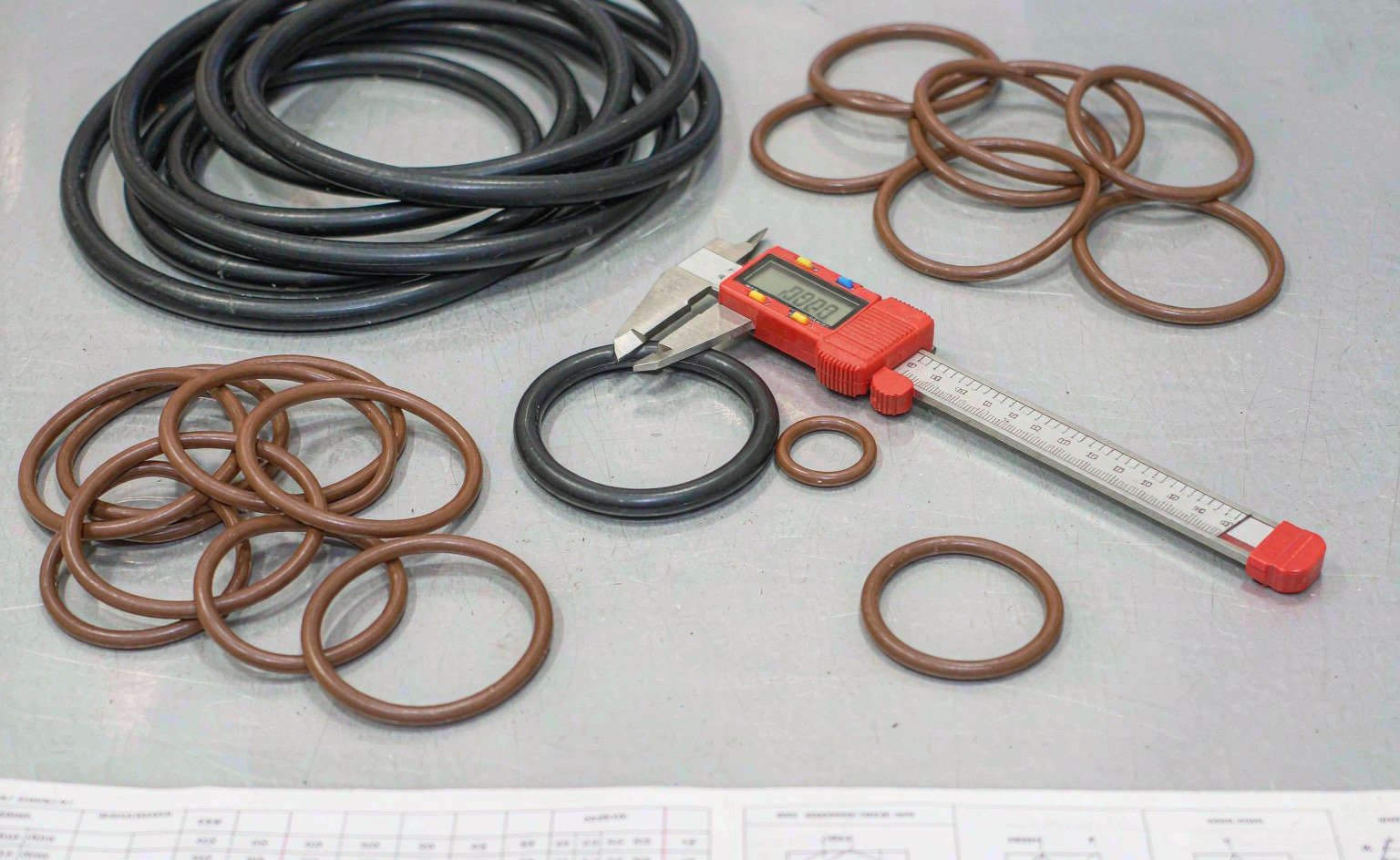
Most sourcing failures are not dimensional. They are material substitutions that pass a visual check and a caliper, then fail in service. The three that hurt most, with the field test that catches each:
NBR supplied as FKM. The classic. Both are black, both mold to 70 Shore A, and the price difference is 4–5×, which is exactly the incentive. Catch it with specific gravity: FKM compounds run about 1.80–1.90 g/cm³, NBR about 1.20–1.30. A ring that should be FKM and sits near 1.25 on a density check is nitrile. Confirm with FTIR or DSC before making a claim.
Standard FKM supplied as a low-temperature grade. A GLT or GFLT compound costs more and is specified for service below -20 °C. Nothing about the part identifies it at room temperature. The only reliable screen is a cold-bend or low-temperature retraction test, or a DSC glass transition check comparing against the approved reference.
Lower cure state supplied as fully cured. Under-cured rubber passes dimension and hardness and fails compression set, which shows up as a seal that takes a permanent flat within months. Ask for compression set to ASTM D395 Method B on the COA, and verify it once per supplier per year at 70 °C for 22 hours. A compound that should read under 20% and reads 35% has a cure problem, not a design problem.
Each of these is cheap to check in the aggregate and impossible to check part by part. That is the argument for a small in-house lab capability — balance, durometer, oven — rather than a larger inspection staff. Authoritative material classifications live in ASTM D2000, and manufacturers such as Precision Polymer Engineering 及 Hallite publish compound data worth comparing against any certificate you receive. Distributor references such as Marco Rubber 及 Darcoid are also useful for cross-checking standard size availability before you commit to a tool. For the parts themselves, our O 型環及 X 型環系列 is quoted with compound, hardness, tolerance class and grade on the line item, because that is what an incoming inspection can enforce.
結論
Buying O-rings from Asia works when the purchase order carries the same information a European or American supplier would demand internally: a material callout with a standard behind it, a tolerance class and surface grade, a sampling plan, a COA with measured values, batch traceability, and a change-notification clause. That is six lines of text, and it costs nothing to write.
What it buys is a supplier relationship where quality is a specification rather than a hope — and a receiving dock that can reject a bad lot on evidence instead of instinct. The suppliers worth keeping will thank you for the clarity. The ones who resist the questions have told you the answer already.