
A seal that has taken a permanent set looks fine on the bench. It has the right inside diameter, the right cross-section, no cuts, no swelling, no hardening you can feel with a thumbnail. It also leaks. The ring has lost the stored energy that made it press against the groove, and no amount of re-torquing the gland will put that energy back.
Compression set is the fraction of an imposed deformation that an elastomer never recovers. It is the single best predictor of seal life on a datasheet, and it is also the most frequently misread number on one, because the test conditions behind it are usually buried in a footnote or missing entirely.
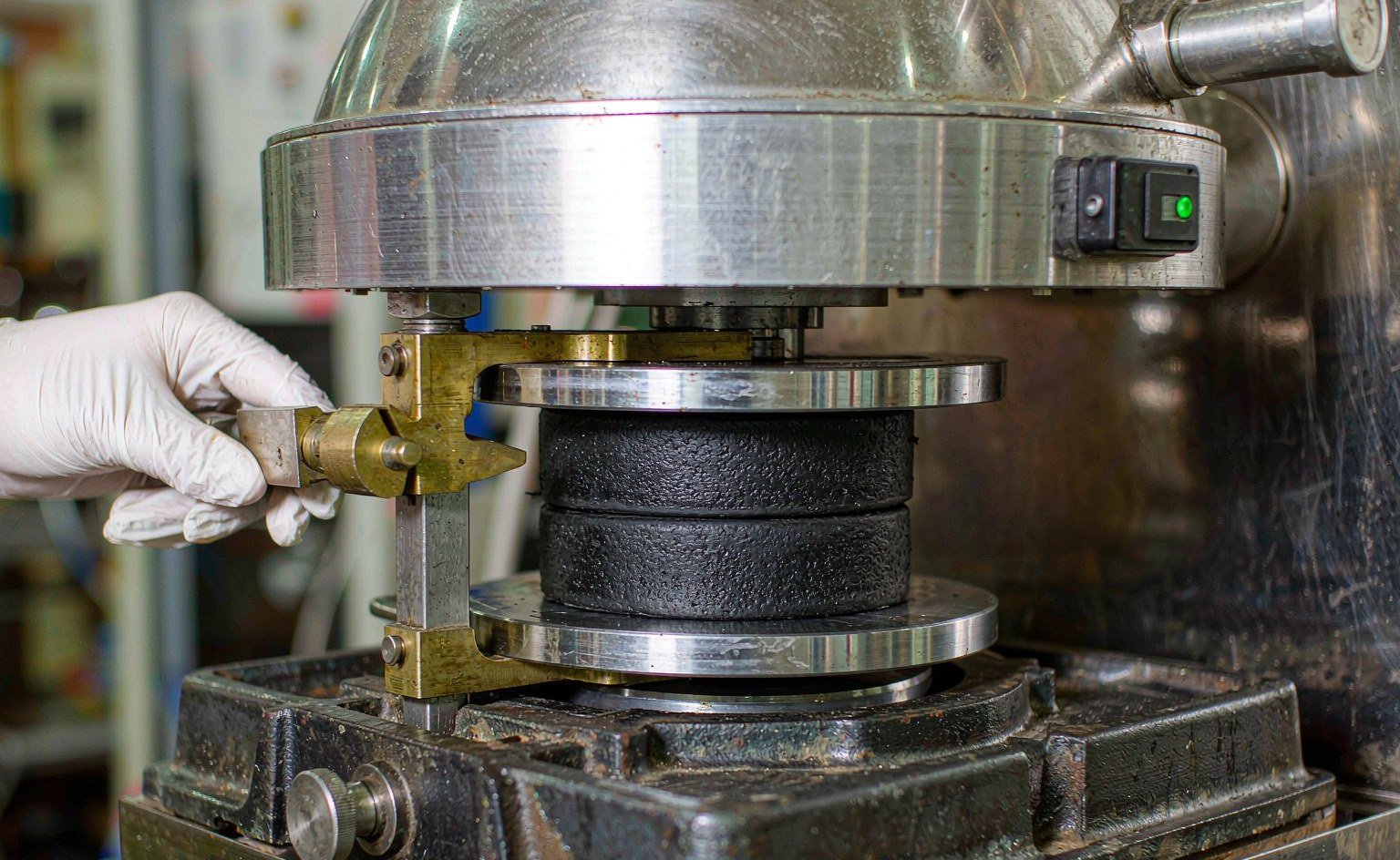
What the Test Actually Measures
ASTM D395 defines three methods. Two of them matter commercially.
Method A compresses a disc under a constant force of 1.8 kN held by a calibrated spring, and reports the unrecovered thickness as a percentage of the original thickness. It answers a different question — how much does the material creep under a fixed load — and it is rarely the method behind the number on a seal datasheet.
Method B compresses the disc to a fixed deflection, usually 25%, using spacer bars, holds it at temperature for 22 or 70 hours, releases it, lets it recover for 30 minutes at room temperature, and reports the unrecovered thickness as a percentage of the applied deflection, not of the original thickness:
CS (%) = (t0 − ti) ÷ (t0 − tn) × 100
where t0 is the original thickness, ti the thickness after recovery, and tn the spacer thickness that defined the compressed height.
That denominator is the reason Method A and Method B numbers cannot be compared. The same rubber tested both ways produces Method B values several times larger than Method A values, and a supplier who quotes “compression set 8%” without naming the method may be quoting the more flattering one. On a 25% deflection, a Method B result of 25% corresponds to roughly 6% of original thickness — the two are describing the same physical reality with different arithmetic.
ISO 815-1 is the international equivalent of Method B, with minor procedural differences that rarely change the ranking of materials. ISO 815-2 covers low-temperature set, which matters for seals that sit compressed in an unheated machine over winter. ASTM D395 remains the reference most North American OEMs write into drawings.
Why Set Kills Seals: The Contact Stress Argument
An O-ring seals because it is squeezed. The groove compresses the cross-section by 15-25%, the rubber pushes back, and that contact stress has to stay above the fluid pressure for the seal to hold. Set is the progressive loss of that push-back.
The relationship is close to linear in the working range. An O-ring installed at 20% squeeze that takes 20% set has effectively 16% squeeze left, and roughly 80% of its original contact stress. Keep going and the math turns against you: once contact stress falls to the same order as system pressure, the seal weeps, and once it falls below, it leaks outright. Field practice puts the threshold at contact stress of roughly 1.2-1.5 times the system pressure for static sealing, with a higher margin for vacuum and for gas service.
This is why set matters more than tensile strength, elongation or even hardness. A seal with 12 MPa tensile and 20% set will outlast a seal with 18 MPa tensile and 35% set in almost every static application, because the second one stops pushing back.
Reading a Datasheet Without Being Fooled
Four details decide whether a set figure means anything for your application.
- Test temperature versus service temperature. Set is strongly temperature-dependent. A 70 °C result says nothing about a gland running at 150 °C. Ask for the number at your service temperature, or at the nearest standard condition above it.
- Duration. 22 hours and 70 hours are both standard, and 70-hour values can be 8-15 points higher. A 22-hour figure is a screening number, not a life prediction.
- Recovery time. The standard recovery is 30 minutes. A lab that measures after 5 minutes reports a higher number; one that measures after 24 hours reports a lower one. Neither is wrong, but they are not comparable.
- Specimen geometry. Type 1 discs are 29.0 mm diameter by 12.5 mm thick; Type 2 are 13.0 mm by 6.3 mm. Thinner specimens age faster because oxygen diffusion is less limiting, so Type 2 results tend to look worse.
There is a companion test worth knowing about: heat ageing per ASTM D573 measures changes in hardness, tensile and elongation after oven exposure, and the combination of heat ageing plus compression set tells you far more than either alone. A compound that hardens 12 points and takes 40% set has failed; one that hardens 3 points and takes 18% set is a candidate.
Typical Values by Material
The ranges below are for 25% deflection, Method B, at the temperature noted. They are starting points for screening, not guarantees; two NBR compounds from different mixers can differ by 15 points.
| Материал | Test condition | Typical CS | Well-formulated CS | Comment |
|---|---|---|---|---|
| NBR, sulfur cured | 100 °C × 70 h | 30-50% | 20-30% | Poor at temperature; fine for ambient oil |
| NBR, peroxide cured | 100 °C × 70 h | 15-25% | 10-15% | Cure system matters more than polymer here |
| HNBR | 150 °C × 70 h | 15-25% | 12-18% | Good high-temperature oil sealing |
| EPDM, peroxide cured | 125 °C × 70 h | 15-25% | 10-18% | Preferred for water and steam |
| FKM, bisphenol cured | 200 °C × 70 h | 15-30% | 10-18% | Standard high-temperature choice |
| FKM, peroxide cured | 200 °C × 70 h | 10-20% | 8-15% | Lower set, better steam resistance |
| VMQ silicone | 175 °C × 70 h | 20-40% | 15-25% | Wide scatter; specify the compound, not the family |
| FFKM | 250 °C × 70 h | 10-20% | 8-15% | Only option above 250 °C |
The pattern is consistent: cure chemistry and post-cure dominate, polymer family sets the ceiling. A peroxide-cured NBR beats a sulfur-cured NBR by 15 points at 100 °C, and a post-cured FKM beats a green one by 5-10 points at 200 °C. Neither improvement costs much at the compounding stage, and both are invisible on a certificate that only lists hardness and tensile. The material data published by seal converters shows the same spread, which is why a single “FKM” line item is never enough to predict behaviour.
Design Levers That Buy Back Set
You cannot stop an elastomer from taking set. You can give it more margin to lose.
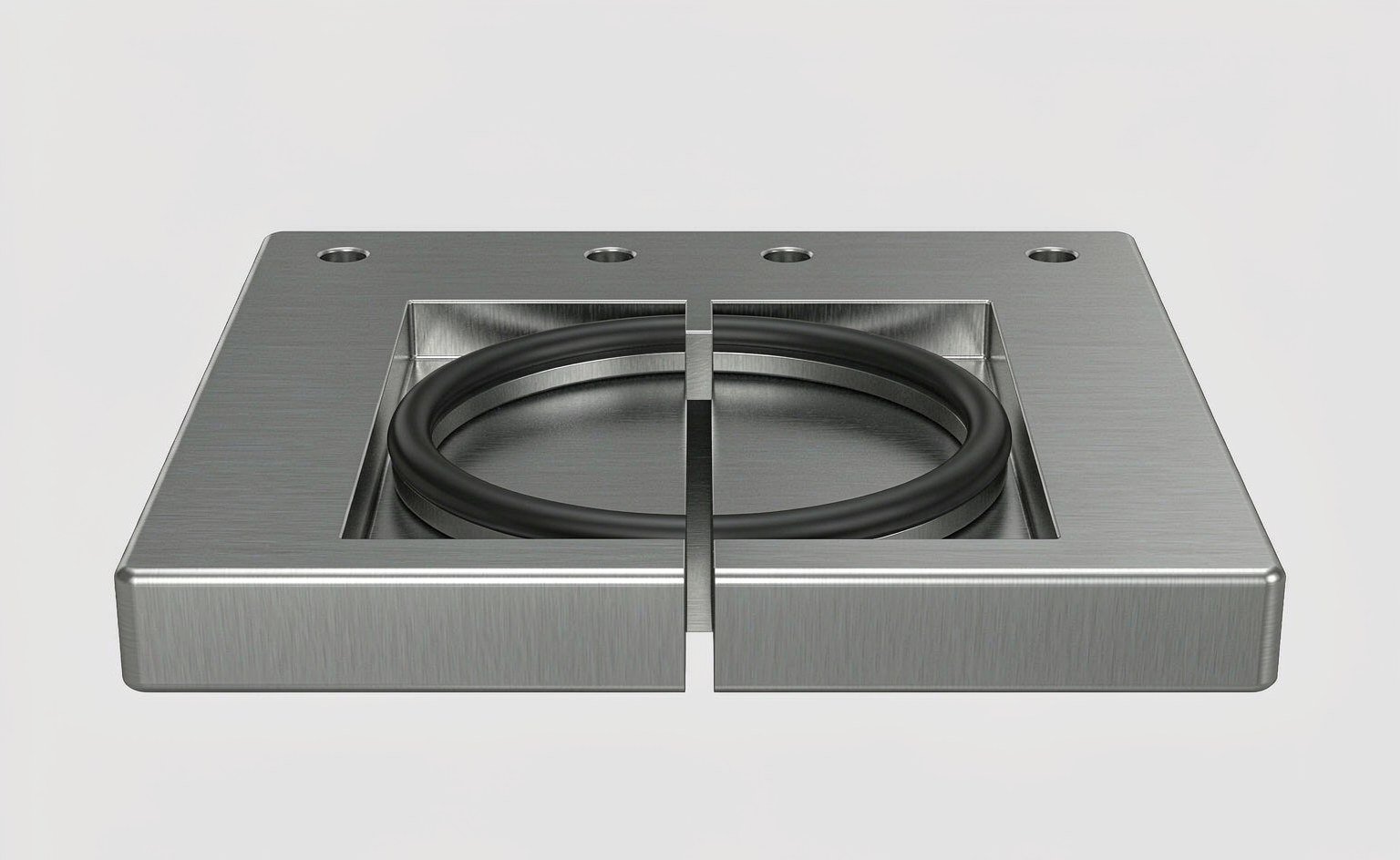
Squeeze. Static seals run 15-25% squeeze; dynamic seals 10-15%. Taking a static gland from 15% to 22% adds roughly 45% more stored energy, which buys years of set at the same operating temperature. The limit is groove fill and installation force, not the rubber.
Groove fill. The cross-sectional area of the seal divided by the groove area should stay between 0.75 and 0.85 for static service. Above that, thermal expansion of the rubber has nowhere to go and the seal extrudes or splits the groove.
Hardness. Higher hardness resists set slightly and resists extrusion a lot, but it needs more squeeze to seal the same surface. A 90 Shore A ring in a 15% squeeze gland is worse than a 70 Shore A ring at 22%.
Backup rings. At pressures above roughly 100 bar, extrusion at the gap becomes the failure mode before set does. A опорное кольцо on the low-pressure side lets you keep a softer, lower-set compound instead of switching to a hard one that needs more squeeze.
Groove finish. A rough groove floor gives the rubber somewhere to flow. Grooves machined to Ra 1.6 µm or better, with no tool marks across the sealing path, hold contact stress far longer than a turned surface with visible chatter.
Compound and Process Levers
If the design is fixed and the seal still takes too much set, the compound is the remaining variable. Three changes do most of the work.
| Lever | Typical effect on CS | Cost impact | Caveat |
|---|---|---|---|
| Peroxide cure instead of sulfur (NBR) or bisphenol (FKM) | 10-15 points lower | Low to moderate | Shorter scorch time; different bonding behaviour |
| Post-cure bake (150 °C, then 200-230 °C) | 5-10 points lower | Oven time only | Must be specified; many shops skip it on short runs |
| Coarser, lower-structure carbon black (e.g. N990 in FKM) | 5-8 points lower | Neutral | Slightly lower tensile and tear |
| Reduced plasticiser and process oil | 5-15 points lower | Neutral | Harder compound, worse low-temperature flex |
| Higher crosslink density | 10 points lower | Neutral | Lower elongation, stiffer feel |
Post-cure deserves a specific mention because it is the most commonly skipped step in low-cost production. A two-stage bake drives off residual volatiles and completes the crosslink network, and the difference only shows up after months in service — long after the parts have been accepted, invoiced and installed. If your drawing does not require post-cure, you are relying on the moulder’s habit. It is one of the first things a technical distributor will ask about when a customer reports premature hardening on an otherwise correct compound.
Setting an Acceptance Limit
A single number across all applications is either too loose for hydraulic sealing or needlessly expensive for a dust cover. The table below reflects what we see specified by customers who have thought about it.
| Application | Max CS | Test condition | Consequence of failure |
|---|---|---|---|
| Precision hydraulic or pneumatic O-ring | 15% | 100 °C × 70 h | Leak, downtime |
| General hydraulic seal | 20% | 100 °C × 70 h | Weep, top-up, eventual leak |
| Высоконапорная гидравлика | 15-20% | At service temperature | Extrusion plus leak |
| Automotive engine or transmission | 25% | 125 °C × 70 h | Warranty claim |
| Food and pharmaceutical | 20% | 100 °C × 70 h | Contamination risk, recall |
| Аэрокосмическая отрасль | 10-15% | Per AMS or MIL spec | Safety |
| Building and enclosure weatherseal | 30-40% | 70 °C × 22 h | Draught, water ingress |
Two cautions on using that table. First, the test temperature should be at or slightly above the real service temperature; a 100 °C test on a gland that sees 140 °C is decoration. Second, do not push the limit below 10% without a reason. Very low set usually comes with lower elongation and tear strength, and a seal that holds its shape but splits at a chamfer during installation is not an improvement.
Field Diagnosis: What Set Looks Like
Set has a recognisable appearance. A seal removed from a gland that has taken too much set is flattened on the contact faces, with a visible band where the groove compressed it, and it does not spring back when you flex it. Cross-section it and the original round profile is now a rectangle with rounded corners.
Distinguish it from the two conditions that look similar. Heat hardening also flattens the seal but comes with a hardness increase of 10 points or more and a glossy, sometimes cracked surface. Chemical swell leaves the seal soft and enlarged, often with a tacky feel. Set alone leaves hardness roughly unchanged — which is exactly why it is missed during incoming inspection of a used part.
If you are replacing seals on a schedule rather than on condition, the set number tells you whether the schedule is right. Pull one seal per machine at half the replacement interval and measure section thickness against a new part. More than 20% loss of squeeze at half-life means the interval is too long, or the compound is wrong for the temperature.
The measurement itself is the same one used at goods-in: section thickness with a flat-foot micrometer, and inside diameter with a taper gauge or caliper. Our guide to measuring an O-ring correctly covers the technique and the tolerance bands, and it is worth reading before you conclude that a seal has “stretched” when it has actually taken set.
Часто задаваемые вопросы
Is lower compression set always better? No. Below about 10% you are usually looking at a highly crosslinked, low-elongation compound that is harder to install and less tolerant of surface defects. Match the number to the duty: 15-20% at service temperature is a good target for hydraulic sealing, 25-30% is acceptable for weatherseals.
Can a seal recover from compression set? Partially, and only while it is uncompressed. Elastomers continue to recover for hours after load removal, which is why the standard allows 30 minutes before measurement and why a seal that has been out of the gland for a day measures better than one measured immediately. In service, the seal never gets that recovery, so datasheet numbers taken after 30 minutes are already optimistic.
Why does my supplier’s 22-hour number look better than my 70-hour test? Because it is. Set grows with time, and the growth is fast early and slow later. A 22-hour result typically understates the 70-hour result by 8-15 points on NBR and FKM. Always compare like with like.
Does shelf life affect compression set? Yes. Rubber that has been stored for years, especially in a hot warehouse, arrives partly aged. Polymer suppliers publish storage guidance, and the practical rule is that a seal older than its shelf life will take set faster in service even if it looks and measures as new.
Will a harder compound fix a set problem? It will mask it for a while. Harder compounds resist extrusion and deform less, but they also need more squeeze to seal and they take set at the same rate. Fix the temperature or the compound first.
What if the groove is the problem? Then no compound will help. A groove that is too deep gives low squeeze, and low squeeze plus normal set equals a leak at month six. Check groove depth and fill before changing material, and if the gland is worn or damaged, a complete seal kit is usually cheaper than a second attempt at the same repair.
Compression set is not a number to optimise in isolation. It is the margin between the squeeze you designed and the squeeze that survives the temperature, the time and the compound you actually bought. Specify the test temperature, demand the post-cure, and give the gland enough squeeze to lose — the O-ring and X-ring range we mould is quoted with set data at the service temperature for exactly that reason, and a compound that is marginally more expensive per part is usually the cheaper seal over five years.