
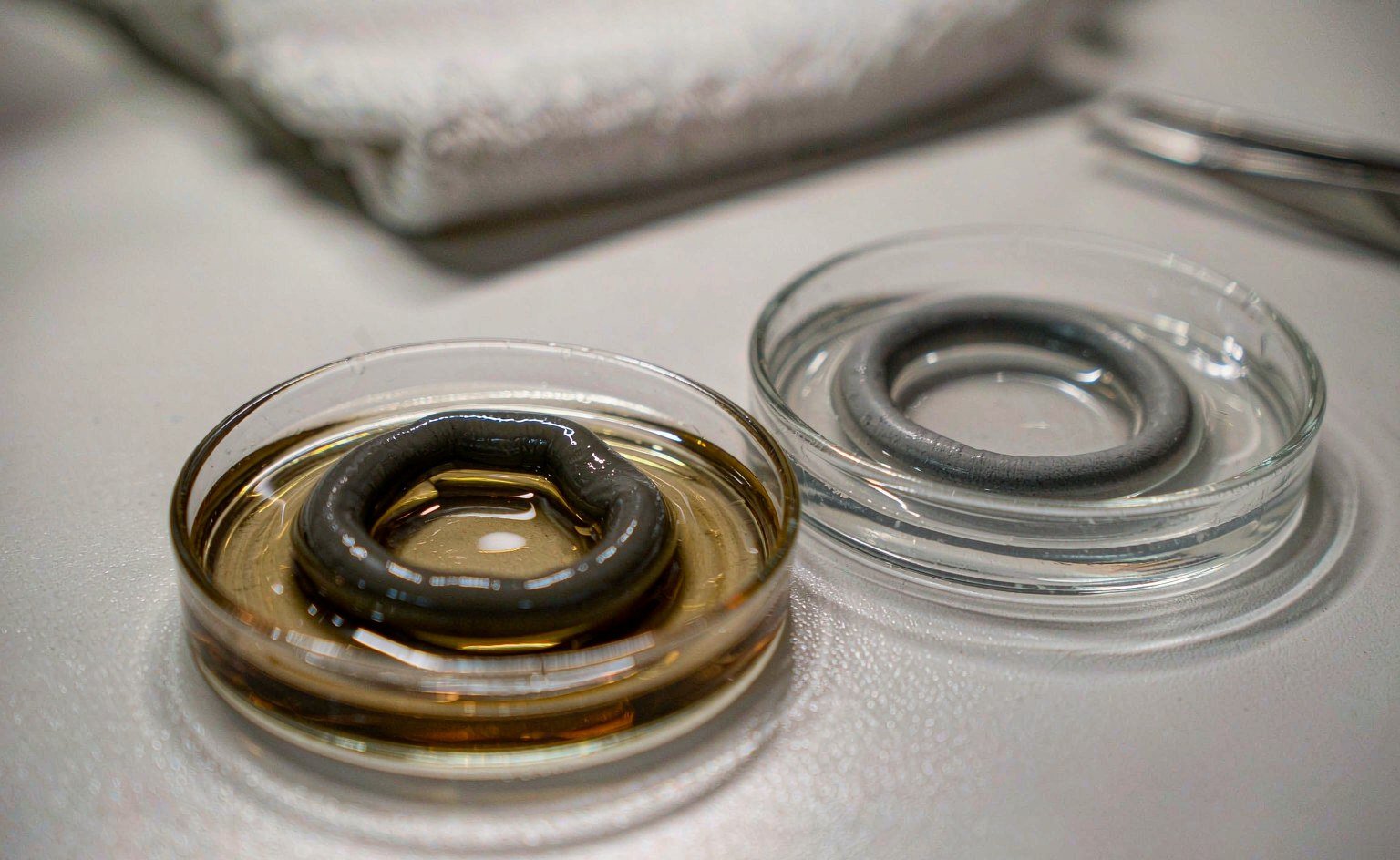
In hydraulyske krêftenheid begjint in liter oalje yn 'e wike te ferliezen. It ûnderhâldsteam ferfangt de O-ringen op 'e filterhúshâlding troch dy út 'e opslachbak, it lek hâldt in moanne op en komt dan werom. De bak is EPDM. De floeistof is minerale hydraulyske oalje. De ringen binne sa'n 20 persint opswold, sêft wurden en wurde troch de groef snien wylst de húshâlding oanlutsen wurdt. Nimmen hat mei opset it ferkearde materiaal keazen; it partnûmer like identyk en de bak stie tichterby.
NBR en EPDM sjogge der itselde út, kostje sawat itselde en binne tsjinsteld yn 'e twa eigenskippen dy't it meast fan belang binne. NBR is it oalje-elastomeer. EPDM is it wetter-, stoom- en waar-elastomeer. Hast elke seleksjeflater tusken de twa is dat immen dy grins oerstekt — yn beide rjochtingen.
Dizze fergeliking jout jo de kompatibiliteitsregel yn ien fraach, de sifers dêrefter en de kostenberekkening om te besluten wannear't gjin fan beide materialen goed genôch is.
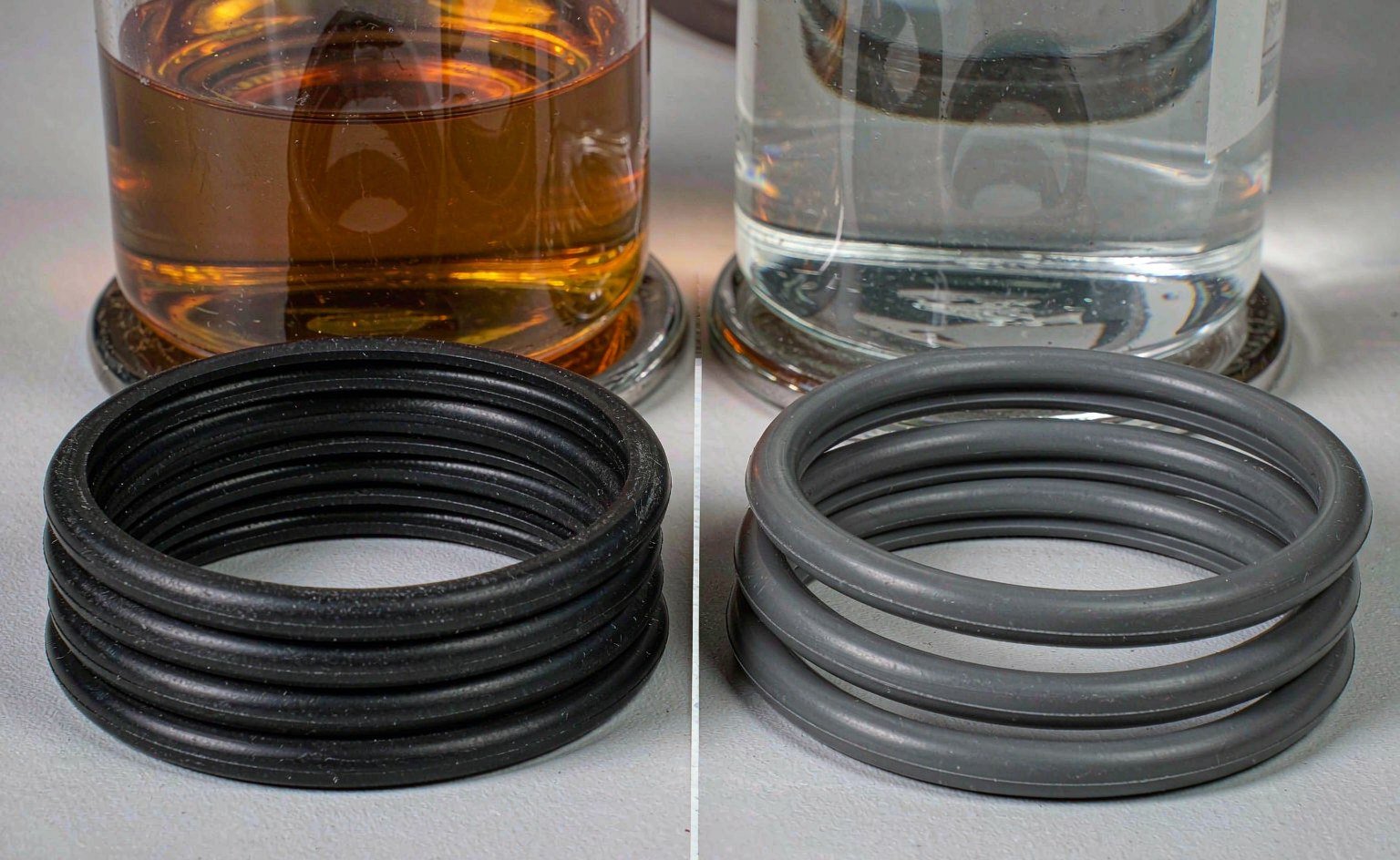
De fraach dy't it beslist
Is de floeistof polêr of net-polêr? Dat is de test. NBR is in koalwetterstofpolymeer en lost koalwetterstoffloeiistoffen op; it hâldt stân yn net-polêre media om't syn akrylnitrilgroepen it polariteit jouwe dy't oalje wjerstiet. EPDM hat in fersadige, net-polêre rêchbonke en gjin sokke wjerstân — minerale oalje, diesel, fet en kerosine swolje it allegear oant it syn krêft ferliest.
Yn 'e praktyk: oaljes, brânstoffen, fetten en koalwetterstofoplosmiddelen geane nei NBR. Wetter, stoom, glykol-kuolmiddelen, remfloeistof, ketonen, alkoholen en bûtenlucht geane nei EPDM. As de tapassing beide is — in waskline dy't ek smeermist sjocht — kiest jo de floeistof dy't it meast by de sealing komt, en dan moatte jo wierskynlik nei FKM sjen.
Njonken elkoar
| Eigenskip | NBR (nitril) | EPDM |
|---|---|---|
| Trochgeande temperatuer | -40 oant +100 °C (120 °C koart) | -50 oant +150 °C (175 °C pyk, peroksidegraden) |
| Minerale oalje, diesel, fet | Poardebêst | Falt — swollet 50%+ en wurdt sêft |
| Wetter en stoom | Reedlik; hydrolysearret yn hjitte stoom | Utstekend, ynklusyf CIP- en SIP-stoom |
| Ozon en UV | Min — barst yn wiken bûtendoar | Utstekend, praktysk ymmún |
| Ketonen, esters, alkoholen | Min | Goed oant utstekend |
| Abrasive en skuorring | Goed oant utstekend | Reedlik — swakker as NBR |
| Kompresjeset by 100 °C | 15–25% | 15–25% |
| Relative mingselkosten | 1.0 | 1.1–1.3 |
Wearden binne typysk foar 70 Shore A-produksjefoarmen. Temperatuerextremen hingje ôf fan 'e spesifike foarm; in legetemperatuer-NBR kin -55 °C berikke en in perokside-uthere EPDM kin 175 °C foar koarte perioaden hâlde.
Temperatuer is wêr't it jild beweecht
De 50 °C-kloof tusken de twa trochgeande wurdearrings is it djoerste ferskil, om't it beslút hoe faak de sealing ferfongen wurdt. By 90 °C yn oalje hâldt NBR it. By 120 °C yn oalje is NBR op 'e râne fan syn berik: it hurdt, ferliest rek en kompresjeset klimt boppe 40 persint binnen in pear tûzen oeren. EPDM soe 120 °C noflik oankinne — mar it soe yn 'e oalje swolje lang foar't temperatuer it probleem waard.
De praktyske regel foar oaljetsjinst is dat NBR in 100 °C-materiaal is en alles boppe dat FKM-gebiet is, net EPDM. Foar wetter- en wetter-glykoltsjinst is EPDM in 150 °C-materiaal en NBR ien fan 90 °C. Yn beide gefallen set it materiaal dat op gemy wint it temperatuerplafond.
Kompatibiliteit, floeistof foar floeistof
| Floeistof of betingst | NBR | EPDM | Brûk ynstee as jo twifelje |
|---|---|---|---|
| Minerale hydraulyske oalje, HL/HLP | Poardebêst | Net geskikt | — |
| Diesel, kerosine, benzine | Goed | Net geskikt | FKM foar benzineblends |
| Wetter, kâld en hjit oant 90 °C | Goed | Poardebêst | — |
| Fersadige stoom oant 150 °C | Net geskikt | Poardebêst | FEPM boppe 150 °C |
| Glykol-kuolmiddel (EG, PG) | Goed | Poardebêst | — |
| Remfloeistof DOT 3/4 | Net geskikt | Standertkar | — |
| Fosfaatester (HFD) | Net geskikt | Goed | Butyl foar heul hege temperatuer |
| Wetter-glykol HFC | Redlik | Goed | — |
| Ketonen, MEK, aseton | Net geskikt | Goed | — |
| Hjitte aminen en ammoniak | Redlik | Goed | FFKM for concentrated service |
| Outdoor, ozone, UV | Net geskikt | Poardebêst | — |
| Ozone from motors and welders | Net geskikt | Poardebêst | — |
Two entries catch people out. Brake fluid is glycol-based, which is why every automotive brake system uses EPDM — and why a well-meaning mechanic who fits NBR rings to a caliper causes a failure that looks like a manufacturing defect. Phosphate-ester hydraulic fluid (aviation and some turbine control systems) destroys NBR completely and is one of the few mainstream reasons to specify EPDM in a hydraulic system.
Read the Failure, Not the Datasheet
When a seal comes out of service, the damage tells you which mistake was made.
Swollen, soft, sticky, strong solvent smell. Chemical incompatibility with a non-polar fluid in EPDM, or with a ketone, ester or phosphate ester in NBR. Volume swell above 15 percent is a fail for a static seal; above 10 percent for dynamic. Measure it: cut a 25 mm length of cord or use a whole O-ring, weigh and measure before and after 72 hours of immersion at the service temperature.
Hard, cracked, with fine fissures that open when stretched. Heat aging or ozone. NBR outdoors, or NBR at 120 °C in oil, both look like this. Ozone cracks are usually perpendicular to the direction of stretch and appear in a pattern; heat cracks are more random and the part is uniformly hard.
Flattened on the contact faces, otherwise intact. Compression set. Both materials do this at their temperature limit, and it is the most common reason a seal that “looks fine” leaks.
Chewed on one side, with a nib of material missing. Extrusion or installation damage. Material choice rarely fixes this; gap, chamfer and backup rings do.
The Cost Arithmetic
EPDM costs roughly 10 to 30 percent more per part than NBR in the same size and hardness. That difference is irrelevant next to the cost of one unplanned stop, which is why the decision has to be made on annual cost rather than unit price.
| Scenario | NBR | EPDM | FKM |
|---|---|---|---|
| Relative part price, same size | 1.0 | 1.2 | 3.5 |
| Expected life at 110 °C in water-glycol | 6–9 months | 3–5 years | 3–5 years |
| Replacements over 5 years | 7–10 | 1 | 1 |
| Relative 5-year part spend | 7–10× | 1.2× | 3.5× |
| Downtime events over 5 years | 7–10 | 0–1 | 0–1 |
Illustrative arithmetic, not a quotation. Insert your own part price, labour rate and downtime cost; the ranking rarely changes.
In oil service at 110 °C the table flips: NBR is out of its range, EPDM is incompatible, and FKM at 3.5× the part price is the cheap option because it is the only one that survives. That is what “pay more” means in this comparison — not paying for a premium material, but paying for the material whose chemistry matches the fluid.
Where Neither Material Works
Three common situations sit outside both columns. High-temperature oil above 120 °C: FKM, or HNBR where abrasion is also a factor. Aggressive solvent or aromatic service: FKM, or PTFE encapsulated rings for ketones and esters. Hot amine and caustic service: EPDM is better than FKM but FFKM is the durable answer at 150 °C and above.
There is also the mixed case — a food plant that washes equipment with caustic at 80 °C and then runs vegetable oil through it. EPDM survives the wash and swells in the oil; NBR survives the oil and degrades in the caustic. The usual resolution is a changeover seal: EPDM for the wash cycle, NBR or FKM for production, with two colour-coded sets. It is cheaper than a single exotic compound and it removes the chance of fitting the wrong one.
Ordering Details That Change Performance
Once the material family is right, three specification lines decide whether two suppliers’ parts behave the same.
Acrylonitrile content for NBR. Standard 26 percent ACN gives a balance of oil resistance and low-temperature flexibility. 33 to 41 percent resists swelling better in aromatic and fuel service but stiffens the ring; 18 percent is for cold service and gives up oil resistance. A drawing that says only “NBR 70” lets the compounder choose, and the cheap choice is rarely the right one.
Cure system for EPDM. Sulfur cure is cheaper and adequate for water and weather. Peroxide cure is required for steam, CIP/SIP cycles and any application where compression set at 150 °C matters. The price difference is small; the life difference is not.
Certification for potable and food contact. EPDM is the usual choice for drinking water (NSF/ANSI 61) and for food contact under FDA 21 CFR 177.2600 or EU 10/2011. Ask for the certificate on the compound, not the company.
Hardness deserves its own line. Going from 70 to 90 Shore A cuts extrusion risk at high pressure but costs about 30 percent of the sealing force at low temperature, and it makes the ring harder to install without twisting. For a static flange at 1 to 10 MPa, 70 Shore A is the right default in both materials. For a dynamic piston seal above 20 MPa, 90 Shore A plus a backup ring beats 70 Shore A alone — EPDM at 90 Shore A is noticeably less forgiving on a scored bore than NBR, which is one more reason EPDM tends to be a static and weather-seal material in practice.
Wichtichste punten
- NBR for oils, fuels and greases; EPDM for water, steam, glycols, brake fluid, ketones and outdoor exposure. The polar/non-polar question decides it in seconds.
- NBR is a 100 °C material in oil and a 90 °C material in water. EPDM is a 150 °C material — but only where the fluid allows it.
- EPDM costs 10 to 30 percent more per part and can return five times that in avoided replacements. FKM costs 3.5× and is the cheaper option once oil temperature passes 120 °C.
- Swelling means wrong chemistry; hardening and cracks mean heat or ozone; flattening means compression set. Diagnose before you reorder.
- Specify ACN content for NBR, cure system for EPDM, and the certificate for anything touching drinking water or food.
Both materials sit in our standard range in 70 and 90 Shore A, with FDA and NSF-capable compounds available on request. Start from the O-ring- en X-ringberik for imperial and metric sizes, or the pneumatyske seelrige as de tapassing lucht is yn plak fan floeistof. Oanpaste mingsels en net-standert maten geane troch oanpaste produkten, en de hydraulyske sucherseelrige omfettet de oaljekant-ekwivalinten yn NBR, HNBR en FKM.
Foar basispolymeergegevens, Zeon produsearret sawol NBR as EPDM en publisearret eigenskiptabellen op graadnivo. Trelleborg hat in ferlykber materiaaloersjoch, en Hallite dokumintearret floeistofkompatibiliteit spesifyk foar hydraulyske seeling. In kompatibiliteitskaart fan in distributeur, nuttich foar snelle kontrôles op ûngewoane media, is te finen op Seal Sales; foar easken oangeande rigel-oanroppen sjoch ASTM D2000.