
A hydraulic power unit starts losing a litre of oil a week. The maintenance team replaces the O-rings on the filter housing with the ones from the stores bin, the leak stops for a month, and then returns. The bin is EPDM. The fluid is mineral hydraulic oil. The rings have swollen about 20 percent, gone soft, and are being cut by the groove as the housing is tightened. Nobody chose the wrong material on purpose; the part number looked identical and the bin was closer.
NBR and EPDM look the same, cost about the same, and are opposites in the two properties that matter most. NBR is the oil elastomer. EPDM is the water, steam and weather elastomer. Almost every selection error between the two is somebody crossing that line — in either direction.
This comparison gives you the compatibility rule in one question, the numbers behind it, and the cost arithmetic for deciding when neither material is good enough.
The Question That Settles It
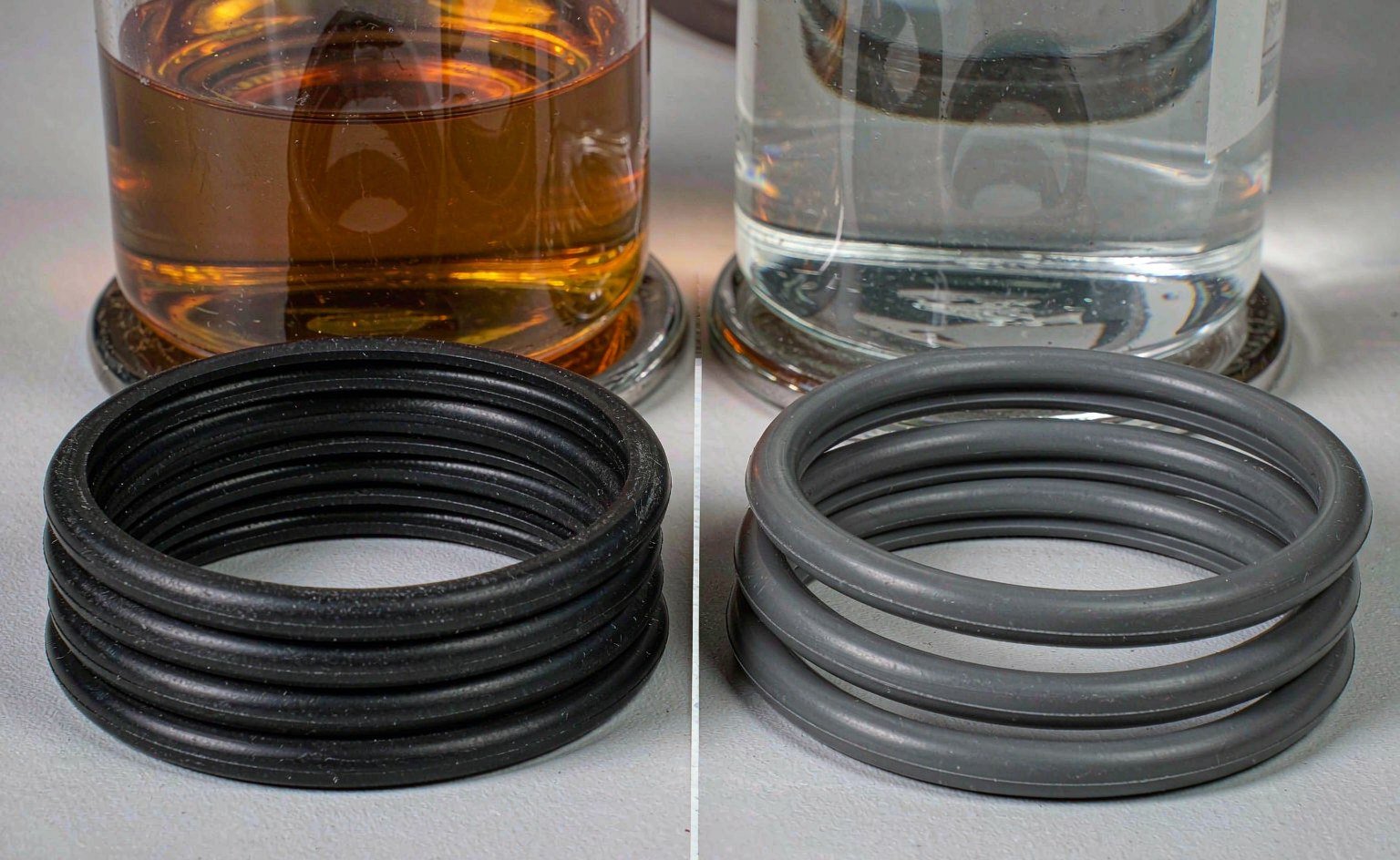
Is the fluid polar or non-polar? That is the test. NBR is a hydrocarbon polymer and dissolves hydrocarbon fluids; it holds up in non-polar media because its acrylonitrile groups give it polarity that resists oil. EPDM has a saturated, non-polar backbone and no such resistance — mineral oil, diesel, grease and kerosene all swell it until it loses strength.
In practice: oils, fuels, greases and hydrocarbon solvents go to NBR. Water, steam, glycol coolants, brake fluid, ketones, alcohols and outdoor air go to EPDM. If the application is both — a washdown line that also sees lubricant mist — you are choosing the fluid that reaches the seal most often, and you should probably be looking at FKM instead.
Side by Side
| Eigenschaft | NBR (Nitril) | EPDM |
|---|---|---|
| Continuous temperature | -40 to +100 °C (120 °C short) | -50 to +150 °C (175 °C peak, peroxide grades) |
| Mineral oil, diesel, grease | Ausgezeichnet | Fail — swells 50%+ and softens |
| Water and steam | Fair; hydrolyses in hot steam | Excellent, including CIP and SIP steam |
| Ozone and UV | Poor — cracks in weeks outdoors | Excellent, effectively immune |
| Ketones, esters, alcohols | Schlecht | Good to excellent |
| Abrasion and tear | Good to excellent | Fair — weaker than NBR |
| Compression set at 100 °C | 15–25% | 15–25% |
| Relative Mischungskosten | 1.0 | 1.1–1.3 |
Values are typical for 70 Shore A production compounds. Temperature extremes depend on the specific compound; a low-temperature NBR can reach -55 °C and a peroxide-cured EPDM can hold 175 °C for short periods.
Temperature Is Where the Money Moves
The 50 °C gap between the two continuous ratings is the most expensive difference, because it decides how often the seal is replaced. At 90 °C in oil, NBR lasts. At 120 °C in oil, NBR is at the edge of its range: it hardens, loses elongation, and compression set climbs past 40 percent within a few thousand hours. EPDM would handle 120 °C comfortably — but it would swell in the oil long before temperature became the issue.
The practical rule for oil service is that NBR is a 100 °C material and everything above that is FKM territory, not EPDM. For water and water-glycol service, EPDM is a 150 °C material and NBR is a 90 °C one. In both cases, the material that wins on chemistry sets the temperature ceiling.
Compatibility, Fluid by Fluid
| Fluid or condition | NBR | EPDM | Use instead when in doubt |
|---|---|---|---|
| Mineral hydraulic oil, HL/HLP | Ausgezeichnet | Not suitable | — |
| Diesel, kerosene, gasoline | Gut | Not suitable | FKM for gasoline blends |
| Water, cold and hot to 90 °C | Gut | Ausgezeichnet | — |
| Saturated steam to 150 °C | Not suitable | Ausgezeichnet | FEPM above 150 °C |
| Glycol coolant (EG, PG) | Gut | Ausgezeichnet | — |
| Brake fluid DOT 3/4 | Not suitable | Standard choice | — |
| Phosphate ester (HFD) | Not suitable | Gut | Butyl for very high temp |
| Water-glycol HFC | Ausreichend | Gut | — |
| Ketones, MEK, acetone | Not suitable | Gut | — |
| Hot amines and ammonia | Ausreichend | Gut | FFKM for concentrated service |
| Outdoor, ozone, UV | Not suitable | Ausgezeichnet | — |
| Ozone from motors and welders | Not suitable | Ausgezeichnet | — |
Two entries catch people out. Brake fluid is glycol-based, which is why every automotive brake system uses EPDM — and why a well-meaning mechanic who fits NBR rings to a caliper causes a failure that looks like a manufacturing defect. Phosphate-ester hydraulic fluid (aviation and some turbine control systems) destroys NBR completely and is one of the few mainstream reasons to specify EPDM in a hydraulic system.
Read the Failure, Not the Datasheet
When a seal comes out of service, the damage tells you which mistake was made.
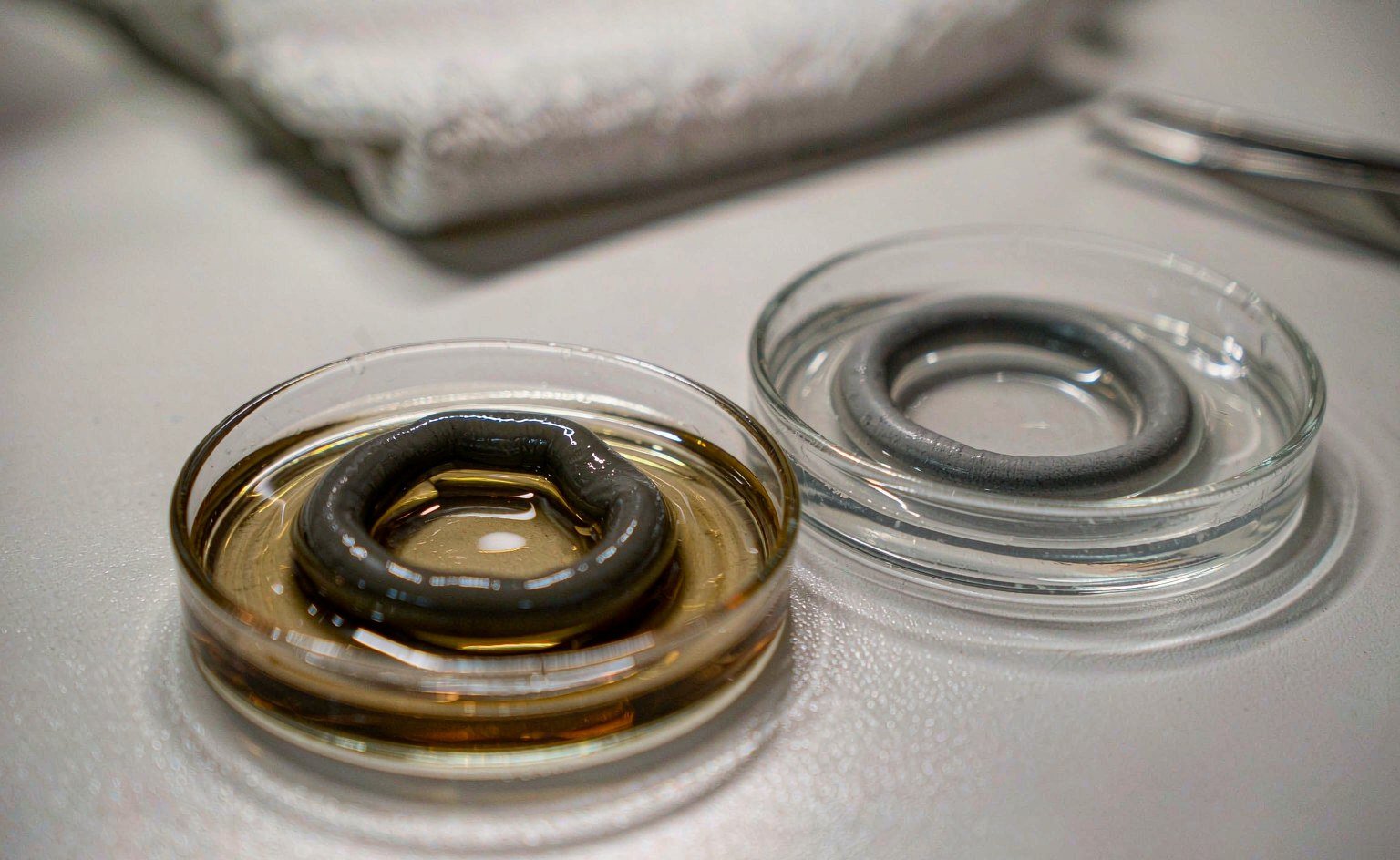
Swollen, soft, sticky, strong solvent smell. Chemical incompatibility with a non-polar fluid in EPDM, or with a ketone, ester or phosphate ester in NBR. Volume swell above 15 percent is a fail for a static seal; above 10 percent for dynamic. Measure it: cut a 25 mm length of cord or use a whole O-ring, weigh and measure before and after 72 hours of immersion at the service temperature.
Hard, cracked, with fine fissures that open when stretched. Heat aging or ozone. NBR outdoors, or NBR at 120 °C in oil, both look like this. Ozone cracks are usually perpendicular to the direction of stretch and appear in a pattern; heat cracks are more random and the part is uniformly hard.
Flattened on the contact faces, otherwise intact. Compression set. Both materials do this at their temperature limit, and it is the most common reason a seal that “looks fine” leaks.
Chewed on one side, with a nib of material missing. Extrusion or installation damage. Material choice rarely fixes this; gap, chamfer and backup rings do.
The Cost Arithmetic
EPDM costs roughly 10 to 30 percent more per part than NBR in the same size and hardness. That difference is irrelevant next to the cost of one unplanned stop, which is why the decision has to be made on annual cost rather than unit price.
| Scenario | NBR | EPDM | FKM |
|---|---|---|---|
| Relative part price, same size | 1.0 | 1.2 | 3.5 |
| Expected life at 110 °C in water-glycol | 6–9 months | 3–5 years | 3–5 years |
| Replacements over 5 years | 7–10 | 1 | 1 |
| Relative 5-year part spend | 7–10× | 1.2× | 3.5× |
| Downtime events over 5 years | 7–10 | 0–1 | 0–1 |
Illustrative arithmetic, not a quotation. Insert your own part price, labour rate and downtime cost; the ranking rarely changes.
In oil service at 110 °C the table flips: NBR is out of its range, EPDM is incompatible, and FKM at 3.5× the part price is the cheap option because it is the only one that survives. That is what “pay more” means in this comparison — not paying for a premium material, but paying for the material whose chemistry matches the fluid.
Where Neither Material Works
Three common situations sit outside both columns. High-temperature oil above 120 °C: FKM, or HNBR where abrasion is also a factor. Aggressive solvent or aromatic service: FKM, or PTFE encapsulated rings for ketones and esters. Hot amine and caustic service: EPDM is better than FKM but FFKM is the durable answer at 150 °C and above.
There is also the mixed case — a food plant that washes equipment with caustic at 80 °C and then runs vegetable oil through it. EPDM survives the wash and swells in the oil; NBR survives the oil and degrades in the caustic. The usual resolution is a changeover seal: EPDM for the wash cycle, NBR or FKM for production, with two colour-coded sets. It is cheaper than a single exotic compound and it removes the chance of fitting the wrong one.
Ordering Details That Change Performance
Once the material family is right, three specification lines decide whether two suppliers’ parts behave the same.
Acrylonitrile content for NBR. Standard 26 percent ACN gives a balance of oil resistance and low-temperature flexibility. 33 to 41 percent resists swelling better in aromatic and fuel service but stiffens the ring; 18 percent is for cold service and gives up oil resistance. A drawing that says only “NBR 70” lets the compounder choose, and the cheap choice is rarely the right one.
Cure system for EPDM. Sulfur cure is cheaper and adequate for water and weather. Peroxide cure is required for steam, CIP/SIP cycles and any application where compression set at 150 °C matters. The price difference is small; the life difference is not.
Certification for potable and food contact. EPDM is the usual choice for drinking water (NSF/ANSI 61) and for food contact under FDA 21 CFR 177.2600 or EU 10/2011. Ask for the certificate on the compound, not the company.
Hardness deserves its own line. Going from 70 to 90 Shore A cuts extrusion risk at high pressure but costs about 30 percent of the sealing force at low temperature, and it makes the ring harder to install without twisting. For a static flange at 1 to 10 MPa, 70 Shore A is the right default in both materials. For a dynamic piston seal above 20 MPa, 90 Shore A plus a backup ring beats 70 Shore A alone — EPDM at 90 Shore A is noticeably less forgiving on a scored bore than NBR, which is one more reason EPDM tends to be a static and weather-seal material in practice.
Wichtigste Erkenntnisse
- NBR for oils, fuels and greases; EPDM for water, steam, glycols, brake fluid, ketones and outdoor exposure. The polar/non-polar question decides it in seconds.
- NBR is a 100 °C material in oil and a 90 °C material in water. EPDM is a 150 °C material — but only where the fluid allows it.
- EPDM costs 10 to 30 percent more per part and can return five times that in avoided replacements. FKM costs 3.5× and is the cheaper option once oil temperature passes 120 °C.
- Swelling means wrong chemistry; hardening and cracks mean heat or ozone; flattening means compression set. Diagnose before you reorder.
- Specify ACN content for NBR, cure system for EPDM, and the certificate for anything touching drinking water or food.
Both materials sit in our standard range in 70 and 90 Shore A, with FDA and NSF-capable compounds available on request. Start from the Sortiment an O-Ringen und X-Ringen for imperial and metric sizes, or the Pneumatikdichtungs-Sortiment if the application is air rather than fluid. Custom compounds and non-standard sizes go through individuell angepasste Produkte, and the hydraulic piston seal range covers the oil-side equivalents in NBR, HNBR and FKM.
For base polymer data, Zeon produces both NBR and EPDM and publishes grade-level property tables. Trelleborg has a comparable material overview, and Hallite documents fluid compatibility for hydraulic sealing specifically. A distributor’s compatibility chart, useful for quick checks on unusual media, is at Seal Sales; for line-callout requirements see ASTM D2000.