
A back-up ring fails quietly. It does not leak, does not squeal, does not show up on the condition-monitoring dashboard — until the day it does not block the extrusion gap, and the O-ring behind it comes out of teardown with a chewed, nibbled edge. By then the material decision that seemed like a footnote has become a downtime event.
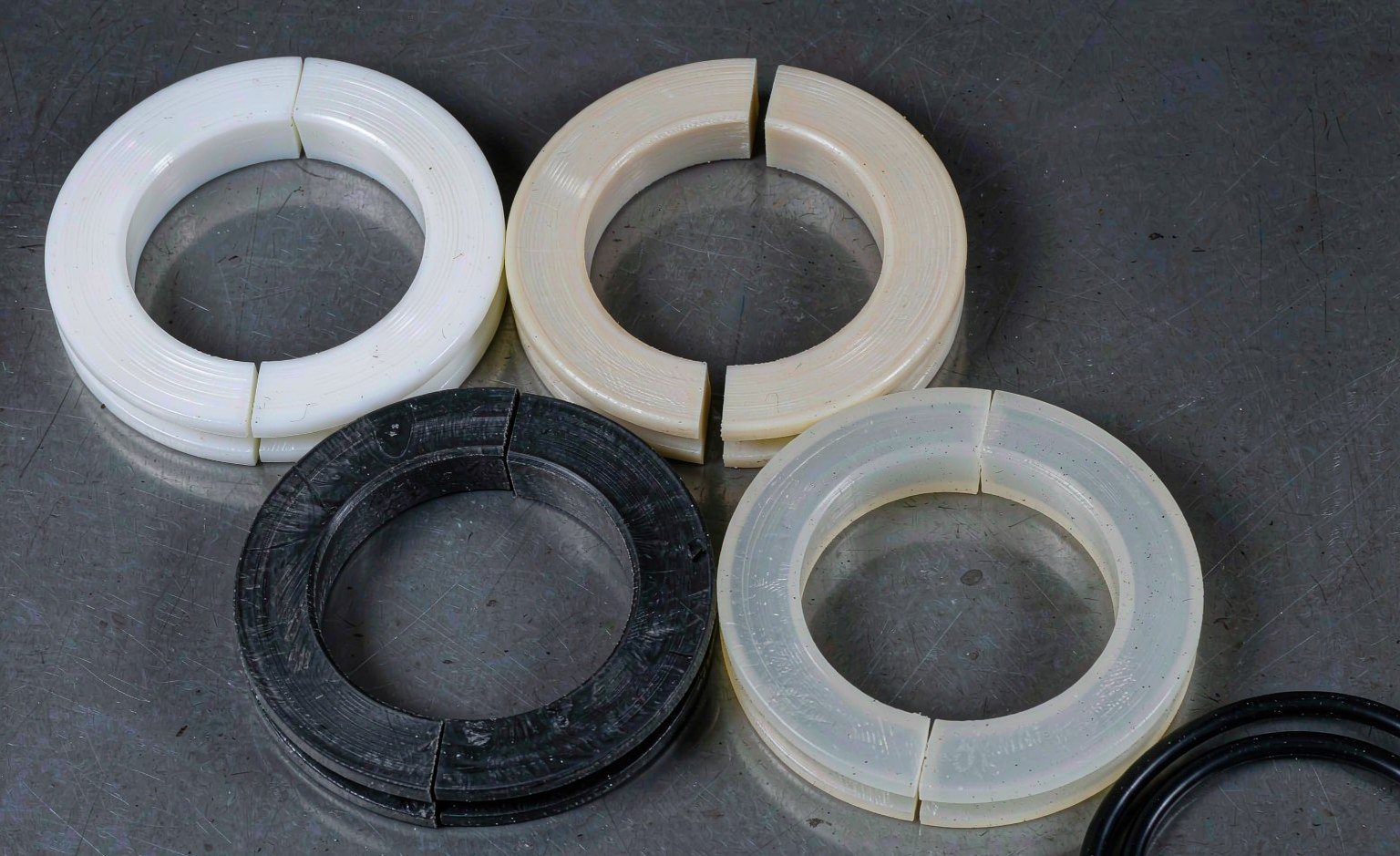
This guide narrows the decision to the four polymer families that cover most hydraulic and process glands — virgin PTFE, filled PTFE, PEEK, nylon 6/6 and UHMWPE — and sorts them by the three variables that actually decide the outcome: pressure, temperature, and the medium. The geometry questions (single vs double, solid vs split vs spiral-cut) are covered in our earlier article on what a back-up ring is; here we go deep on material.
Start With Pressure, Not the Datasheet Alphabet
Extrusion resistance is the whole job. The numbers below reflect commonly published service limits for back-up rings, and they separate the four materials cleanly:
- PTFE virgen: serviceable to roughly 25 MPa (3,600 psi). Beyond that, cold flow takes over — the ring slowly deforms into the gap it was meant to block.
- PTFE cargado (glass, carbon, bronze): to roughly 40 MPa (5,800 psi). Fillers do for the ring what they do for seal jackets: they defeat creep.
- Nylon 6/6: comfortably below about 69 MPa (10,000 psi) — stiff and inexpensive, with a temperature catch discussed below.
- PEEK: to about 138 MPa (20,000 psi). Compressive strength above 140 MPa, and it keeps that strength at temperatures where nylon has already surrendered. This is the oilfield and injection-molding answer.
Two boundary notes from experience. At roughly 700 bar (70 MPa) and above, the extrusion gap itself becomes the dominant variable — no ring material rescues a sloppy gland, and either the diametral clearance shrinks or an anti-extrusion design takes over. And UHMWPE, though an excellent anti-extrusion material at moderate pressure (extrusion-resistant, Shore D 60–65), sits in the same service band as virgin-to-filled PTFE; we specify it for its wear life, not for pressure ceiling records.
| Material | Pressure ceiling (typical) | Max temp | Water absorption | Resistencia química | Costo relativo |
|---|---|---|---|---|---|
| PTFE virgen | ≈ 25 MPa (3,600 psi) | ≈ 260 °C | None (0.01%) | Near-universal, pH 0–14 | Medio |
| Filled PTFE (glass/carbon/bronze) | ≈ 40 MPa (5,800 psi) | ≈ 260–290 °C | Ninguno | Broad; filler-dependent | Medium-high |
| Nylon 6/6 (often MoS₂-filled) | < ≈ 69 MPa (10,000 psi) | ≈ 86–120 °C | 0.5–1.4% / 24 h | Good oils; poor acids, weak in water-glycol long-term | Bajo |
| PEEK | ≈ 138 MPa (20,000 psi) | ≈ 250–260 °C | ~0.5% saturated, low | Broad incl. hot steam, most solvents | Alta |
| UHMWPE | Moderate-pressure band (like virgin-to-filled PTFE) | ≈ 80–100 °C | ~0% | Ácidos/bases débiles, la mayoría de disolventes; no oxidantes fuertes | Low-medium |
Material data sheets for PEEK grade properties and processing are published by the resin makers themselves — Victrex is the reference most engineers start with — and their figures are the ones to quote on a specification, not a reseller’s summary.
Then Temperature — Where Nylon Quietly Loses
Pressure capability means little if the ring softens. The temperature column in the table above drives three recurring decisions:
- Above about 90–100 °C, nylon 6/6 is out. Its service ceiling sits near 86 °C in many published guides — hot hydraulic circuits, steam-adjacent equipment and anything near an engine compartment move the choice to PTFE or PEEK.
- Above about 80 °C, UHMWPE softens too (short excursions toward 100 °C are survivable, continuous service is not). Its wear resistance — several times that of virgin PTFE — makes it painful to give up, but stiffness falls fast with temperature.
- Cryogenic side, PTFE and UHMWPE both stay functional to roughly −200 °C, and PEEK to about −70 °C. For low-temperature hydraulic actuators in cold regions, a virgin-PTFE ring inside a PTFE or UHMWPE jacket system is the stock answer from our low-temperature seal range.
One caution that bridges pressure and temperature: extrusion resistance falls as temperature rises, for every polymer in the table. A filled-PTFE ring fine at 40 MPa in an 80 °C circuit may need a PEEK substitute in the same circuit running 180 °C. When the duty includes both numbers, qualify the pair, not each separately.
The Medium: Water Absorption and Chemical Attack
PTFE and PEEK are chemically indifferent to almost everything a hydraulic or process gland sees. The material decisions here are really about the other two:
- Nylon absorbs water — 0.5 to 1.4% in 24 hours by common published figures, more at saturation. In water-glycol HPU circuits, humid tropical warehouses or marine equipment, that absorption means dimensional swell (a fit problem in a close-clearance groove) and a stiffness drop. MoS₂-filled nylon trades some of this for lower friction, but water-heavy duty still argues for PTFE or PEEK.
- UHMWPE hates strong oxidizers — concentrated nitric acid, hot sulfuric, permanganate streams attack it. For everything short of that, including most aqueous media, it is chemically sound and exceptionally abrasion-resistant.
- Filled PTFE inherits a caveat from its fillers: a bronze-filled ring in a strongly acidic or chlorinated stream can corrode the filler, which is why chemical service defaults to glass- or carbon-filled grades, or virgin PTFE at low pressure. Our gama de plásticos técnicos lists filler systems per grade so the chemistry call is made at the grade level, not the family level.
Single or Double, Solid or Split: Geometry Follows Pressure Direction
Material selection and geometry interact, so settle them together:
| Configuration | When it applies | Material notes |
|---|---|---|
| Single ring, low-pressure side | Pressure acts from one side only | Any of the four; cheapest option. Do not mount a single ring on both sides “for symmetry” |
| Two rings, one each side | Double-acting cylinders, pressure reversal | Pairs must be identical material and hardness; mismatched pairs tilt the O-ring under reversal |
| Solid (turned) ring | Static glands, moderate duty | Best extrusion sealing; installation needs a stretching motion past shoulders |
| Scarf-cut / spiral-cut ring | Dynamic rods and pistons, field installation over grooves | Cut angle set so the O-ring cannot mark the joint; install cut faces apart from the seal’s pressure side |
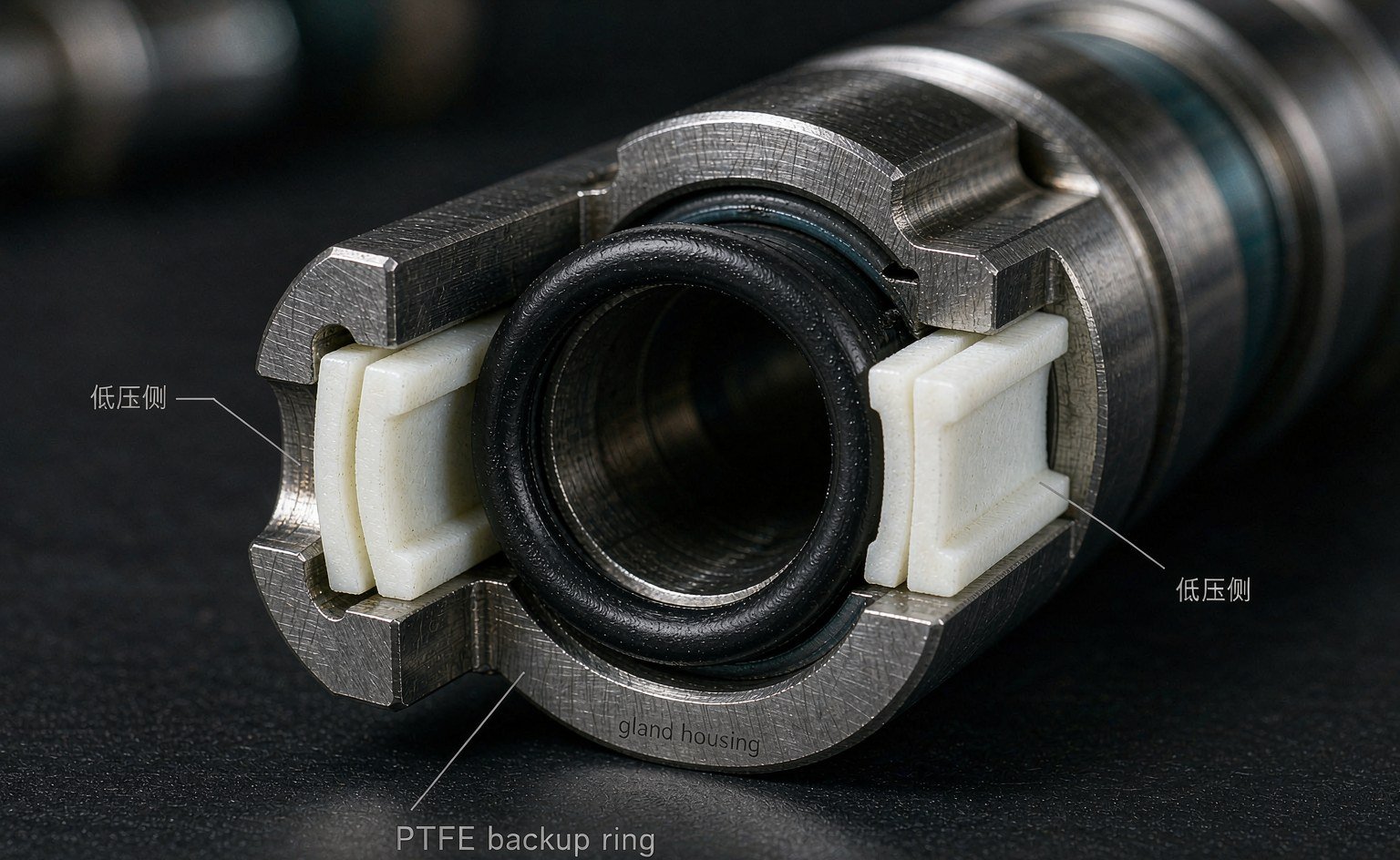
On big static flanges, split rings exist so maintenance crews can install them without dismantling the joint. On reciprocating rods, the scarf cut is what keeps the ring from becoming a second leak path; solid rings in dynamic glands can actually wedge and score. Standards work in the background here: ISO 3601’s part 4 covers anti-extrusion rings for O-ring applications, and most hydraulic component drawings reference MIL-G-5514-style gland geometry that the ring must match.
What a Wrong Material Looks Like at Teardown
Failure forensics short-circuits a lot of specification debate, because each misuse leaves a signature:
- Ring flattened into a D-shape, flowed into the gap — virgin PTFE used above its pressure ceiling, or any ring at temperatures beyond its rating. Escalate the material, close the gap, or both.
- Swollen ring, tight fit, groove scuffing — nylon in wet service. Swap to PTFE/PEEK or expect a repeat at every overhaul.
- Ring intact but O-ring still nibbled — geometry problem, not material: gap too wide for the ring width, ring mounted on the wrong side, or a single ring in double-acting service.
- Ring surface pitted or discolored — chemical attack on the filler (bronze PTFE in acid duty) or on UHMWPE in an oxidizer.
- Bore or rod scoring along the ring path — ring material too hard for the counter-surface (PEEK against soft aluminium), or debris packed between ring and gland. Revisit hardness pairing or add filtration.
When the teardown shows O-ring extrusion damage in a gland that already has back-ups, run the extrusion and gap analysis before reordering anything — in about half the cases we see, the ring material was never the problem.
A Selection Shortcut You Can Keep on a Card
For buyers who stock back-up rings against a range of equipment, the four-line decision rule covers most cases:
- ≤ 25 MPa, any chemistry, any temperature to 260 °C → virgin PTFE.
- 25–40 MPa, dynamic, 260 °C ceiling → filled PTFE (glass or carbon for chemistry, bronze for stability).
- 40–70 MPa, dry, < 90 °C, cost-sensitive → nylon 6/6, MoS₂-filled if it slides.
- Above 70 MPa, or above 90 °C with high pressure, or steam → PEEK, and check the extrusion gap before the invoice.
UHMWPE enters wherever abrasion or aqueous media dominate and pressure stays moderate — slurries, water hydraulics, food-washdown environments. If the card gives two defensible answers, pick the cheaper one and stock a PEEK variant for the hot cells. Component sets that pair rings with the matching seal elements, like our gama de juntas dinámicas de pistón hidráulico y las gasket, washer and back-up ring category, take that matching decision off your shelf-count problem entirely.
Sourcing advice applies here the same way it does for O-rings: general marketplaces such as Seal Sales y Darcoid are useful for comparing common sizes and pricing, while a manufacturer gets involved the moment pressure, temperature or chemistry leaves the standard card — that is when the grade, the filler system and the gap check start to matter more than the price list. Global fluid-power suppliers like Hallite publish their gland and back-up guidance openly, and their tables agree with the logic above, which is the reassurance buyers should look for.
La conclusión
Back-up ring material selection is a three-number problem — pressure, temperature, medium — and the four polymer families answer it in a fixed order: PTFE for chemistry, filled PTFE for creep, nylon for cost in dry moderate-pressure service, PEEK for the top of the pressure and temperature range, UHMWPE for wear and water. Get the pressure-temperature pair qualified together, respect nylon’s water absorption, and match ring hardness to the counter-surface. Do those things and the ring returns to being what it should be: the quietest part in the gland.
Four Ring Materials, One Groove Standard
PTFE, PEEK, nylon and UHMWPE rings are all machined to drawing here, in solid, split and double-turn forms, including the bronze- and graphite-filled grades this article compares. Because all four come off the same benches, a pressure-temperature pair can be qualified against the groove you already have rather than against a catalogue range.
The checks we run before cutting: pressure and gap together, temperature at the ring, water absorption for nylon in wet service, and ring hardness against the counter-surface. Then the geometry — single or double, cut direction, scarf angle — because a good share of wrong-material diagnoses at teardown are really wrong-geometry diagnoses.
Send the groove drawing, the pressure-temperature pair and the medium, and we will quote the four candidates side by side so the trade-off is priced instead of argued. Reply usually within 24 hours, engineering review free — sales@bosssealing.com or the formulario de contacto.