
Split Oil Seal Core Material Composition
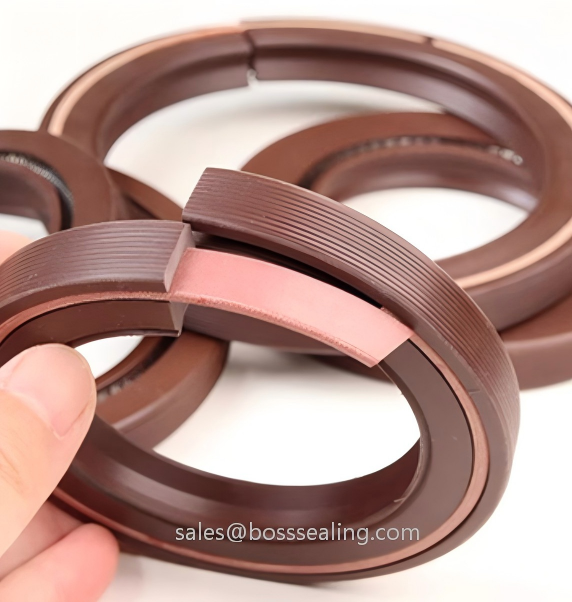
For any split oil seal requirement, please request us.
A split oil seal is usually not made from a single material. It is a composite assembly:
Sealing body: This is the core functional part that provides sealing. The most commonly used material is polyurethane (PU/TPU). Nitrile rubber (NBR) and fluoroelastomer (FKM) are also widely used. Polyurethane is particularly popular in split oil seals because of its excellent wear resistance and resilience.
Split joint / connecting block: This is a distinctive feature of split oil seals. It is typically made of reinforced PTFE (polytetrafluoroethylene) or a special polymer composite. Its function is to ensure that the cut ends close tightly after the seal is reassembled, preventing leakage through the split.
Carcass and spring (internal structure): To maintain shape and provide continuous sealing force, the seal usually contains a metal carcass (such as carbon steel) and a stainless steel spring (commonly V-shaped or Z-shaped).
Main Manufacturing and Reference Standards
As an industrial sealing component, split oil seals are generally manufactured and selected with reference to the following standards:
Basic dimensions and tolerances: GB/T 28413-2012, Sealing elements — Reciprocating seals for hydraulic cylinders — Groove dimensions and tolerances, is a commonly referenced national standard. It specifies installation groove dimensions and tolerances.
Product performance and inspection: In industrial procurement, standards such as GB/T 13871.1, covering rotary shaft lip-type seals incorporating elastomeric sealing elements, are also referenced for physical properties and media resistance.
Industry and application standards: In specific industries such as coal mining and metallurgy, industry standards such as the MT/T series (e.g., MT/T 1164) may be applied to seals used in hydraulic supports and similar equipment, with more specific requirements.
Split Oil Seal Structural Design Features
In addition to materials, the design of split oil seal offers important advantages:
Split configuration: The most notable feature is the single-split or double-split design, together with a dedicated locking structure. This allows fast installation or replacement without dismantling the equipment.
Multi-lip design: Split oil seals usually have a primary sealing lip and an auxiliary dust lip. This helps prevent internal media leakage while blocking external dust and contaminants.
In summary, the performance of a split oil seal is the result of its material formulation, structural design, and manufacturing accuracy. When selecting a seal, the material and standard should be matched to the specific operating temperature, media, and shaft speed.
For any split oil seals demand, please contact us.
Tags: Split Seals