
The X-ring (quad-ring) is not a better O-ring — it is a different answer to a specific failure mode: the O-ring that spirals, rolls and wears out in reciprocating and oscillating service. In static glands, the O-ring remains unbeatable on cost and availability, and no amount of profile cleverness changes that. This article puts numbers on where the X profile moves the needle — friction, squeeze, twist resistance — and where it just moves the price, so you can specify it on the jobs where it earns the 10–20% premium and skip it everywhere else.
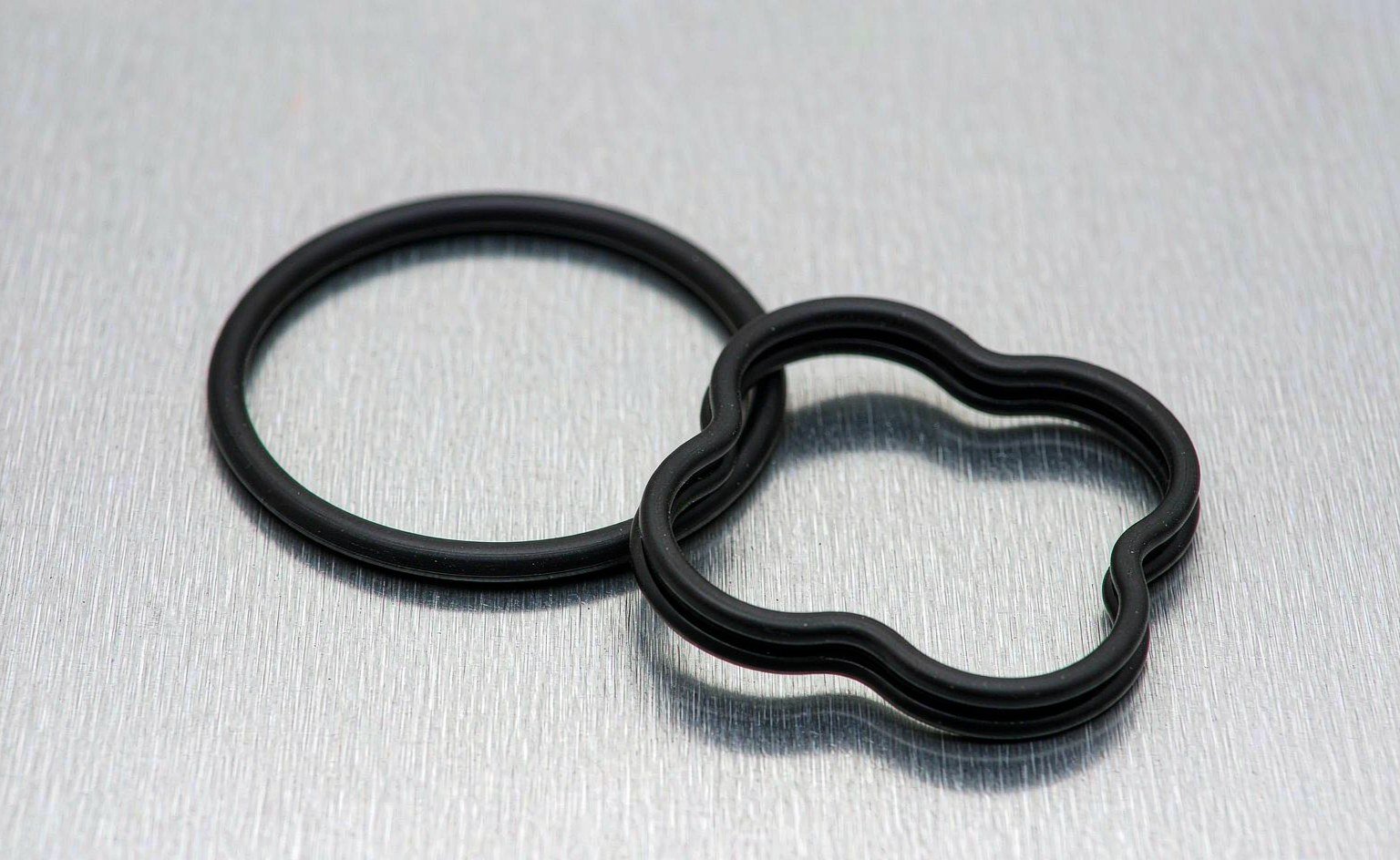
Two Profiles, One Job
An O-ring seals because diametral squeeze deforms its round cross-section against the gland walls, and system pressure adds to that contact stress rather than fighting it. Simple geometry, and the reason it dominates static sealing in every industry. An X-ring carries the same sealing principle but spreads it over a four-lobed cross-section: two sealing lines per side, with the parting line and mold flash located in the valleys between lobes — away from the contact bands. The valleys themselves do a second job: they hold lubricant against the sealing interface, which is why an X-ring survives dry start-ups and long storage in a cylinder better than a round section of the same compound.
Because both profiles seal by squeeze in the same style of rectangular gland, X-rings are broadly drop-in candidates for O-ring grooves — with one caveat on dynamic groove depth that we cover below.
Where the Numbers Move: Squeeze, Friction and Lubrication
The published manufacturer data converges on three measurable differences. First, compression force: X-ring geometries reach an effective seal at roughly 30–50% lower compression force than the equivalent O-ring, which directly reduces breakaway friction. Second, contact area: four narrow lip bands replace one continuous contact arc, so less rubber rubs on the moving surface on every stroke. Third, lubrication: the lobe valleys retain grease and oil at the interface, blunting the stick-slip behavior that plagues slow-moving pneumatic cylinders.
| Property | O-ring | X-ring | Practical effect |
|---|---|---|---|
| Sealing lines | 1 per side | 2 per side | Redundant contact; steadier low-pressure sealing |
| Compression force for equal seal | Baseline | ~30–50% lower | Lower breakaway friction, less heat |
| Twist / spiral resistance | Poor in reciprocation | High — lobes lock the section | The main reason to convert |
| Lubrication at interface | Squeezed out of contact | Retained in lobe valleys | Less stick-slip, longer dry-start survival |
| Parting line location | Can sit on sealing surface | Between lobes, off the seal path | No flash leak path across the contact band |
| Unit cost | Baseline | ~10–20% higher | The premium to justify per application |
The Failure O-Rings Own: Spiral Twist
Spiral failure is the signature O-ring death in reciprocating service: on the stroke out, friction drags part of the ring along the groove wall while the sealed side grips the rod; on the return stroke, the grip flips. Over thousands of cycles the ring rolls a fraction of a degree each stroke, winds itself into a helix, develops surface cracks at the twist point, and leaks — often within weeks on a long-stroke cylinder that was built correctly in every other respect. Back-up rings stop extrusion, not twist; reducing squeeze helps friction but undermines the seal. The four-lobed section attacks the mechanism itself: the lobes resist rolling geometrically, so the ring stays oriented for the life of the cylinder.
If your maintenance history shows O-rings replaced at short, inconsistent intervals on rod glands — with cracking across the diameter at roughly 45° to the section — that is spiral failure, and that is the account where the X profile pays for itself in the first year.
A field pattern worth naming: telescopic boom cylinders on mobile equipment. Long strokes, side loading at partial extension, and glands that are only serviceable with the boom stripped — the worst possible combination of spiral risk and access cost. A cylinder shop we supply tracked its reseal returns on a crane fleet for two seasons: standard 70 Shore A NBR O-rings in the stage-two and stage-three rod glands were coming back at four to nine months, almost all with the diagonal crack signature. The conversion to NBR X-rings in the same grooves, with the squeeze verified per the X-ring table, moved the median reseal interval past two years. The cylinders did not get gentler; the profile stopped the twist mechanism that had been setting the service life.
Where the O-Ring Still Wins
Run the reverse audit honestly. Static flanges, end caps and fittings see no reciprocation, so twist resistance buys nothing there — and O-rings are cheaper, stocked in every size on three continents, and available in every compound from NBR to FFKM. Low-pressure pneumatic duties with short strokes rarely generate the friction pattern that starts spiraling. High-volume OEM assemblies count pennies, and a 10–20% premium across millions of units needs a failure to justify it. Availability matters more than buyers admit: an X-ring in a specialty compound can carry a factory lead time that an off-the-shelf O-ring does not, and that difference alone disqualifies the upgrade on MRO accounts where downtime tolerance is measured in hours.
Compound chemistry is identical between the two profiles — an FKM X-ring handles the same media as an FKM O-ring, and material data from industry bodies and elastomer suppliers such as Zeon applies unchanged. The choice is geometry-driven, not material-driven.
Stocking depth is the second quiet advantage of staying with O-rings on static work. Every distributor on three continents carries the full dash-number range in five common compounds; X-ring coverage in specialty compounds — HNBR, low-temperature FKM, EPDM peroxide-cured — is thinner, and a single non-stocked size can turn a same-day repair into a factory-order wait. For MRO accounts, map your dynamic gland sizes to X-rings and stock those deliberately; leave the static tail of the size range on O-rings so no repair waits on a four-lobed ring that has no static job to justify the inventory.
Converting a Groove from O to X
Three checks make the conversion boring instead of eventful. First, groove depth: for dynamic glands, X-rings seal reliably at lower squeeze than O-rings, so an O-ring groove designed at the deep end of its tolerance band can leave an X-ring under-compressed — many manufacturers recommend a groove slightly deeper than the O-ring equivalent precisely because the section runs lower squeeze; verify the squeeze percentage against the X-ring maker’s table rather than assuming the O-ring numbers transfer. Second, diameter fit: cross-sections are sold to match standard O-ring cord sizes, so gland width is usually fine as-is. Third, installation: the X section is stiffer to load and the lobes can catch on sharp threads and port edges; the same lubrication and installation discipline as O-rings applies, with slightly more attention to orienting the ring rather than dragging it over edges.
On price, run the arithmetic that matters. If a standard O-ring costs one unit and fails twice a year on a machine that costs a production shift to access, a 20% premium X-ring that holds for three years is not a premium at all. If the seal is one of ten thousand static plugs assembled in a clean plant, the premium is pure cost. Purchasing comparisons across supplier catalogs — for example Eriks or Seal Sales — show the price gap is stable and small; the payoff difference is entirely application-driven.
| Scenario | Recommendation | Reasoning |
|---|---|---|
| Rod gland, long strokes, frequent cycling | Convert to X-ring | Spiral failure is the known killer here |
| Oscillating shafts, rotary valves | Convert to X-ring | Twist accumulates in partial rotations too |
| Static flange or fitting seal | Stay with O-ring | No motion, no benefit, lower cost |
| Short-stroke low-pressure pneumatic | O-ring unless stick-slip reported | Spiral risk low; friction benefit only matters if felt |
| Hydraulic piston groove with back-up rings | X-ring can delete the back-ups | Lobed section resists extrusion better at medium pressure |
For stockists and cylinder builders, both profiles ship from the same production line in our O-ring and X-ring range, and the rod and piston gland applications above map to our hydraulic rod and piston seal families. Where the X-ring upgrades a dynamic gland but the cylinder still needs a proper pressure-rated main seal, pair it with profiles from our piston seal range or pneumatic seal kits — the X-ring frequently replaces only the O-ring in the gland, not the engineered seal that does the pressure work. References on elastomer selection and dynamic seal practice from Hallite and Bal Seal cover the surrounding design questions in depth.
FAQ
Can an X-ring replace an O-ring in the same groove without changes?
Usually yes, especially in static and mixed glands, but verify squeeze against the X-ring manufacturer’s groove table for dynamic duty — the section expects lower squeeze, and an O-ring groove at its deepest tolerance can under-compress an X-ring.
Do X-rings handle higher pressure than O-rings?
Modestly. The lobed section resists extrusion and rolling better, and at medium pressures an X-ring can sometimes eliminate a back-up ring. At genuinely high pressure, a back-up ring or an engineered anti-extrusion profile still outperforms either plain ring.
Why does my O-ring keep failing at an angle across its cross-section?
That crack pattern is spiral (twist) failure — the ring wound itself up under reciprocating friction. Shorten the diagnosis: it is a dynamic gland problem, and the X profile is the standard fix.
Is the X-ring worth it for static seals?
No. Static glands gain nothing from twist resistance or lubricant valleys, and the 10–20% price premium buys no additional leak-tightness at proper squeeze.
Which compounds are available as X-rings?
The same range as O-rings: NBR, HNBR, FKM, EPDM, silicone and others. Material compatibility data carries over unchanged; only the geometry differs.
X-Profiles in the Compounds You Already Use
X-rings are molded in the same compound families as our O-rings — NBR, HNBR, FKM, EPDM, silicone and FFKM — so a groove can be converted or left alone without reopening the material specification. Both profiles are held in common sizes and molded to drawing where the section is non-standard.
The conversion question in this article is a groove question: an X-ring wants a slightly different groove width and a scrub-free installation path, and it buys nothing in a static gland where squeeze already does the work. We check the groove against the profile before quoting, and we will say when the O-ring is the better purchase.
Send the sizes, the compound and the groove dimensions to sales@bosssealing.com, and we will quote both profiles side by side with the price premium visible. Usually within a working day; the engineering review costs nothing, and the contact form works equally well.