
An O-ring rated to 230 °C costs about as much as a cup of coffee. It will hold pressure for a shift, sometimes for a month. Then it comes out of the groove flat, hard and square-edged, and the flange starts to weep at the bolts. Nothing about the nameplate temperature was wrong. The failure was the number of hours spent at that temperature, the fluid that was present, and the fact that nobody asked what the elastomer would look like after 4,000 of those hours.
Sealing above 200 °C is not a materials-shopping exercise. It is a heat-budget exercise with three variables: continuous temperature at the seal interface, dwell time at that temperature, and the chemical environment that accelerates or blocks oxidation. Get those three right and the material shortlist writes itself. Get them wrong and FFKM will fail in the same six weeks as a $0.30 FKM ring.
This guide compares the four families that actually get used above 200 °C — FKM, FFKM, PTFE/PEEK and graphite or metal — with the numbers that separate them, the hardware changes each one demands, and the workflow we use when a customer sends a hot-application RFQ to our plant in Foshan.
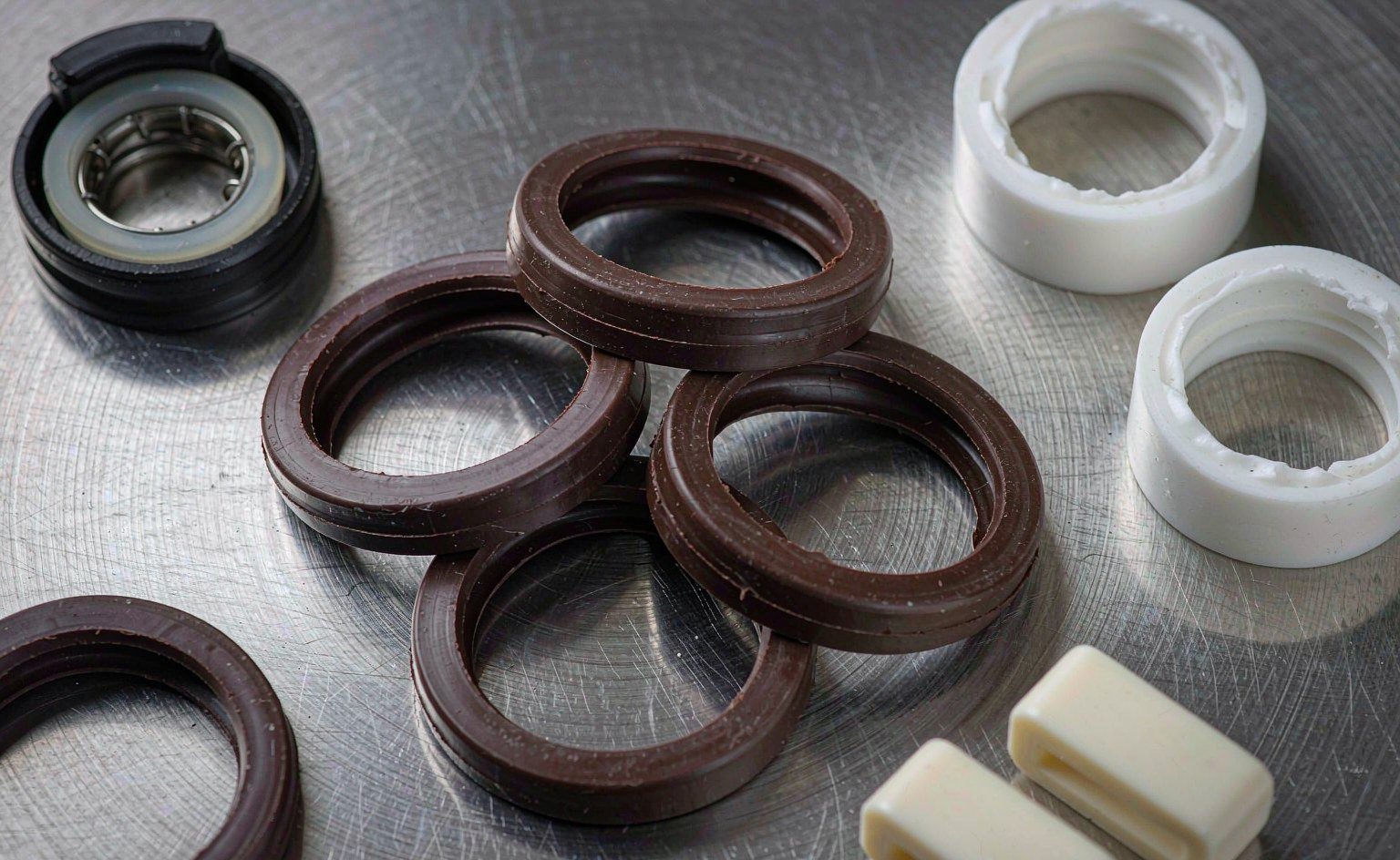
What 200 °C Actually Does to a Seal
Polymers do not melt at 200 °C. What happens is slower and more expensive. Four mechanisms run at the same time, and the one that finishes first sets your maintenance interval.
Oxidation and crosslink hardening. Oxygen attacks the polymer backbone and adds crosslinks. The rubber gets harder, loses elongation at break, and stops following the groove as pressure cycles. A 70 Shore A compound measured at 85 Shore A after aging still looks like a seal and no longer behaves like one.
Compression set. The seal is deformed by design — usually 15 to 25 percent of its cross-section. Heat lets the polymer chains relax out of that deformation permanently. Once set exceeds roughly 40 percent, contact pressure at the sealing line drops below the fluid pressure it is supposed to hold back, and leakage starts without any visible damage.
Dehydrofluorination. Specific to fluorocarbon. Above about 150 °C in steam, hot water or strong bases, FKM loses hydrogen fluoride from the chain. The surface hardens and blisters, and the attack moves inward. This is the reason a seal that works at 200 °C in dry oil fails at 160 °C in saturated steam.
Modulus loss and extrusion. Heat softens the compound. At 200 °C a 75 Shore A FKM ring has perhaps half the compressive modulus it has at 23 °C. The same pressure and the same gap that were safe when cold now push material into the clearance. Once a nib of rubber is sheared off, the seal is finished.
Four Systems That Actually Run at 200 °C
Heat in sealing applications comes from four sources, and each one has a different signature. Knowing which one you have narrows the material choice before you open a datasheet.
Compression and friction. Air compressors, hydraulic power packs and gearboxes heat the oil, and the oil heats the seal. Discharge-side seals in a reciprocating compressor see 180 to 220 °C routinely, with oil present. FKM handles this well as long as the oil is mineral or PAO based and water content stays low.
Process heat conducted through metal. A flange on a 220 °C reactor, a valve bonnet on a steam header, a heat-exchanger channel cover. Here the seal is at metal temperature and the fluid may be benign — often the case in food, pharma and chemical skids. Conduction is steady and predictable, so the continuous rating is the right design number.
Electric heat and radiant load. Heated platens, extruder barrels, dispensing valves with cartridge heaters, semiconductor chamber doors. These run 180 to 250 °C at the seal with almost no fluid cooling. The failure mode is dry oxidation: hardening and cracking rather than swelling, and often a hot spot on one side of the ring because the heater is not concentric.
Engine and exhaust. Turbocharger oil feeds, EGR circuits, exhaust-adjacent gaskets. Peaks of 250 to 300 °C are normal, and the seal sees thermal cycling rather than steady state. Thermal cycling is more damaging than steady heat, because each cycle re-extrudes the seal into the gap and re-compresses it cold.
First, Measure the Temperature You Really Have
Most hot-application failures we investigate start with a wrong number in the RFQ. Three habits fix that.
Put the thermocouple at the seal, not on the housing. A probe on the outside of a bearing housing or cylinder head reads 40 to 80 °C below the sealing interface in steady state, because the heat path runs through the seal first.
Record the soak-back peak. When a pump, compressor or heat exchanger stops, coolant and process flow stop with it, but the metal mass keeps dumping heat into the seal. Soak-back temperatures of 30 to 60 °C above operating temperature are normal, and they can last for hours. If the seal sees 205 °C running and 250 °C for two hours after every shutdown, the material has to survive 250 °C, not 205 °C.
Log the start-up ramp. A seal at 25 °C pressed against a flange that reaches 200 °C in four minutes sees the flange expand before the seal does. That differential is where nibbling and groove wear begin.
The Four Families, With Numbers
The table below gives practical continuous limits in dry air or inert gas, plus short-term peaks. Steam, hot oil with high aniline point, amines and oxidizers all pull these numbers down. Treat the continuous column as the design target and the peak column as an event you can survive a few times, not a shift pattern.
| Материал | Continuous max | Short peak | Low limit | Elastic recovery | Cost index |
|---|---|---|---|---|---|
| HNBR | 150 °C | 175 °C | -40 °C | Хорошо | 1.5× |
| VMQ silicone | 200 °C | 230 °C | -60 °C | Good, low strength | 2× |
| FKM (стандартный) | 200 °C | 230 °C | -20 °C | Хорошо | 3× |
| FEPM (AFLAS type) | 200 °C | 230 °C | -5 °C | Удовлетворительно | 6× |
| FFKM | 260–325 °C | 300–350 °C | -15 °C | Хорошо | 40–80× |
| PTFE, virgin and filled | 260 °C | 280 °C | -200 °C | None without spring | 1–1.5× |
| PEEK | 250 °C | 300 °C | -60 °C | None | 8–12× |
| Flexible graphite | 450 °C in air | Higher in inert gas | -200 °C | None | 2× |
Cost index is relative to a standard NBR O-ring of the same size, based on our own quotation history for production volumes. It is an order-of-magnitude guide, not a price list.
Read the table as a ladder, not a menu. Each rung buys roughly 30 to 60 °C of continuous service and costs three to ten times more than the rung below. The engineering question is never “what is the best material” but “what is the cheapest material that survives the whole duty cycle”.
Compression Set Decides, Not Datasheet Temperature
Every compound datasheet carries a temperature rating and a compression set figure. Buyers read the first and ignore the second. The second is the one that predicts leaks.
Compression set is measured by ASTM D395 Method B (or ISO 815): a specimen is compressed 25 percent, held at temperature for a fixed time — 22 hours or 70 hours are common — released, allowed to recover for 30 minutes, and measured. The result is the percentage of the original deflection that did not come back.
| Материал | 70 h at 150 °C | 70 h at 200 °C | 70 h at 230 °C | Примечания |
|---|---|---|---|---|
| NBR 70 | 25–35% | Not rated | — | Hardens fast above 120 °C |
| HNBR 70 | 20–30% | 40–55% | — | Peroxide-cured grades hold longer |
| FKM 75, bisphenol cure | 15–25% | 30–45% | 45–60% | Standard workhorse |
| FKM 75, peroxide cure | 12–20% | 25–35% | 35–50% | Better in steam and bases |
| FFKM 75 | 10–18% | 15–25% | 20–35% | Grade-dependent, verify report |
| VMQ 70 | 15–25% | 25–40% | 40–60% | Low strength limits use |
Ranges compiled from published compound datasheets. Ask your supplier for the test report on the actual batch, not the family typical. A 10-point spread on this table is the difference between a two-year seal and a six-month seal.
Two rules follow. First, if the application sits at 200 °C continuously, standard FKM with 35 percent set at that temperature gives you a seal that will creep toward failure within a year or two; a peroxide-cured grade or FFKM buys years. Second, if the application touches 230 °C for 10 percent of its running time, the aging that matters happens during that 10 percent, and it happens at an accelerated rate — roughly doubling for every 10 °C above the rated continuous limit.
FKM at 200 °C: Which Grade, and Where It Stops
Standard FKM — the A-type bisphenol-cured compounds that make up most of the market — is the correct answer for dry air, hydraulic oil, diesel, lubricating grease and most mineral oils at 200 °C continuous. It is the wrong answer in three situations that show up constantly:
- Steam and hot water above 150 °C. Dehydrofluorination sets in. Switch to a peroxide-cured FKM for marginal cases, FEPM (AFLAS type) or EPDM for real steam service.
- Amines, ammonia and many alkaline cleaners. FKM swells and softens. FFKM or PTFE.
- Cold start below -20 °C combined with 200 °C service. Standard FKM has a glass transition around -18 to -20 °C and will crack on a cold start. Low-temperature grades extend this to about -40 °C, but usually at the cost of some high-temperature set resistance.
Peroxide-cured FKM is worth the 10 to 20 percent premium in any hot application that also sees water, coolant, or CIP chemicals. Bisphenol cure is attacked by the base in many alkaline wash cycles; peroxide cure is not. If your line is cleaned with caustic at 80 °C every night, that difference decides the seal life, not the 200 °C rating.
FFKM: What the Extra 60 °C Costs
Perfluoroelastomer replaces every hydrogen on the polymer backbone with fluorine. That single change pushes continuous service to 260–325 °C depending on grade, and it makes the material resistant to nearly everything except molten alkali metals and elemental fluorine at temperature.
It also changes the design rules. FFKM has lower tensile strength and lower tear resistance than FKM, so it is less forgiving of sharp groove edges and more prone to nibbling during installation. It has a higher coefficient of thermal expansion, which matters on large diameters. And in high-pressure gas service — hydrogen, nitrogen, CO2, natural gas — it is susceptible to rapid gas decompression damage: gas dissolves into the polymer at pressure, then expands explosively when pressure drops, blistering the seal from the inside. The fix is a decompression-resistant grade with 90 Shore A hardness and a defined depressurization rate, not a standard FFKM ring.
At 40 to 80 times the cost of NBR, FFKM earns its place in exactly three cases: the temperature is above 230 °C continuously, the chemistry destroys FKM (amines, strong bases, ketones, hot acids), or the seal is inaccessible and the downtime cost dwarfs the part cost. If none of those three is true, FFKM is an expensive way to hide a design problem.
PTFE and PEEK: No Elastic Recovery, So Design Around It
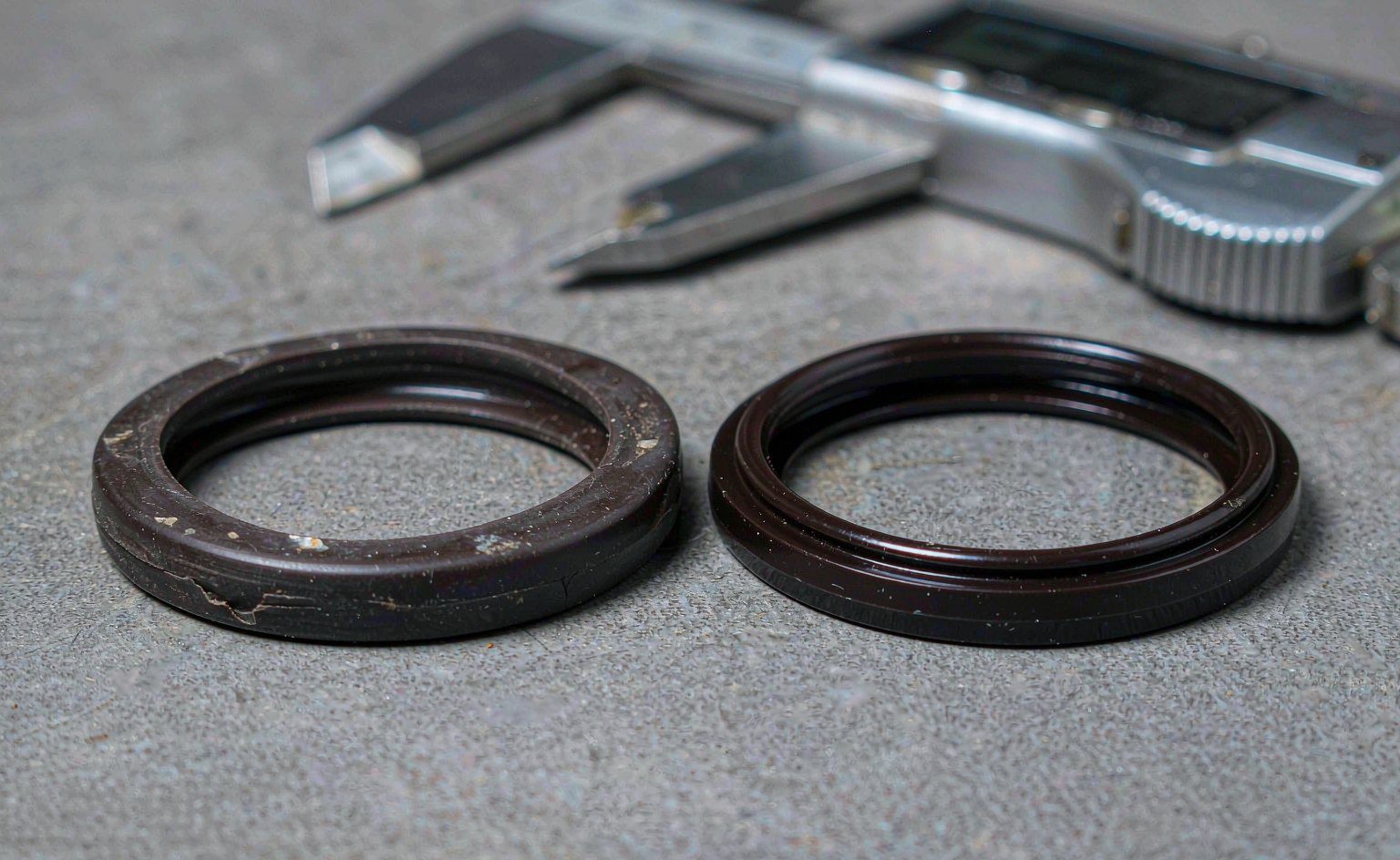
Both materials hold their properties to 250–260 °C and resist nearly every fluid. Neither behaves like rubber. PTFE creeps under load and has essentially no elastic memory, so a plain PTFE ring in a groove will leak as soon as pressure drops. The standard solution is a spring-energized design: a canted coil, helical or cantilever spring inside a PTFE jacket supplies the permanent load that the polymer cannot.
PEEK is machined, not molded, which makes it ideal for backup rings, guide elements, lantern rings and wear parts at 250 °C where an elastomer would extrude. It is also used as the seat material in high-temperature check valves. What it will not do is seal dynamically on its own at low pressure — it has no recovery, so contact pressure has to come from somewhere else.
Above 200 °C, the most common combination we ship is an FKM or FFKM O-ring with PEEK backup rings on both sides. The elastomer provides the seal; the PEEK stops the softened elastomer from extruding into the gap. At 200 °C and 20 MPa, a 75 Shore A ring without backup will fail by extrusion in hours. Our backup ring range covers PEEK, filled PTFE and POM in the standard section sizes, and the spring-energized range covers the cases where the PTFE jacket has to carry the seal on its own.
Above 300 °C: Graphite, Metal and Ceramic
Once the requirement passes 300 °C, elastomers leave the conversation. Flexible graphite packing and gaskets handle 450 °C in air and far more in inert gas or under compression, and they are the standard answer for valve stem packing and high-temperature flanges. Metal C-rings, O-rings and E-rings in 316L, Inconel or Monel take over where pressure, thermal cycling and permeation all matter at once.
These seals move the difficulty from material to hardware. Metal seals need high and stable bolt load, very flat flanges, and a surface finish measured in Ra 0.4 µm or better. They do not tolerate thermal cycling well unless the flange and bolt materials are matched, and they need a defined crush or springback allowance. Graphite needs compression retention and oxidation protection; in an oxidizing atmosphere above 450 °C it simply burns away.
Hardware Rules for Hot Joints
Half of the high-temperature failures we see are hardware problems wearing a material costume. These four rules cover most of them.
| Параметр | Rule at 200 °C | Почему это важно |
|---|---|---|
| Extrusion gap | 0.15 mm max for 75 Shore A without backup; 0.25 mm with PEEK backup | Modulus at temperature is roughly half the room-temperature value |
| Groove surface finish | Ra 0.8 µm or better on sealing faces; no axial scratches | Hot rubber is softer and conforms into scratches, then tears on release |
| Groove fill | Keep O-ring cross-section area below 85% of groove area | Thermal expansion of the elastomer has nowhere to go at higher fill |
| Flange and bolt material | Match expansion coefficients within about 15% | Differential growth at 200 °C opens the joint faster than the seal can follow |
Add two installation rules. Heat the seal, not the groove, when fitting above 150 °C — a warm seal is more compliant and less likely to be cut by the groove edge. And never reuse a seal that has been at temperature: compression set is permanent, and a used ring has already spent part of its life.
A Selection Workflow That Survives Audit
This is the sequence we run on incoming RFQs for hot applications. It takes about 30 minutes when the customer has the data, and it prevents most of the expensive mistakes.
- Fix the temperature triple. Continuous, peak and soak-back, each with duration. Write them on the drawing, not in an email.
- Identify the fluid at the seal, not in the tank. Additives, water content and aeration change compatibility. A hot oil with 0.5% water is a different environment from dry oil.
- Set the pressure and gap. Calculate the maximum extrusion gap at operating temperature, including tolerance stack-up and thermal growth.
- Pick the lowest rung that clears all three. Start at FKM, move to FFKM only for temperature above 230 °C or chemistry that rules FKM out.
- Add backup rings or a guide element if the gap calculation is close, if pressure exceeds 20 MPa, or if the seal is dynamic.
- Define the acceptance test. Compression set after 70 h at the continuous temperature, hardness change, and a 24-hour fluid immersion with volume swell recorded. Put the limits on the purchase order.
- Ask for the batch report. Compound batch, cure date, post-cure cycle and test data. Without it you cannot tell a good batch from a lucky one.
What We See on the Production Floor
Our ovens run air-circulating aging tests at 200 °C and 230 °C for customer batches, and the pattern is consistent: the parts that fail early are almost never the ones with the wrong polymer. They are the ones where post-cure was shortened to meet a ship date. Post-cure — the second bake that drives off volatiles and completes crosslinking — is what makes an FKM part hold 30 percent set instead of 50 percent. Skipping four hours of it to save a day of lead time costs the customer a year of service life.
The second pattern is dimensional. A high-temperature seal is specified at 23 °C and installed at 200 °C, and the drawing often carries only the room-temperature tolerance. Ask for the thermal expansion allowance on the diameter. On a 200 mm ring, FKM grows several millimeters in free diameter between 23 °C and 200 °C — an order of magnitude more than the steel around it — and if the groove has no room for that growth, the seal either buckles or extrudes.
The third is documentation. For hot service, buyers should insist on the compound batch record and the aging test report with the shipment. It costs nothing at the factory and it settles arguments at the plant two years later.
Главный вывод
Above 200 °C, the material choice narrows quickly: FKM to 200 °C continuous in dry oil or air, FFKM from 230 °C up or where the chemistry attacks FKM, and PTFE, PEEK, graphite or metal once the temperature passes 260 °C or the fluid defeats every elastomer. That part is simple.
The part that decides whether the seal lasts is the duty cycle: how many hours at the continuous temperature, how hot the soak-back gets, and how much gap the softened compound has to cross. A standard FKM ring with correct backup, a 0.15 mm gap and a real compression set limit will outperform an FFKM ring jammed into a groove designed for room temperature.
Send us the temperature triple, the fluid and the gap, and we will tell you which rung of the ladder you need — and which one you can stop paying for. Browse the ассортимент уплотнений для высоких и низких температур for the standard profiles, or look at machined PEEK and PTFE components if the answer is a backup ring rather than an elastomer.
For the material science behind the ratings, Trelleborg publishes a useful overview of seal materials and their application limits, and ASTM D2000 remains the line-callout standard most US drawings still reference. Compression set test details are in ASTM D395. For perfluoroelastomer base polymer data, Zeon publishes grade-level temperature and chemical tables. A distributor view of the same trade-offs, written for maintenance engineers rather than designers, is at Darcoid.