
Every seal distributor hears the same purchasing question: why does this O-ring cost five times that one when they look identical? The answer is fluorine. FKM (sold under trademarks like Viton) is built from fluorinated monomers that cost several times more than the butadiene-based chemistry behind nitrile rubber, and that raw-material gap flows straight through compounding, molding and the final quote. The engineering question is whether that premium buys anything for your application — and the honest answer is that in maybe half the O-ring positions on a typical machine, it buys nothing at all.
This article puts numbers around the decision: where compound prices actually sit, what the premium buys in temperature and chemical resistance, the four failure modes that flip the economics, and a worked break-even example you can adapt to your own part costs and teardown costs.
The Price Gap in Plain Numbers
Published compound and market data puts the two families in clearly separated price bands. Industrial-grade nitrile compounds trade roughly in the USD 8–28 per kilogram range depending on grade, fillers and certification overhead, while FKM compounds sit at roughly USD 45–95 per kilogram for the mainstream grades. Different market reports land on slightly different windows — commodity NBR nearer the bottom of the range, oil-and-gas or pharma-specified compounds nearer the top — but the ratio is stable across sources: FKM compound costs roughly 4 to 5 times what NBR costs, per kilogram.
Two things follow from that ratio. First, the raw-material gap dominates the price of a small molded part — an O-ring or a washer — almost entirely, so a finished FKM part reliably prices at a multiple, not a percentage, above its NBR twin. Second, the ratio compresses for large, labor-heavy or custom-machined parts where processing cost dilutes the material share of the quote. That is why a custom-molded FKM gasket can cost “only” twice its NBR equivalent while a stock O-ring costs 4–5 times as much.
| 컴파운드 | Published compound price range (USD/kg) | Typical finished-part cost ratio (NBR = 1.0) | Continuous temperature window |
|---|---|---|---|
| NBR (nitrile / Buna-N) | ~8–28 | 1.0× | approx. -30/-40 °C to +100/+120 °C |
| FKM (fluoroelastomer, e.g. Viton) | ~45–95 | ~4–5× (stock small parts) | approx. -20 °C to +200/+205 °C (special grades lower) |
Price sources move with the fluoropolymer market — fluoroelastomer raw materials have seen swings of 15–30% over recent years tied to monomer capacity — so treat the table as a structural picture of the gap, not a live quote. What does not move is the engineering side of the ledger below.
What the Extra Money Buys
The premium is not for prestige; it buys specific resistance envelopes that NBR physically cannot reach.
Temperature. Standard NBR compounds serve continuously to about +100 °C, with premium grades reaching +120 °C; above that, hot-air aging hardens the compound and the lip loses seal force within weeks to months. FKM serves continuously at +200 °C. In an engine bay near the exhaust, a steam line, a compressor discharge or any position where the hardware soaks above 120 °C, the decision makes itself — this material question runs through our earlier FKM 컴파운드 선택 가이드. Fluoroelastomer producers such as Zeon and seal manufacturers including Bal Seal 와 Trelleborg publish grade-by-grade temperature and chemical charts worth keeping on file.
Chemistry. NBR excels against petroleum oils, diesel and hydraulic fluids — that is its home turf. FKM adds resistance to aromatic fuels, hot engine oils, many solvents and aggressive additives, and it survives fluid formulations that attack NBR quickly, such as fuels blended with high aromatic content. The limits run the other way too, which buyers forget: standard FKM is poor in hot water, steam, and amine-based fluids, where a correctly chosen NBR (or EPDM) outlives it easily.
Aging in air. NBR is an unsaturated rubber; ozone and UV attack the carbon backbone and produce the familiar surface cracks. FKM’s saturated backbone simply does not crack this way. We documented the mechanism and its prevention in our article on ozone cracking in elastomer seals — any NBR part stored or running near electric motors, welders or outdoor exposure needs ozone protection or a different polymer.
| 속성 | NBR | FKM (Viton-type) |
|---|---|---|
| 연속 사용 온도 | ~+100/+120 °C max | ~+200/+205 °C |
| Low-temperature flexibility | Better (standard grades to -30/-40 °C) | Worse (standard grades ~-20 °C; special grades lower) |
| Petroleum oils and hydraulic fluids | 우수 | 우수 |
| Aromatic fuels and solvents | 불량~보통 | 우수 |
| Hot water and steam | 보통 | Poor (standard grades) |
| Ozone and weathering | Poor — cracks without protection | 우수 |
| Compression set at high temperature | Rises sharply above ~90 °C | Stays low through ~200 °C |
| Compound cost index | 1.0 | ~4–5 |
Where NBR Is Still the Right Answer
Half of specification work is knowing where the cheap material wins, and NBR’s win list is long. Indoor hydraulic power units running clean mineral oil below 90 °C: NBR 70/90 Shore O-rings last their full design life, and the FKM alternative is money spent on nothing. Water-glycol and HFA/HFB fire-resistant fluids: NBR handles them; standard FKM does not love the water content. Pneumatic cylinders with mineral-oil misting: NBR is the industry default for good reason — the same logic applies across our 고무 O-링 및 X-링 제품군. Static positions on machined castings that never see above 80 °C: NBR, always. And in rotary service, NBR lip oil seals remain the workhorse below 100 °C, which we cover alongside their FKM alternatives in our rotary shaft seal selection guide.
There is also a procurement argument beyond the unit price. NBR is stocked deeper by every distributor on earth, in more sizes, more hardnesses and more colors, with shorter lead times and no allocation cycles. When a production line needs 500 O-rings by Friday, the availability difference between the two families can outweigh the per-part price difference — an FKM part on backorder has an infinite unit cost. This is the same logic we laid out for distributors comparing NBR and EPDM O-rings: match the polymer to the failure risk, then buy the commodity material wherever the risk profile allows.
The Four Failures That Flip the Math
Four field mechanisms turn a 4–5× price premium into the cheapest line item on the bill of materials.
1. Temperature creep. Machines grow hotter over their service life — new guarding, higher duty cycles, summer ambient, a heater added next door. An NBR seal specified when the housing ran 85 °C meets 115 °C after a redesign, and hot-air aging does the rest: the lip hardens, flattens against the gland and leaks. Every teardown after that point is pure FKM-prevention cost.
2. Fuel and fluid reformulation. Fuel and hydraulic fluid formulations change under your machine without anyone updating the seal drawing. Higher aromatic content, new detergent packages, biodiesel blends — each reformulation quietly narrows NBR’s compatibility window. FKM grades ride through most of these changes; that insensitivity is a real part of what the premium buys.
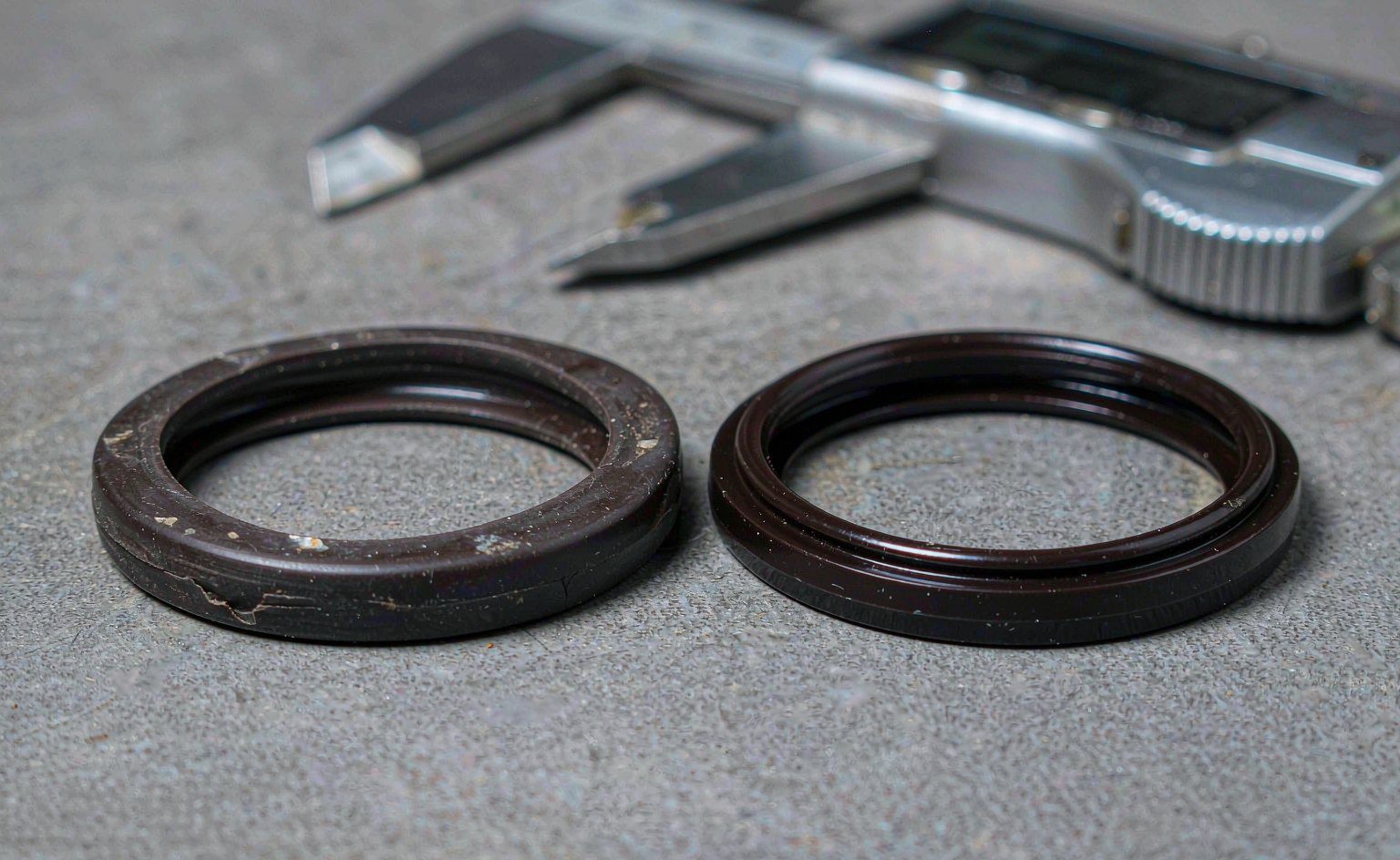
3. Ozone exposure. A warehouse O-ring cabinet next to a battery charger, a motor or a welding bench ozonates everything stored nearby. Cracked NBR seals fail within months in storage — a failure that happens before the part even earns its keep. The FKM equivalent waits out the same storage window unaffected; peer suppliers such as Apple Rubber 와 Darcoid list ozone resistance as a primary FKM selection reason in their material charts.
4. Compression set in hot static glands. A static O-ring in a flange at 110 °C is the classic NBR trap: the compound takes a set, the contact stress decays, and the joint weeps months to years later. Because the failure is slow and hidden, it surfaces as a warranty claim or an environmental leak rather than a maintenance line item — the most expensive way to discover an under-specified seal.
A Worked Break-Even Example
The numbers below are illustrative but the structure is exactly how we recommend customers run the comparison with their own costs. Assume a hydraulic manifold O-ring, 2,000 units consumed per year across a fleet, with the realistic cost of an unplanned teardown attached to each failure.
| 항목 | NBR option | FKM option |
|---|---|---|
| Unit price (assumed) | $0.50 | $2.25 (4.5×) |
| Annual consumption | 2,000 pcs | 2,000 pcs |
| Annual seal spend | $1,000 | $4,500 |
| Extra annual spend vs NBR | — | +$3,500 |
| Cost of one unplanned teardown (assumed: 4 h labor at $85/h, oil replacement, lost production) | ≈ $500+ | ≈ $500+ |
| Teardowns per year that FKM must prevent to break even | ≈ 7 failures/year | |
Read the last row carefully: the entire FKM premium pays for itself if switching prevents just seven teardowns a year across a 2,000-part fleet — roughly one prevented failure per 285 seal positions per year. In a fleet running anywhere near the FKM temperature or chemistry envelope, a failure rate that low is not a stretch; it is the normal outcome. Where the application stays comfortably inside NBR’s envelope, the same math shows the opposite: $3,500 a year spent preventing failures that were never going to happen.
The same structure scales to distributor inventory decisions. A shelf of FKM stock in sizes your customers use at temperature costs shelf money; the returns come back as the account whose NBR keeps failing in their hot positions — and as the trust that follows a distributor who switches a customer’s failing part to the right polymer instead of selling them the same failure twice.
The Decision in Three Lines
Line one: below about +100 °C, in petroleum oils, water-based fluids and clean indoor air, NBR wins on price and availability — buy it in volume and stop there.
Line two: the moment any position crosses ~120 °C continuously, meets aromatic fuels or solvents, or sits where ozone and weathering reach it, FKM is the cheaper part over its life despite the 4–5× sticker — run the break-even math with your own teardown cost and it will usually close the case within a page.
Line three: when the fluid itself is the enemy — hot water, steam, amines — neither polymer is the answer; step to EPDM, HNBR or PTFE-based solutions rather than forcing this comparison. The material choice is only a cost decision after the chemistry is settled.