
シールに注目が集まりますが、その隣にある摩耗部品がアセンブリの寿命を左右します。ガイドリング、ウェアバンド、バックアップリング、ブッシング、バルブシート、スクレーパーパッドは、隣接するエラストマーリップよりも先に摩耗で故障します。そして、これらの部品に選ぶ材料はシールの判断ではなく、プラスチックの判断です。8種類のエンジニアリングプラスチックで、産業機器のほぼすべての摩耗部品をカバーできます。本ガイドでは、実際のPV限界、温度上限、コスト係数でこれらを比較し、各材料をそれが優位に立つ部品にマッピングします。
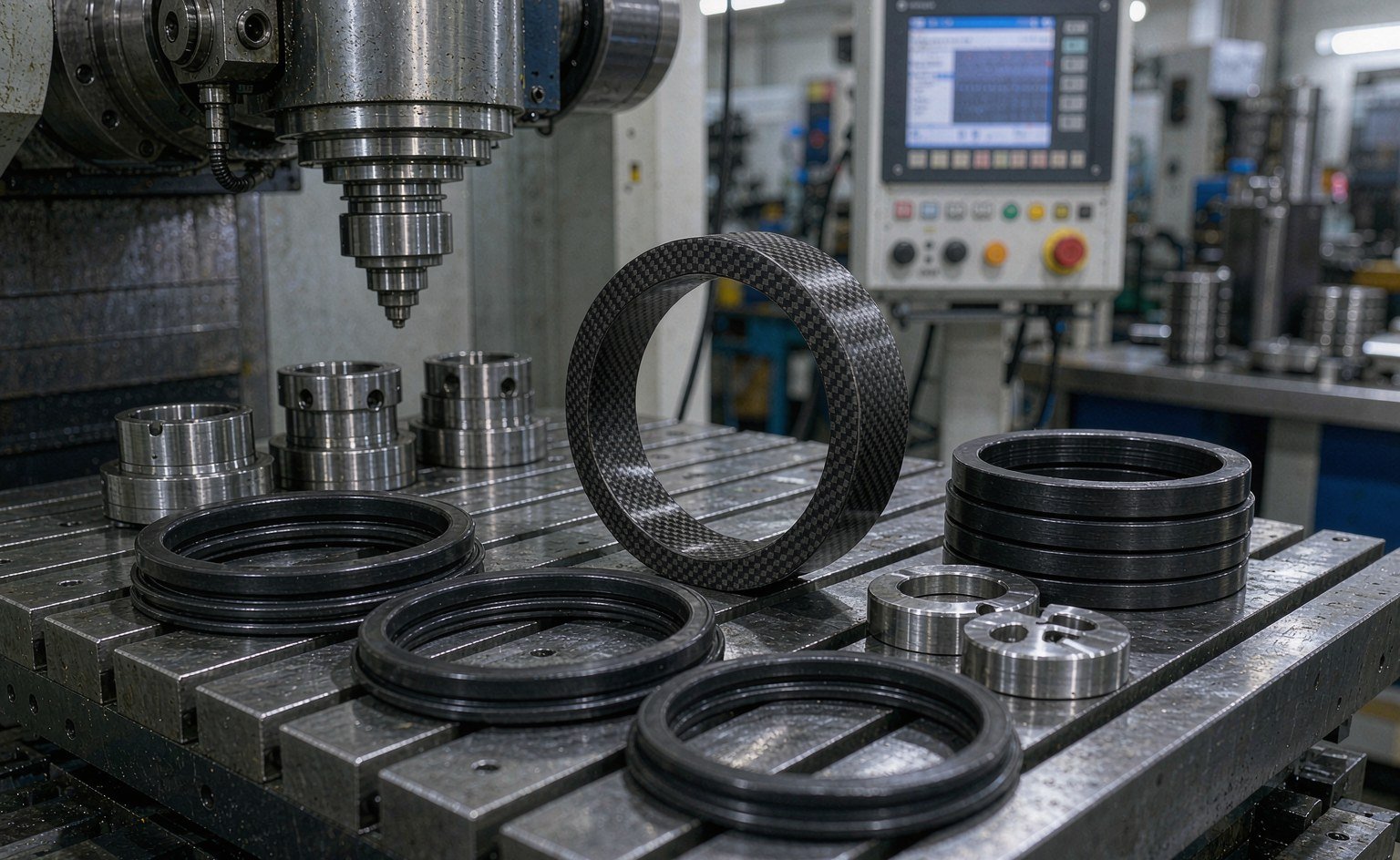
摩耗部品を支配する数値:PV
乾燥運転の軸受や摩耗面では、支配的なパラメータはPV限界です。これは軸受圧力(P)に摺動速度(V)を掛けた値で、これを超えると摩擦熱が材料の放熱能力を上回り、摩耗は徐々に進むものではなくなります。限界以下では、部品はゆっくりと予測可能な形で摩耗します。限界を超えると熱軟化が支配的になり、部品は数時間で故障します。
この定義から、実用的な3つのルールが導かれます。
- 限界の半分で設計する。 連続運転では公表されているPV限界の約50%に抑えるべきです。間欠運転では、サイクル間に冷却時間があれば75%まで許容できます。
- 温度はすべてを低下させます。 20°Cで約5,000 psi-fpmの定格を持つナイロンブッシングは、剛性の低下により80°Cでは1,500~2,000 psi-fpmしか保持できない場合があります。
- メーカーのデータは材料ファミリーのデータに勝る。 ファミリーレベルの数値(以下に示すもの)はスクリーニング用の数値です。あるサプライヤーの充填グレードは、ファミリー平均を大きく上回ることがあります。
8種類の材料を並べて比較
以下の数値は、業界で最も広く参照されている軸受グレード比較表の一つであるQuadrant Engineering Plastic Productsの設計・加工ガイドから引用しています。値は鋼に対する乾燥摺動のもので、潤滑環境では限界値が何倍にもなります。
| 材質 | 連続使用温度 | 限界PV(psi·fpm) | 摩耗係数 k | 動摩擦 | コスト係数 |
|---|---|---|---|---|---|
| UHMWPE | 82°C(180°F) | 2,000 | 11 | 0.12 | 0.5 |
| アセタール(POM-C/POM-H) | 82°C(180°F) | 2,700 | 200 | 0.25 | 1.2 |
| ナイロン PA6/PA66(未充填) | 93°C(200°F) | 2,700~3,000 | 75~100 | 0.20~0.25 | 1.0 |
| ナイロン+油/固体潤滑剤(NSMタイプ) | 93°C(200°F) | 15,000~17,000 | 12~26 | 0.14~0.18 | 1.4~1.5 |
| 充填PTFE(Fluorosintタイプ) | 260°C(500°F) | 8,000~20,000 | 30~600 | 0.10~0.15 | 12 |
| PPS(Techtronタイプ) | 221°C(430°F) | 8,750~25,000 | 62~800 | 0.20 | 18~22 |
| PEEK(未充填/充填/HPV) | 249°C(480°F) | 8,500~25,000 | 100~375 | 0.20~0.40 | 20~55 |
| PAI(Torlon/Duratronタイプ) | 260°C(500°F) | 22,500 | 10~45 | 0.20 | 28 |
この表から2つのことが際立ちます。第一に、内部潤滑ナイロン(油充填NSMクラス)はリスト中で最もPVのコストパフォーマンスに優れています。未充填ナイロンの5~6倍の限界PVを持ちながら、価格はPEEKの半分程度です。第二に、コストは性能に単調には比例しません。ナイロンの半分のコストであるUHMWPEは、PEEKでは高価すぎる過剰性能となる湿潤・研磨・低速の用途で、明確に優位に立ちます。
フィラー系がベースポリマーをどのように変化させるかをより詳しく知りたい場合は、以前のガイドで PEEKシール部品 シーリング用途におけるカーボン充填およびガラス充填PEEKグレードを特集しています。
材料を拘束条件に合わせる
摩耗部品の材料選定は、荷重、速度、温度、摩擦、環境のうち、どの制約が最初に効いてくるかを考えると容易になります。表の各列には明確な勝者がいます。
| 拘束条件 | 第一選択 | 勝つ理由 |
|---|---|---|
| 最高の乾燥荷重+速度(高PV) | PAI、次いで充填PEEK | 260°C連続でPV 22,500 psi·fpm |
| 高温+薬品曝露 | PPS、次いでPEEK | 221~249°Cの使用環境で幅広い耐薬品性 |
| 最低摩擦、乾燥運転 | 充填PTFE | μ 0.10~0.15、フィラーがPTFEのコールドフロー問題を解決 |
| 湿潤、汚れ、研磨性、低速 | UHMWPE | 最高の耐摩耗性、ほぼゼロの吸水率、最も低コスト |
| 精密+低コスト、中程度の負荷 | アセタール | 寸法安定性、良好な切削性、低吸水率 |
| 許容できる乾燥PVで最も低コスト | 内部潤滑ナイロン | コスト係数1.4で15,000+ psi·fpm |
| 極端な温度(300°C以上) | ポリイミド(PI) | 316°C連続、PI/PBIグレードでPV 37,500~40,000まで |

材料をシール隣接部品にマッピングする
8つの材料は、シール周辺の一般的な摩耗部品に驚くほど重複が少なく対応します。以下の割り当ては、現場サービスで実際に故障するものと、サプライヤーが標準形状として在庫しているものを反映しています。
| 摩耗部品 | 標準材料 | アップグレード経路 | 根拠 |
|---|---|---|---|
| 油圧ガイドリング/ウェアバンド | PTFE+青銅、またはフェノール織物 | 高側方荷重にはPEEK | クロムに対する低摩擦。荷重スパイクが軟質バンドを潰す場合はPEEK |
| 空気圧シリンダーベアリング | アセタールまたは充填ナイロン | 湿気がある場合はUHMWPE | 乾燥運転、低スティックスリップ、大量生産で低コスト |
| バックアップリング(耐押し出し) | PTFE、ナイロン、UHMWPE | 約40 MPa超または高温にはPEEK | グランドに傷を付けずに押し出しギャップを橋渡しする剛性 |
| バルブシートおよびボールガイド | 充填PTFE | 高圧差にはPAIまたはPEEK | シール適合性+耐摩耗性 |
| 回転シャフトベアリング(乾燥) | 潤滑充填ナイロン | 100°C超にはPEEK HPV/PAI | Internal lubricant carries the PV load without grease |
| Scraper / wiper wear pads (conveyors, buckets) | UHMWPE | Nylon where heat builds | Abrasion king at the lowest cost per part |
| Pump wear rings (chemical service) | PPS or PEEK | Carbon-filled PEEK for dry-start tolerance | Chemical resistance plus dimensional stability at temperature |
Note how rarely unfilled PEEK is the right answer despite its reputation. Filled and internally lubricated grades (the HPV/CA30 class) carry roughly three times the PV of virgin PEEK because the fillers interrupt the wear mechanism instead of letting adhesive wear run against a smooth polymer surface. The same logic applies to our guide ring and wear band selection guide, where the fill system decides the band’s load rating.
Machining, Moisture and the Details That Change the Answer
Three second-order effects regularly overturn a table-based selection:
Moisture swelling. Nylon absorbs 1.5–2.5% water in 24-hour immersion and keeps going over weeks; running clearances specified for dry nylon seize in wet service. Acetal and UHMWPE absorb almost nothing. If the part sees water, emulsion or washdown, nylon either gets a moisture-compensated clearance or loses the job.
Cold flow (creep). Unfilled PTFE creeps under sustained load — it is why neat PTFE bushings collapse and why filled grades exist. Any PTFE part under sustained compression needs filler content or a design that limits preload.
Surface finish of the counterface. Plastic bearings want a steel counterface around 0.2–0.4 μm Ra. Much rougher and the plastic abrades itself; much smoother and adhesive wear takes over because no micro-reservoirs of transfer film form. This mirrors the shaft-finish discipline for hydraulic seals — the counterface matters as much as the polymer.
Manufacturing route matters too, particularly for volumes. Standard stock shapes (rod, tube, sheet) machined on CNC cover prototypes and low-to-mid volumes economically; molded production parts win above thousands of pieces. The trade-offs are laid out in our molded vs machined comparison, and the same economics apply to wear parts as to seals.
Running Clearances and Thermal Growth
Plastic bushings run hotter and expand more than the steel around them. Typical thermal expansion coefficients run five to ten times that of steel — roughly 50–80 × 10⁻⁶/°C for most of these polymers versus about 12 for steel — so a clearance that works at ambient can close up at operating temperature. Standard practice for plastic plain bearings sets running clearance at 0.3–0.8% of shaft diameter to absorb thermal growth and moisture swelling together; tighter than that risks seizure, looser than that costs precision and edge loading.
Bushing proportions matter as much as clearance. A length-to-diameter ratio between roughly 0.8:1 and 1.5:1 keeps edge loading and frictional heat manageable: shorter than 0.8:1 and the bushing misaligns, longer than 1.5:1 and the ends carry disproportionate load as the shaft deflects. Wall thickness of 1.5–3 mm on small bores balances strength against heat transfer — plastic sheds frictional heat through the housing, so a chunky bushing insulates its own wear surface.
One more installation detail: plastics press-fit differently than bronze. Interference fits relax over time as the polymer creeps, so housings that rely on press-fit alone to locate a plastic bushing should pin or otherwise mechanically retain it. Every one of these rules trades against the PV table above — the material only delivers its rated wear life inside a geometry that keeps it cool and aligned.
Verifying Quality Before the First Production Run
Plastic wear parts are easy to specify and easy to get wrong in the supply chain. Virgin resin grades are straightforward; filled grades are where substitutions happen, because the filler system is invisible once the part is machined. Three checks that catch most problems:
- Material certification. Ask for a certificate of conformity naming the exact grade (not just “PEEK” — the difference between virgin 450G and a carbon-filled CA30 grade is three times the PV limit), plus filler percentage where applicable.
- Burn or density spot checks. Filled PTFE grades differ measurably in density with filler content; a quick density check against the datasheet flags a filled-vs-virgin substitution without a lab.
- First-article dimensional audit at temperature. For precision parts, measure a machined part after thermal cycling to the expected service temperature. Hidden residual stress from aggressive machining shows up as drift that only appears in service.
Suppliers differ more on wear parts than on seals because the material market has more entry-level players. When evaluating a new source, benchmark against the stock-shape majors’ published data — and treat any quoted PV figure materially above the family values in Table 1 with healthy suspicion until it comes with test conditions attached. For the semi-finished stock shapes most of these parts start from, see our engineering plastics product range.
よくある質問
Is PEEK always worth the premium over nylon or acetal?
No. PEEK earns its cost factor of 20–55 in high temperature, high PV or aggressive chemical service. A pneumatic bushing at 40°C and moderate load is a place where acetal or filled nylon does the same job for a tenth of the price. Buy PEEK where a constraint table says you must, not as insurance by default.
Can UHMWPE replace nylon everywhere it is cheaper?
Not quite. UHMWPE’s 82°C ceiling and its low stiffness exclude it from precision loaded parts and anything near hot oil. It wins on abrasion, wet environments and friction; it loses on stiffness, temperature and dimensional precision.
How do I verify a PV rating before committing a design?
Run the bearing pressure from your actual load and projected area, multiply by surface velocity, and keep continuous operation at or below half the published limit — then re-check at the maximum operating temperature, since PV limits derate sharply as material stiffness drops. For a worked method, the PV comparison reference at mechcodex walks through the screening calculation step by step.
Which material for a wear part that also has to seal?
Filled PTFE when chemical exposure or low friction dominates, PEEK when pressure differential or wear life dominates. The sealing function changes the question from pure wear to wear-plus-compression behavior, which favors the filled fluoropolymers and the stiffer high-performance polymers over commodity nylon.