
Ozone cracking looks like a molding defect and almost never is one. A black NBR O-ring that sat on a warehouse shelf for eighteen months, or a seal on a packaging machine door 300 mm from a brushed DC motor, comes back with a fine map of cracks running at right angles to the direction it was stretched. The compound was correct when it was pressed. The environment changed the chemistry.
What follows covers the mechanism, where ozone actually comes from in a plant, the compounds that survive it, the test that ends supplier arguments, and five fixes ordered by what they cost.
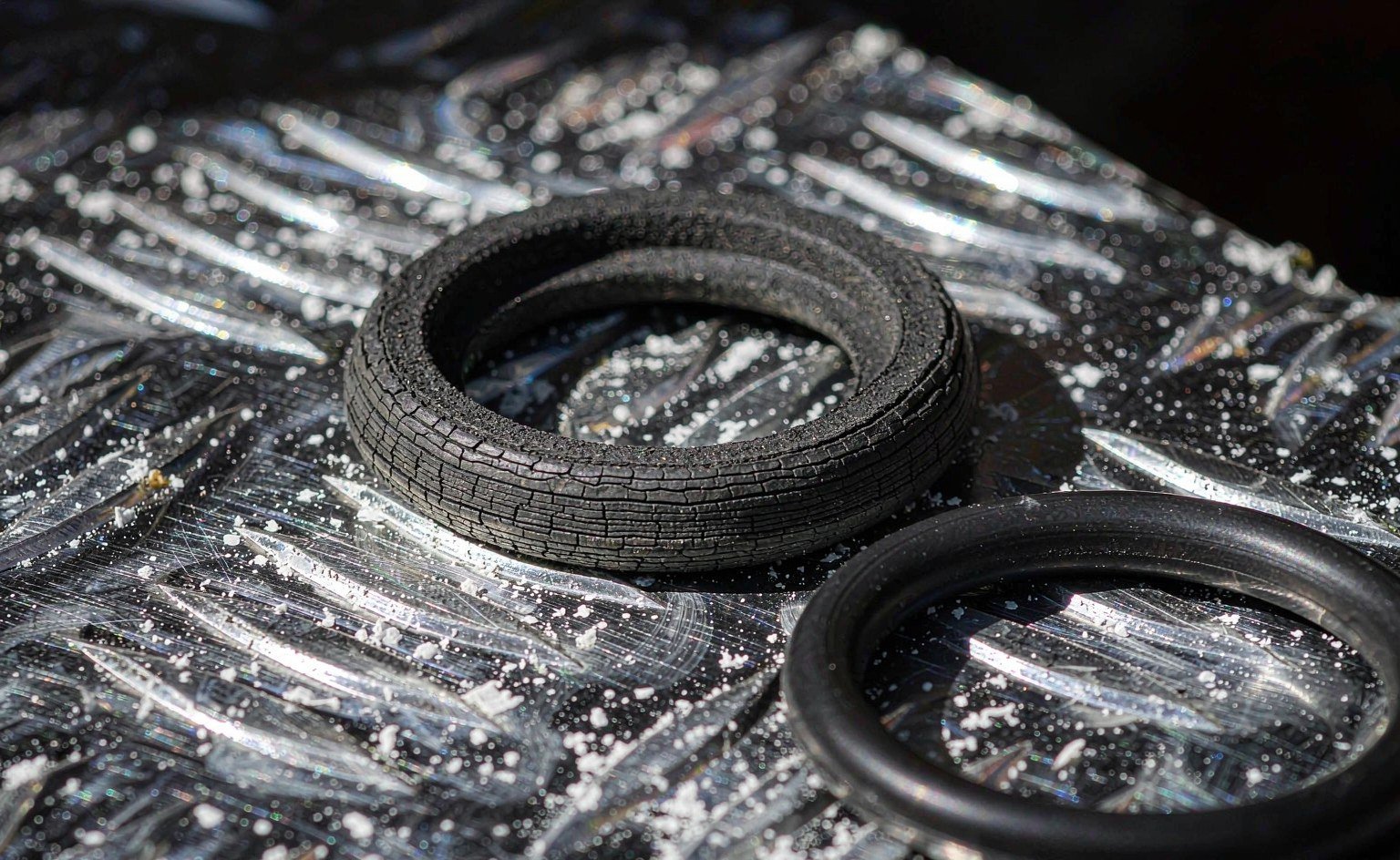
How Ozone Attacks a Stretched Elastomer
Ozone is a strong electrophile, and the carbon-carbon double bonds in unsaturated rubber are exactly what it looks for. The reaction adds across the double bond to form an unstable ozonide, which splits the polymer chain. That much happens at the surface within micrometres of depth.
The second condition is mechanical. Ozone attacks unsaturated rubber even when it is unstretched, but the severed chains stay tangled and nothing visible appears. Apply a few percent tensile strain and the cut chains pull apart into a microscopic fissure. The fissure tip concentrates stress, fresh polymer is exposed to more ozone, and the crack propagates through the section. Because the crack opens along the strain axis, the visible cracks always run perpendicular to the direction of stretch — that orientation is the field signature that separates ozone damage from heat or chemical attack.
Concentration matters less than people assume. Background ozone outdoors is roughly 1 to 10 pphm (parts per hundred million). The standard accelerated test runs at 50 pphm, and a general-purpose NBR held at 20% strain in that chamber shows visible cracks within weeks. A brushed motor, a laser printer, a UV curing lamp or an arc welder can push local concentration well above outdoor background in a small volume of air.
Where the Ozone Comes From on a Normal Shop Floor
Ozone forms wherever electrical discharge or short-wave ultraviolet light meets oxygen. The common sources on production equipment:
- Brushed DC motors and power tools. Brush arcing generates ozone continuously. The concentration falls quickly with distance, but a seal within a metre of an unenclosed motor sees far more than the ambient level.
- Laser printers and copiers. Corona wires in the charging stage are a steady low-level source inside the cabinet.
- UV curing lamps and germicidal lamps. 185 nm output generates ozone directly from air; the 254 nm germicidal line does it more slowly but over long duty cycles.
- Arc welding and plasma cutting. Strong local generation, usually transient and often near cylinder seals during maintenance work.
- Electrostatic precipitators, ionizing blowers and ozone water treatment. Deliberate ozone generation, sometimes only a partition away from rubber components.
The practical consequence is that a seal does not need to be outdoors to be at risk. We have seen NBR gland seals crack on indoor packaging equipment where the only unusual feature was a brushed motor and a closed cabinet that trapped the air around it.
Which Compounds Survive, and Which Only Look Like They Do
Saturated backbones have nothing for ozone to add to. EPDM, HNBR, FKM, silicone (VMQ) and FFKM all lack double bonds in the main chain, so they resist ozone structurally rather than through additives. Polychloroprene (CR) is partly saturated and lands in the middle. Natural rubber, SBR, NBR and most polyurethane grades are unsaturated and depend on protection packages.
| Compound | Main-chain double bonds | Ozone resistance | What it costs you |
|---|---|---|---|
| NR / SBR | Yes | Min | Cracks within weeks under strain; indoor only |
| NBR (nitril) | Yes | Min | Needs antiozonant + wax; not for exposed outdoor or motor-adjacent service |
| HNBR | Effectively none | Very good | 2–3× NBR price, keeps oil resistance to ~150 °C |
| CR (neoprene) | Partly | Middel | Better than NBR, still not a permanent outdoor answer |
| EPDM | None | Poardebêst | No mineral-oil resistance — 50%+ swell in ASTM Oil No. 1 |
| Silicone (VMQ) | None | Poardebêst | Low tear strength, poor dynamic oil service, permeable |
| FKM | None | Poardebêst | Highest material cost short of FFKM, limited low-temperature range |
| FFKM | None | Poardebêst | Chemical and thermal headroom at 10–20× NBR price |
| Cast polyurethane | Grade dependent | Limited to moderate | Excellent abrasion resistance, not a first choice for exposed outdoor seals |
Published ozone ratings from the major seal houses follow the same ranking — see the Trelleborg sealing materials data and the Hallite fluid power material tables. Two traps sit behind that table. First, antiozonant chemicals (6PPD, IPPD) and paraffin waxes work by migrating to the surface and forming a sacrificial or physical barrier. A sliding or wiping seal removes that film on every stroke, so the protection is gone in dynamic service — wax is a static-seal tool. Second, EPDM is the cheapest complete answer to ozone but the worst possible answer to mineral oil. Swapping a leaking hydraulic rod seal to EPDM to stop ozone cracking trades a surface crack for a swollen, extruding seal.
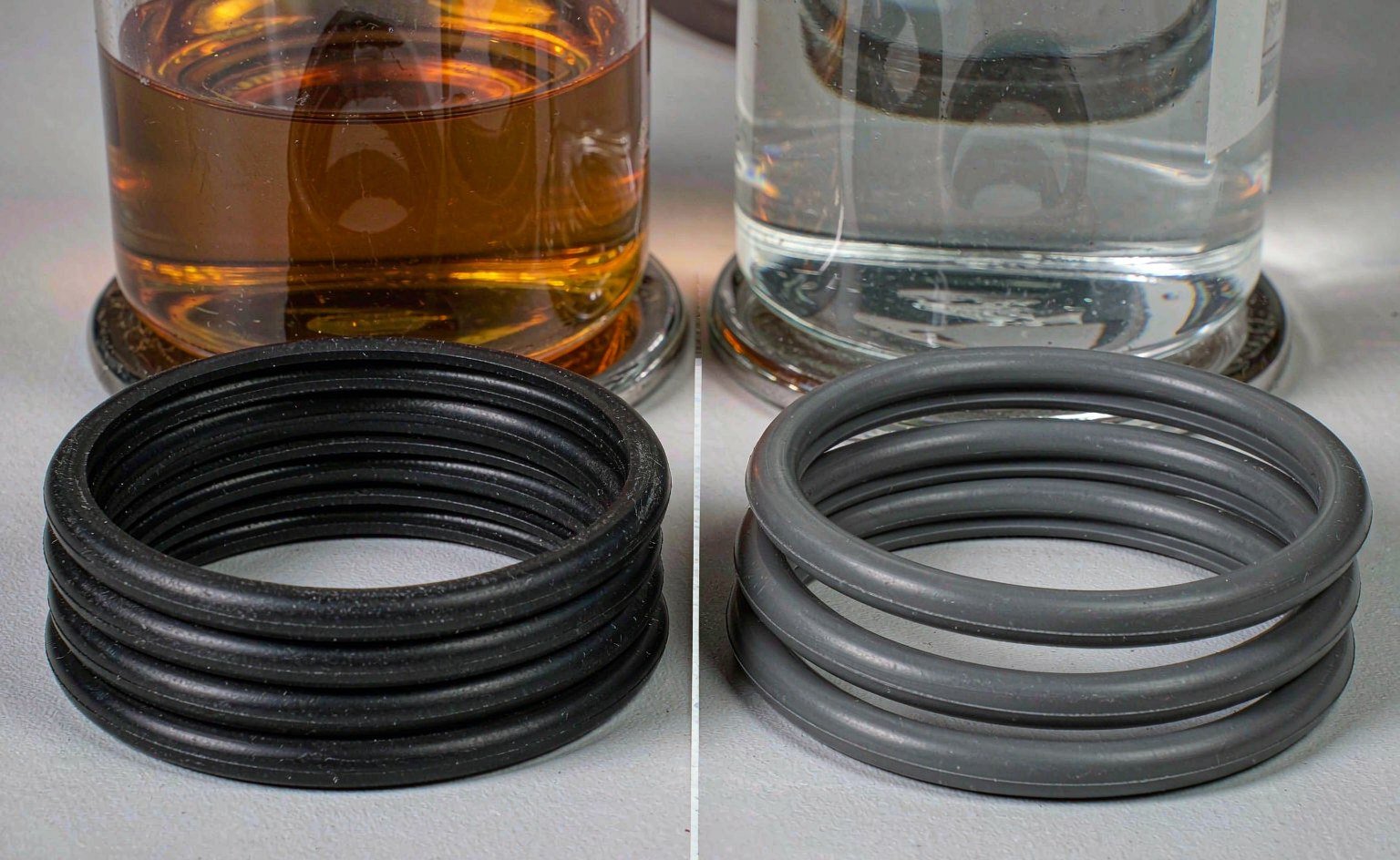
The Test That Ends the Argument
ASTM D1149 and ISO 1431-1 are the reference methods for ozone cracking in a controlled chamber. Both stretch the specimen to a fixed elongation, hold it at controlled temperature and ozone concentration, and inspect at intervals for the time to first crack and the final crack grade. The standard conditions are consistent enough that a purchase order can cite them directly.
| Parameter | Standard condition | Wêrom't it útmakket |
|---|---|---|
| Ozone concentration | 50 ± 5 pphm | Roughly 50× outdoor background — accelerates without changing the failure mode |
| Temperatuer | 40 °C | Keeps the reaction kinetics comparable between labs |
| Strain | 20% static elongation | Below ~5% strain, crack growth is negligible; 20% reproduces installed O-ring stretch |
| Duration | 72 h typical; 96 h and 168 h for tougher specs | Short runs hide slow-initiation compounds |
| Inspection | 2× magnification, 7× if fine cracking is suspected | Grade 0 at 2× is the common acceptance line |
| Referinsje | ASTM D1149 / ISO 1431-1; ISO 1431-3 for dynamic | Dynamic adds flexing and is significantly more severe |
The purchase order line we recommend is one sentence: ozone resistance — no cracks at 2× magnification after 72 h at 50 pphm, 40 °C, 20% strain, per ASTM D1149. It removes the conversation about whether a compound is “ozone resistant,” because the answer becomes a chamber report rather than a datasheet adjective.
One limit on the data: a chamber ranks compounds, it does not predict years of service. Outdoors, UV, heat, humidity and flexing act at the same time, and each one changes how fast a crack grows.
Five Fixes, Cheapest First
- Cut the strain. O-ring installation stretch should stay at or below 5% of ID for static seals and 2–3% for dynamic ones. A seal stretched 10% to fit a groove is pre-loaded for cracking before it ever sees ozone.
- Shield the seal or move the source. A sheet-metal partition between the motor and the seal costs less than a compound change and often solves the problem outright.
- Ventilate the enclosure. Trapped air concentrates ozone. A filtered intake and an exhaust fan in a cabinet drop the concentration by an order of magnitude in minutes.
- Replace the motor. Brushless DC eliminates the ozone source at the origin. It is the most expensive hardware fix and the most permanent one.
- Change the compound. EPDM for water, steam and outdoor air; HNBR where oil resistance has to stay; FKM where heat or chemicals are also present. Keep the antiozonant package as a second line, not the plan.
Storage and Warehouse Traps
ISO 2230 treats ozone as a storage hazard for a reason. Seals should sit in the dark at 5–25 °C and below 65% relative humidity, away from electric motors, mercury lamps and fluorescent fixtures with failed ballasts. An NBR pallet stored for two years beside a brushed motor can arrive at the assembly line already cracked, and the failure will be blamed on the press shop.
Goods-in inspection catches it in ten seconds: bend a sample O-ring 180° and look at the outer diameter under 2× magnification. Distributor references such as Marco Rubber en Apple Rubber publish the same handling cautions for stored stock. Cracks perpendicular to the bend radius mean the batch has been exposed. Our own shelf-life rules are set out in the ISO 2230 storage guide.
When It Is Not Ozone
Half the “ozone” failures we are asked to analyze are something else with a similar appearance. The differential comes down to crack orientation, surface condition and where the damage starts.
| Failure mode | Crack pattern | Other evidence |
|---|---|---|
| Ozone | Fine, uniform, perpendicular to strain, surface-initiated | Seal was stretched or exposed to a motor/UV source; no swelling |
| UV / weathering | Fine crazing plus chalking | Colour fade, chalky residue, one side facing a window or lamp |
| Heat aging | Random cracks, hard and brittle feel | High compression set, loss of elongation, darkened surface |
| Chemical attack | Softening, blistering or sticky surface | Volume swell, weight gain, fluid residue in the groove |
| Skea by ynstallaasje | One deep cut or nick, no network | Damage at a single clock position, tool marks nearby |
| Extrusion | Nibbled or sheared edge at the gap | Backup ring missing or damaged, pressure spike history |
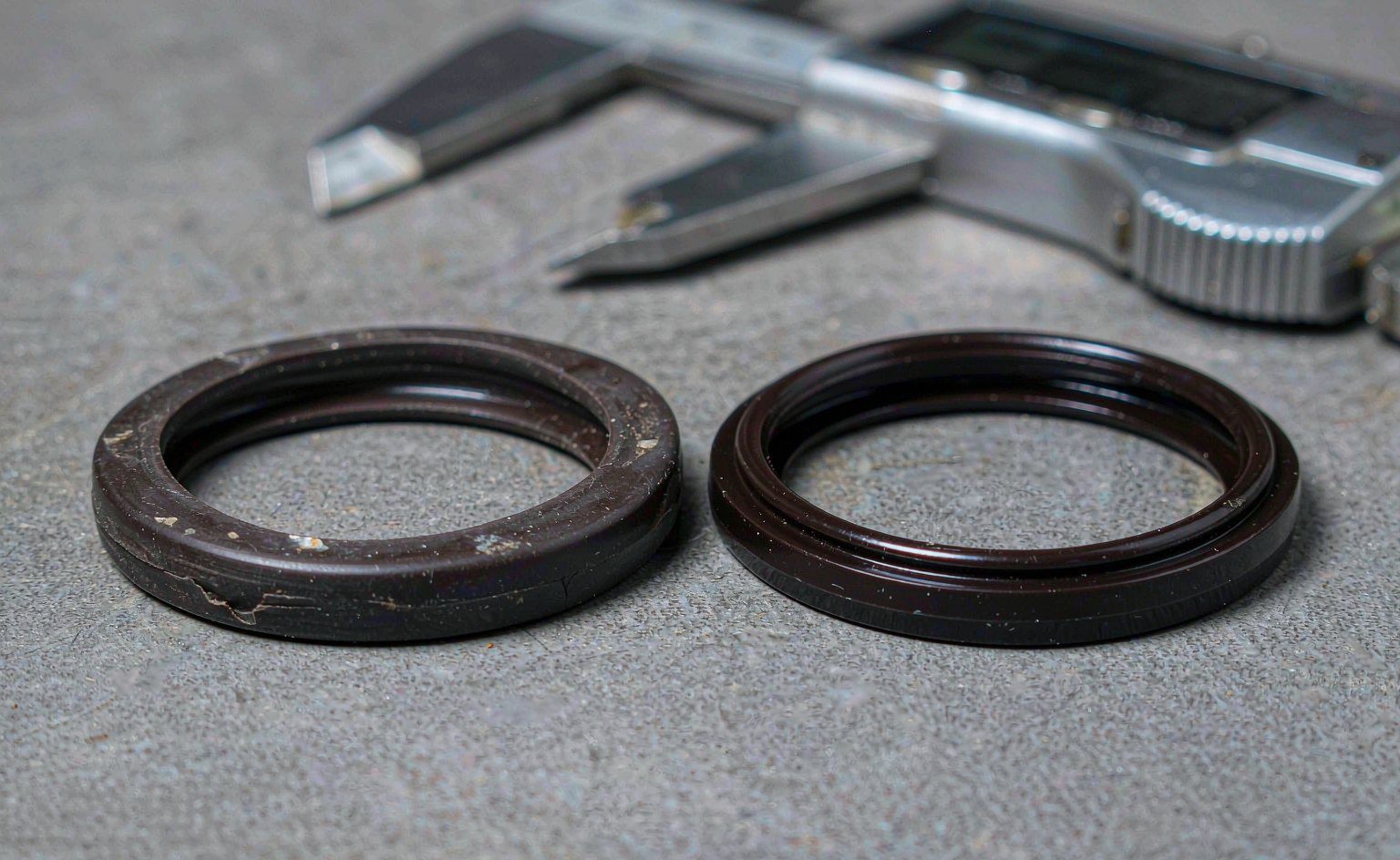
Heat aging is the usual impostor. A seal that has gone hard and taken a permanent set cannot follow the groove, and the resulting cracks look similar at a glance. Compression set data separates the two quickly, and our note on why compression set kills seals covers the measurement.
Quick Field Checklist
- Confirm crack orientation — perpendicular to stretch means ozone, random means heat.
- Map every brushed motor, UV lamp and corona source within 2 m of the seal.
- Measure installed stretch: (groove ID − free ID) ÷ free ID, target ≤5% static.
- Check storage records: light exposure, motor proximity, years on the shelf.
- Look for wax film on the seal surface — if it is missing, the barrier is gone.
- Specify ASTM D1149 on the next purchase order rather than trusting a datasheet claim.
- If oil is present, do not jump to EPDM. Move to HNBR or FKM and keep the oil resistance.
For seals that live outdoors or near motors, the compound list is short: EPDM and HNBR O-rings cover most of it, and where a standard compound will not do the job, custom compound development is usually cheaper than a field failure. The material trade-offs between the two workhorses are covered in NBR vs EPDM O-rings.