
Oilfield sealing fails on physics before it fails on chemistry. A compound that looks fine on a datasheet can blister apart on the first blowdown, embrittle in a sour well, or extrude through a widened gap at the third pressure spike. The eight challenges below account for most elastomer seal failures we see from drilling, wellhead and production equipment customers — each with the material answer and the qualification standard that turns a guess into a spec.
The Two Tests That Change Everything
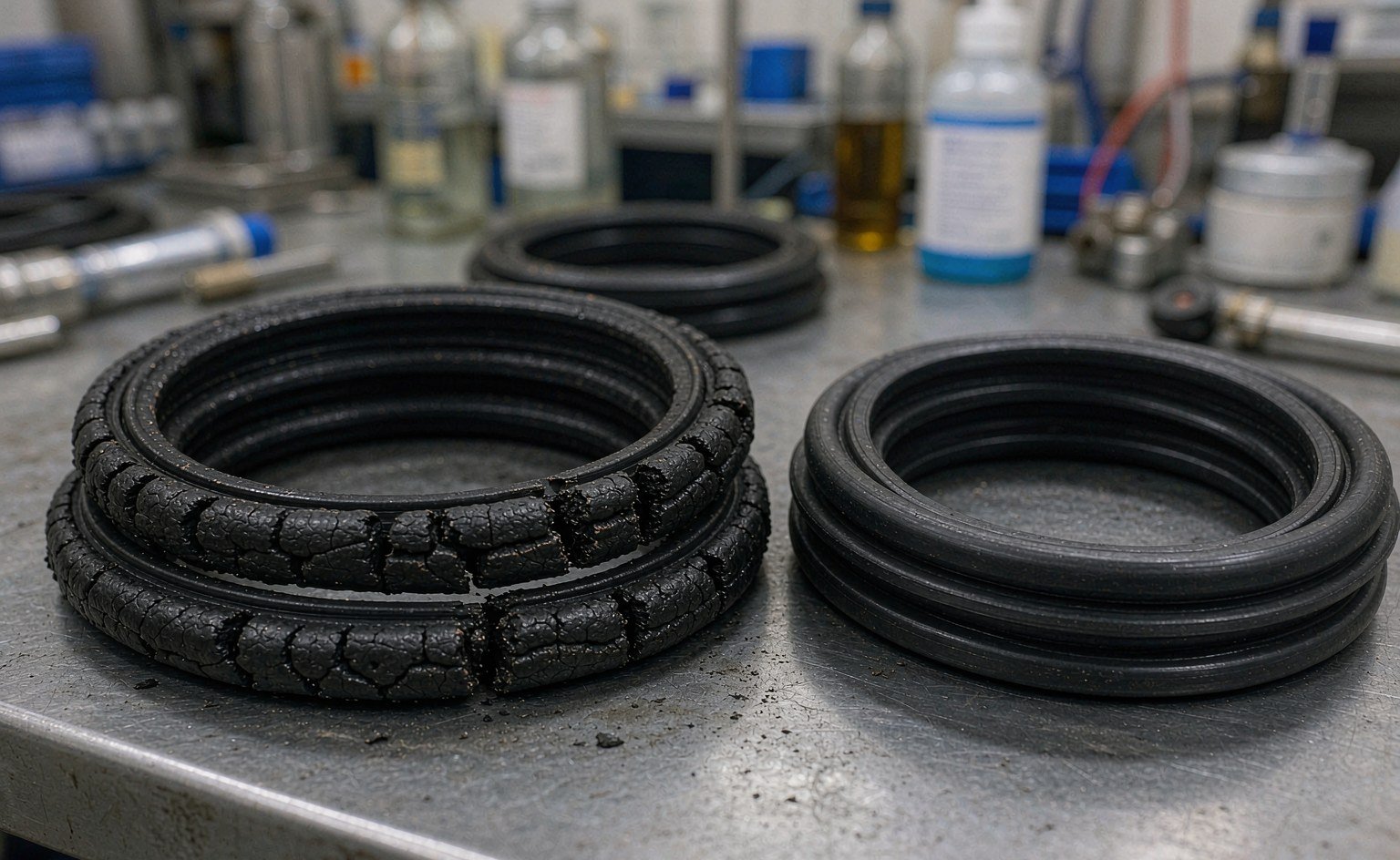
Before the list, two qualification frameworks frame every oilfield seal decision. The first is rapid gas decompression (RGD, also called explosive decompression): gas dissolved in the elastomer under hours of high-pressure soak expands faster than it can diffuse out when pressure drops, nucleating internal bubbles that blister and split the seal from within. Resistance is a compound property tested under NORSOK M-710 and ISO 23936-2 — not something you can infer from the material family name. The second is sour service: hydrogen sulfide attacks many elastomers and the metals around them, and material selection in H₂S-containing environments is governed by NACE MR0175 / ISO 15156, now maintained under AMPP. A compound that performs well in sweet service can fail within weeks in sour conditions, so the qualification — not the polymer family — is what you buy.
Challenge 1: Rapid Gas Decompression
Where it hits: high-pressure gas valves, subsea connectors, BOPs, downhole completion tools, gas compressors — anywhere a pressure boundary cycles from operating pressure to atmospheric in minutes.
The material answer: high-hardness, high-crosslink-density compounds with documented RGD test passes. HNBR at 90 Shore A leads the ranking for CO₂-rich service; AED-qualified FKM compounds cover hotter duties; FFKM where chemistry demands it. Hardness matters: a 70 Shore A compound that passes RGD at one gap will fail where a 90 Shore A compound survives. Pair the compound with tight clearances and backup rings — material alone rarely closes the extrusion path.
Challenge 2: Sour Gas and H₂S
Where it hits: sour wells, gas processing trains, any production where H₂S partial pressure crosses the NACE threshold.
The material answer: compounds qualified for H₂S exposure. Standard Type A FKM tolerates low H₂S percentages before degradation; base-resistant (Type B/Type F-family) FKM compounds tolerate far higher H₂S concentrations; Aflas (FEPM) resists H₂S, amines and steam and is often the sour-gas workhorse at mid-range temperatures; FFKM sits at the top for the most aggressive combinations. Specify at enquiry stage that the compound and hardness must carry NACE MR0175 / ISO 15156 qualification with documentation, not just the right family name.
Challenge 3: Amine and Base Exposure
Where it hits: amine treating units, corrosion-inhibitor injection lines, alkaline production chemicals.
The material answer: amines destroy standard FKM — the bisphenol cure system that gives Type A FKM its oil resistance is exactly what amine attack degrades. Aflas (FEPM) and base-resistant FKM grades are the correct answers; EPDM handles purely alkaline water systems where hydrocarbons are absent. If your process injects amine inhibitors, check which FKM family your supplier quoted — this is a specification error we see weekly in quotes from buyers who ordered “FKM” generically.
Challenge 4: Steam and Hot Water
Where it hits: steam-assisted gravity drainage (SAGD), thermal recovery, steam injection wells, hot-water washdown on rigs.
The material answer: steam attacks both by hydrolysis and by extraction of cure-system ingredients. Aflas and EPDM handle saturated steam well; HNBR covers moderate hot water; FFKM compounds with steam ratings cover the top end. Standard FKM degrades in steam above roughly 150 °C through hydrolytic defluorination — another case where the family name is not the qualification.
Challenge 5: Extrusion at High Pressure
Where it hits: 10,000–15,000 psi-class wellhead and downhole equipment, pressure spikes across partially open valves.
The material answer: hardness plus hardware. Standard O-ring designs assume service around 1,500 psi with tight gaps; beyond that, the compound must be a 90 Shore A extrusion-resistant grade and the gland must have controlled clearance — or backup rings, or an extrusion-resistant profile (T-seal, spring-energized PTFE). Every micron of gap widening from erosion or hardware wear multiplies the extrusion force; qualified compound and controlled gap are a package, not alternatives.
Challenge 6: Low-Temperature Subsea
Where it hits: subsea trees, ROV-operated valves, cold-water splash zones where a seal must seal at seabed temperature and stay flexible through depressurization.
The material answer: low-temperature FKM grades (GLT-type) rated to about −40 °C, special XLT compounds to −46 °C and below, HNBR with appropriate low-temp formulation, or low-temperature FFKM for the combination of RGD, sour and cold. The trap: elastomers that pass every chemical test can fail on a cold commissioning depressurization. Low-temperature sealing behavior (TR10 or equivalent testing) belongs in the qualification set for subsea.
Challenge 7: Drilling Fluids and Chemical Injection Compatibility
Where it hits: mud motors, MWD tools, chemical injection mandrels, slickline equipment.
The material answer: the fluid list is long — oil-based and synthetic muds, brines with weighted solids, scale inhibitors, oxygen scavengers, lubricants. HNBR handles most drilling-fluid chemistries with strong abrasion resistance; FKM covers hot hydrocarbons; EPDM serves water-based and glycol systems (but dies in oil contact); PTFE spring-energized seals take the duties where no single elastomer spans the chemical window. Map the actual fluid inventory, not the mud program headline — chemical additives change the compatibility picture more than the base fluid.
Challenge 8: Thermal Cycling and Compression Set
Where it hits: wells cycling between production and injection temperatures, surface equipment in desert and arctic installations, anything that shuts down overnight.
The material answer: compression set is the cumulative damage clock. Compounds with low compression set at the maximum wellbore temperature — AED-qualified FKM, FFKM, premium HNBR — hold contact stress through hundreds of cycles where generic compounds flatten out. The acceptance criterion for critical service should be a compression set limit at the actual operating temperature, not at standard test conditions, and seal replacement should be scheduled by thermal cycles, not just calendar time.
The Material Map, Side by Side
| Material | Service temperature | Strengths in oilfield service | Qualification you should ask for |
|---|---|---|---|
| HNBR | −30 °C to 150 °C (compound dependent) | Best RGD resistance, abrasion, drilling fluids | NORSOK M-710 AED pass |
| Standard FKM (Type A) | −20 °C to 200 °C | Hot hydrocarbons, sweet service | RGD pass, temperature data |
| Base-resistant FKM | −15 °C to 200 °C | Amines, high-H₂S service | NACE MR0175 / ISO 15156 qualification |
| Aflas (FEPM) | −10 °C to 250 °C | Sour gas, amines, steam | AED test, sour qualification |
| Low-temp FKM (GLT/XLT) | −46 °C to 200 °C | Subsea cold service with RGD | NORSOK M-710, low-temp testing |
| FFKM | to ~310 °C (grade dependent) | Widest chemical window, sour + steam + heat | Compound-specific test reports |
| PTFE spring-energized | −200 °C to 260 °C | Chemical span, extrusion immunity | Design-level verification |
| Challenge | Dominant failure mode | First-line material answer | Governing standard / test |
|---|---|---|---|
| Gas decompression | Internal blistering and splitting | 90 Shore A HNBR or AED FKM | NORSOK M-710, ISO 23936-2 |
| Sour gas (H₂S) | Swelling, embrittlement, cracking | Base-resistant FKM, Aflas, FFKM | NACE MR0175 / ISO 15156 |
| Amines and bases | Cure-system degradation of FKM | Aflas or base-resistant FKM | Fluid immersion testing |
| Steam and hot water | Hydrolysis, extraction | Aflas, EPDM, steam-rated FFKM | Immersion + set at temperature |
| High-pressure extrusion | Gap extrusion, nibbling | 90 Shore A compounds + backup rings | Gland design verification |
| Subsea low temperature | Loss of flexibility, brittle seal-off | GLT/XLT FKM, low-temp FFKM | TR10 / low-temp + NORSOK |
| Drilling fluids | Swelling, abrasion | HNBR (fluids), PTFE spring-energized (span) | Fluid compatibility matrix |
| Thermal cycling | Compression set, load decay | Low-set qualified compounds | Compression set at service temp |
Sourcing Discipline: Buy the Test Report, Not the Family
The theme across all eight challenges: polymer family names are marketing categories; qualifications are engineering facts. When a project requires NORSOK or NACE compliance, ask the supplier for the compound’s test documentation — pressure, temperature, gas composition and acceptance level — and match hardness to the gland. Peer resources such as the Marco Rubber oil and gas materials overview, the International Seal oil and gas page y las Polymax NORSOK explainer all converge on the same point from the buyer’s side: generic descriptions are insufficient, and certified compounds with traceability are what actually ship to the rig.
Our own practice for oilfield customers follows the same rule. We supply AED-tested HNBR and qualified FKM compounds for downhole and wellhead duties, spring-energized PTFE seals through our Vari-Seal range where chemical windows exceed any single elastomer, high-pressure backup and anti-extrusion hardware in our backup ring line, and material certificates with every batch. For duty cycles that combine heat and sour chemistry, the gama de retenes para alta y baja temperatura carries the extreme-temperature compounds, and standard replacement parts for drilling support equipment come from the seal kits line. Equipment qualification bodies publish the test frameworks for each standard; the supplier’s job is to hand over the passing compound with the paperwork attached.
La conclusión
Oilfield sealing is not one material problem; it is eight, and the two that kill seals fastest — explosive decompression and sour service — are invisible on any datasheet that lists only temperature and hardness. Specify by qualification: NORSOK M-710 and ISO 23936-2 for decompression, NACE MR0175 / ISO 15156 for sour, compression set at service temperature for cycling duties, and documented fluid compatibility for everything else. Buy the test report with the compound, pair hardness with gap control, and schedule replacement by cycles. Do that, and the remaining failures will be the interesting ones worth investigating — not the predictable ones that were preventable at the purchase order.
Oilfield Seals and the Test Reports Behind Them
The eight challenges in this article are the ones the oilfield asks us to quote against, and the range follows them: HNBR and FKM for sour and sweet service, FFKM for amine and solvent duty, PTFE and PEEK back-up rings for pressure and clearance, and metal-to-metal and graphite constructions where elastomers stop. Compounds are supplied with the RGD and sour-service data the operator’s specification asks for, not just a hardness figure.
What separates a usable quotation from a price is the test evidence: rapid gas decompression results, H₂S ageing, compression set at the well temperature, and hardness paired with the extrusion gap. Where a specification calls for a qualification we cannot support, we say so before the order rather than after the acceptance test.
Send the well conditions, the specification and the seal drawing to sales@bosssealing.com, and we will return a proposed compound per position with the test reports behind it, plus price and lead time — usually within one working day. The formulario de contacto reaches the same engineers.