
PTFE encapsulated O-rings exist because two failures keep meeting in the same gland: a rubber O-ring that the process fluid destroys, and a solid PTFE ring that cannot recover enough load to seal. An encapsulated ring is the compromise that fixes both — a thin fluoropolymer jacket carrying the chemistry, an elastomer core carrying the force. This guide walks through the material decisions, the compatibility limits, the hardware rules and the installation discipline that decide whether the hybrid actually holds in your equipment.
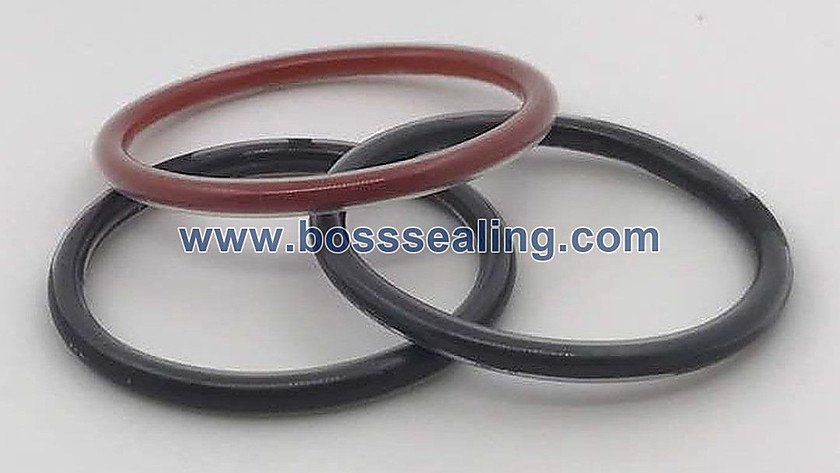
We produce these rings at scale for chemical processing, sanitary equipment and instrumentation customers, and most warranty returns we see trace back to one of four root causes covered below: a jacket split during installation, a gland cut for rubber, a temperature rating read off the core instead of the jacket, or a dynamic duty the jacket was never built for. None of them are exotic. All of them are avoidable at specification time.
How the Jacket and the Core Split the Work
An encapsulated O-ring is two components doing separate jobs under one part number. The jacket is a sleeve of melt-processable fluoropolymer — FEP or PFA — formed around the core with no seam facing the medium. Everything aggressive in the process touches that jacket: acids, alkalis, solvents, oxidizers, cleaning chemistry. PTFE-family fluoropolymers are close to inert against the chemicals that attack most elastomers, which is the entire reason the design exists.
The core is the part doing mechanical work. Squeezed into the gland, the elastomer core pushes the jacket against the two sealing faces and keeps pushing as temperature cycles and hardware moves slightly. A solid PTFE ring has chemical resistance but almost no elastic recovery; once it creeps into a new shape, contact stress decays and the joint weeps. The core restores that recovery. Silicone cores give the widest low-temperature flexibility and the softest squeeze; FKM cores hold up where heat or oils would degrade silicone and where a damaged jacket could expose the core to hydrocarbons.
The design implication is simple: the jacket is a chemical barrier, not a structural element. It is a few tenths of a millimeter thick, it does not stretch the way rubber does, and it will not forgive abuse in installation or a groove that squeezes it past its limit. Everything else in this guide follows from that.
FEP or PFA: The Jacket Decision
Both jacket materials come from the same fluoropolymer family and behave nearly identically in a gland. The difference is heat capability and shape retention. Resin-maker datasheets put FEP at a 200 °C upper service temperature (the UL 746 figure) and PFA at 260 °C continuous use. PFA also holds its geometry better at temperature, which matters in a wall section thinner than a paper clip. FEP is cheaper and covers the majority of chemical process and sanitary applications; PFA is the answer when the process runs hotter, when the specification calls for it, or when thermal cycling is severe.
| الخاصية | FEP jacket | PFA jacket |
|---|---|---|
| Upper service temperature (resin datasheet) | 200 °C | 260 °C |
| Low temperature flexibility | About −60 °C | About −60 °C |
| Shape retention at heat | جيد | Better; preferred for cycling duty |
| التكلفة النسبية | Lower | Higher, roughly 1.5–2× |
| Typical use | Process flanges, couplings, sanitary fittings below 200 °C | Hot service, steam-adjacent lines, aggressive cycling |
| Compliance options | FDA, USP Class VI grades available | FDA, USP Class VI grades available |
Read those resin figures as ceiling numbers for the jacket, not ratings for the finished ring. The ring runs at the lower of the jacket figure and the core’s family limit — a PFA jacket over a silicone core does not buy you 260 °C service, because the silicone core stops contributing near 200 °C. The ring maker’s datasheet governs; if the supplier cannot tell you which limit was the binding one, ask.
The Compatibility Map
The jacket’s chemical window is the widest of any common seal material family, and it is the reason buyers pick an encapsulated ring over an FFKM in many static joints. The short version: nearly everything except molten alkali metals, elemental fluorine and related strong fluorinating agents, and hot hydrofluoric acid touches the fluoropolymer without measurable effect. The core never sees the medium unless the jacket fails.
| Chemical class | Jacket performance | Notes for the seal specifier |
|---|---|---|
| Mineral and organic acids (HCl, H₂SO₄ dilute, acetic) | Excellent across the concentration range | Hot concentrated sulfuric acid is the boundary case; verify per supplier data |
| Alkalis and caustics (NaOH, KOH, amines) | ممتاز | Where elastomer compatibility fails, the jacket usually holds |
| Halogens and oxidizers (chlorine, peroxides, nitric) | Excellent at process concentrations | Strong fluorinating agents are the exception |
| Solvents and aromatics (ketones, toluene, chlorinated) | ممتاز | No swelling of the jacket; core protected unless jacket is breached |
| Hydrocarbons, fuels, lubricants | ممتاز | Specify an FKM core so a damaged jacket does not compound the failure |
| Water, steam, CIP/SIP chemistry | ممتاز | Sanitary clamp fittings are a high-volume application |
| Molten alkali metals, elemental fluorine, hot HF | Not acceptable | Move to a different sealing concept entirely |
Two cautions keep the map honest. First, compatibility applies to the fluoropolymer surface; it tells you nothing about the core if the jacket is scratched, and jacket damage is invisible until the leak appears. Second, compatibility is not pressure capability. An encapsulated ring in a high-pressure gas duty can absorb gas through a pinhole and blister on decompression like any elastomer. Static liquid service is the design envelope; treat anything else as an engineering review.
Where the Chemistry Gets In: Four Jacket Failure Modes
Because the jacket is the only barrier, every field failure we dissect comes down to the jacket being compromised or overworked. Four mechanisms account for most of what we see on the returns bench.
Installation cuts. Sharp threads, burrs on the gland lead-in, metal assembly tools and dry pulling through a port are the usual causes. A split jacket can look intact on the outside — the failure shows up weeks later as weeping at a joint that passed its pressure test. Pre-warming the ring, chamfered lead-ins and plastic assembly tools remove most of this population.
Groove overfill. Encapsulated rings are stiffer than the same cross-section in rubber and they need the gland volume calculated for them, not for an NBR O-ring copied off an old drawing. When the gland was sized for a soft elastomer, the jacket gets squeezed past its limit, creases, and then cracks in service. Groove fill above roughly 85% for these sections is where we start seeing crease failures.
Abrasive media. Slurry, catalyst fines and crystallizing salts wear through a jacket measured in tenths of a millimeter. If the medium carries solids, the answer is flushing, a spring-energized PTFE seal with a reinforced lip, or accepting elastomer replacement as maintenance — not hoping the jacket lasts.
Dynamic duty. The jacket creases and wears where a rubber ring slides. Encapsulated rings are for static and slow-rotating glands; a valve stem or pump shaft needs a different family. We cover alternatives in the last section.
Cores: Silicone or FKM
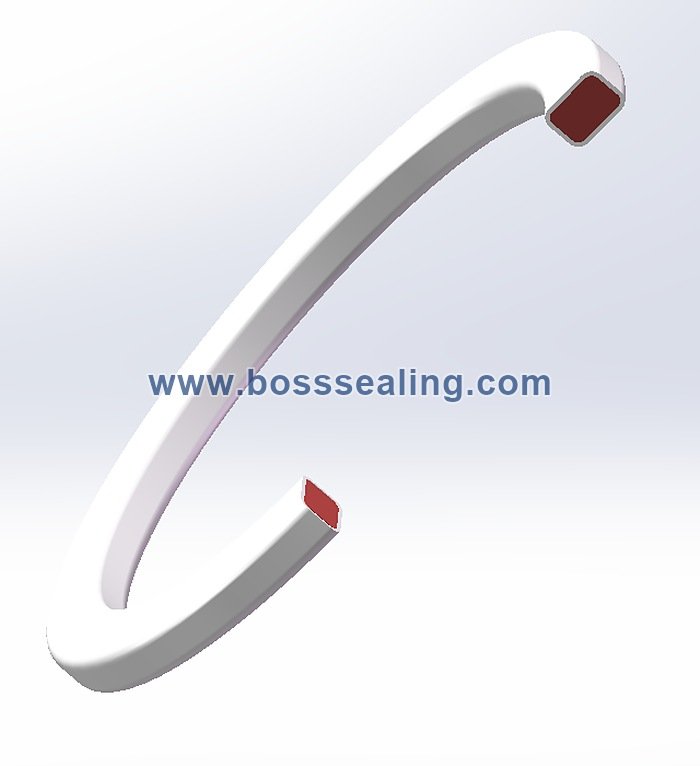
The core decides how the ring behaves when the jacket is intact, and how badly things go when it is not. Silicone cores run from about −60 °C up to 200 °C, stay flexible in cold rooms and outdoor instrumentation, and give the lowest squeeze force — useful on glass-lined equipment and plastic fittings that cannot take hard gland loads. FKM cores run from about −20 °C to 204 °C, tolerate oils and fuels, and hold compression set resistance at temperature. If the process could ever reach the core through a damaged jacket, an FKM core limits the damage; a silicone core will swell and lose load quickly in hydrocarbons.
| Attribute | Silicone core | FKM core |
|---|---|---|
| Useful core temperature | −60 °C to 200 °C | −20 °C to 204 °C |
| Low-temperature sealing | Best available in this design | Limited below −20 °C |
| Squeeze force | Low; suits fragile hardware | Higher; suits metal flanges |
| If the jacket is breached | Swells in oils and fuels | Resists most hydrocarbons |
| Compression set at heat | متوسط | جيد |
| Typical duty | Sanitary, cryo-adjacent, outdoor instrument glands | Chemical process, refinery, hot media |
Solid Core or Hollow Core
Most catalog sizes ship with a solid core: maximum sealing force, best recovery, and the compression set resistance you want in a joint that stays assembled for years. A hollow core compresses with noticeably less force, so it seats in thin-walled hardware, glass fittings and light flanges, and it tolerates flange misalignment better because the core collapses rather than pushing the flanges apart. The trade is load — a hollow core delivers less contact stress, so it belongs on joints that leak at low pressure, not on pressure boundaries.
The selection rule we give buyers: hollow core when the hardware is fragile or the flange flatness is questionable, solid core everywhere else. If a joint needed gasket-style compliance, a hollow core is a patch, not a design fix — the hardware needs looking at.
Grooves, Squeeze and Hardware Rules
Grooves cut for rubber will over-squeeze an encapsulated ring. The jacket cannot distribute the load the way an elastomer does, so the numbers matter more, not less. Three rules cover most glands:
First, target squeeze in the range standard for fluoropolymer-jacketed sections — typically 15–25% of cross-section for static service — and check gland fill including thermal growth and tolerances. If fill climbs past roughly 85%, open the groove or step down a cross-section. Second, finish the sealing faces as you would for any quality static seal: a smooth, scratch-free surface around Ra 1.6 µm or better, with no axial scoring across the seal line. Third, give the ring a lead-in chamfer with generous radii and deburr the port threads; the jacket fails on edge contact, and the chamfer costs one machining pass.
Pressure rating is a gland conversation too. Encapsulated rings are static seals for low to moderate pressure — process flanges, couplings, instrument and sanitary connections. For service beyond that envelope, add backup rings behind the jacket to control extrusion, or move to a spring-energized design. Suppliers such as Precision Polymer Engineering و Trelleborg Seals and Profiles publish gland tables for their jacketed and spring-energized ranges, and our own engineers size glands to the ring rather than assuming the drawing is right — a five-minute check that removes most of the crease failures described above.
Installing Without Splitting the Jacket
The jacket stretches far less than rubber, so installation is a heat-and-cleanliness procedure, not a thumb-and-forefinger exercise. Two pre-warm methods work in the field: hot water at about 100 °C for three minutes, or a low oven at the same temperature for 10–15 minutes, then fit the ring while it is warm. Warm fluoropolymer relaxes enough to pass over threads and shoulders without whitening or creasing. Lubricate only with something compatible with the process — water, glycerin or a specified assembly paste — because silicone grease inside a sanitary line is its own audit finding.
Use plastic or nylon tools, never metal picks. Push, do not roll, the ring into the gland. If the ring must pass over a sharp edge, protect the edge with a sleeve or request a split gland. Inspect after fitting: any visible white stress marks or creases in the jacket mean the ring comes back out and gets scrapped. A jacket crease never heals, and every crease is a future leak path.
When an Encapsulated Ring Is the Wrong Answer
Three situations should send you to a different family. Dynamic service is the first — valve stems, pump shafts, any gland with relative motion. The jacket is a wear part in that duty; a spring-energized PTFE seal with the right lip profile is the correct PTFE-family answer, and we manufacture those under our Vari-Seal spring-energized range for exactly this crossover. The second is service where the medium is one of the documented jacket killers — molten alkali metals, elemental fluorine, hot HF — where no jacket helps. The third is duty that genuinely needs elastomeric recovery at high pressure or temperature above the jacket ceiling: that is FFKM territory, priced higher but qualified for it, or a metal-to-metal sealing concept.
Where the requirement is a straight static gland with aggressive chemistry, moderate pressure and hardware in decent condition, the encapsulated ring remains the most economical inert seal available. Our مجموعة الأختام المغلفة covers FEP and PFA jackets over both core materials in standard inch and metric sections, and our custom products line handles the odd cross-sections and special profiles that keep showing up in dispensing and semiconductor equipment. For buyers comparing against vendor sheets from other encapsulated-ring makers, the comparison that matters is identical: jacket resin and its ceiling, core material, groove guidance and — the one that separates suppliers — installation and inspection support.
Pressure, Vacuum and the Operating Envelope
Encapsulated rings carry a moderate pressure envelope, and the limits come from three directions at once. The first is extrusion: above roughly 20 bar with standard clearances, the jacket starts to push into the gap, and the thin wall section has no stiffness to resist it. Backup rings made of PTFE or PEEK on both sides of the ring extend the envelope substantially — the same trick used with conventional O-rings — and we recommend planning the backup at specification time rather than retrofitting after a weep appears. The second direction is gas permeation: fluoropolymer jackets pass gas at low but measurable rates, so very-high-vacuum or long dwell-time gas duties need the supplier’s permeation data rather than a catalog yes. The third is thermal cycling, which works on the core rather than the jacket — every cycle compresses and relaxes the elastomer, and compression set accumulates where the gland runs hot. A ring that seals on day one can lose a third of its contact stress after a year of daily heat cycles, so joints that cycle thermally should have replacement intervals based on cycles, not just on leaks.
Vacuum service deserves a specific note because it keeps coming up in semiconductor and laboratory inquiries. In static vacuum below roughly 10⁻⁶ mbar, an encapsulated ring with a solid silicone core is a legitimate choice: the fluoropolymer surface outgasses far less than most elastomers, and the core holds load without creep for years. Below that range, metal seals or qualified spring-energized designs take over. The honest answer for a vacuum application is a leak-rate target written into the specification, then a ring selected against it — not the reverse.
One envelope rule ties these together: the encapsulated ring earns its keep where the medium is aggressive and the mechanical duty is gentle. Push it on either axis — pressure or movement — and you are buying its failure modes at a price you did not need to pay.
Maintenance, Inspection and Replacement Planning
Encapsulated rings fail quietly, which changes the maintenance conversation. A rubber O-ring approaching failure often announces itself — swelling, cracking, visible extrusion on disassembly. A jacket breach shows nothing from the outside, because the damage is under the fluoropolymer and the ring still looks serviceable on the shelf. That makes inspection discipline the main defense. At every planned disassembly, pull the ring and check for creases, whitening (stress marks from over-stretch), discoloration of the core visible through the jacket, and any surface scratch that catches a fingernail. Any of the four is a scrap decision, not a judgment call; a jacketed ring costs a fraction of the downtime its failure causes.
Replacement planning should follow the duty, not the calendar alone. Sanitary fittings that get opened every CIP cycle replace their rings on the open count. Process flanges in continuous service replace at turnaround intervals, with the ring batch recorded so a systemic problem traces back to a jacket resin lot. Equipment in intermittent service — spare pumps, standby skids — replaces by age, because the core keeps setting even when the gland is dry and idle; five years on a shelf and a standby pump both consume the same compression-set clock.
Stock discipline matters too. Encapsulated rings should be stored like any elastomer product — cool, dark, sealed bags, away from ozone sources — even though the jacket itself is inert, because the core inside is a normal rubber that ages by the same rules. Our مجموعة السدادات عالية ومنخفضة الحرارة page carries the storage guidance we give customers with mixed elastomer inventory, and it applies unchanged to jacketed rings.
الأسئلة الشائعة
Can an encapsulated O-ring handle vacuum? Yes, in low-outgassing static service — the fluoropolymer surface is a standard choice for instrumentation. For high vacuum with low leak-rate requirements, discuss hollow-core versus solid-core and check the supplier’s outgassing data.
How do I size a replacement? Measure cross-section and ID as you would any O-ring, then confirm the gland was designed for a jacketed section. If the old ring was plain rubber, do not drop an encapsulated ring into the same groove without rechecking squeeze and fill.
What happens if the jacket cracks in service? The core is exposed to the medium. With a silicone core in hydrocarbons, expect swelling and loss of load within days; with an FKM core, the ring may hold until the next turnaround. Either way, plan the replacement — the failure is progressive, not instant.
Are these rings suitable for food and pharma? With FDA-compliant jacket resins and USP Class VI core options, yes, and sanitary clamp fittings are a major application. Ask for the compliance package per batch — resin lots change and certificates should follow the shipment, not the brochure.
Can I use them on rotating shafts? Only at very slow speeds and light duty. The jacket does not tolerate continuous sliding; specify a spring-energized PTFE lip seal or a conventional rotary oil seal instead.
How long do they last in service? With the right gland and a static duty, multi-year service between turnarounds is normal, and sanitary rings opened frequently get replaced on open count instead. The honest answer depends on temperature cycles and how often the joint is disturbed — plan inspections at each disassembly and scrap on any jacket crease.
Why is my supplier asking about the gland dimensions? Because the most common failure is a ring specified by size and installed into a groove cut for rubber. Squeeze and fill numbers tell the supplier whether the gland will work before the ring ships — and that check costs nothing compared to a rebuild after a crease failure.
Jacket, Core and Groove as One Specification
FEP and PFA encapsulated O-rings are supplied in both jacket polymers, with silicone or FKM cores, solid or hollow, in the sizes this guide maps against chemical compatibility. Because the jacket is the barrier and the core is the spring, the two are quoted as a pair: a PFA jacket on a silicone core behaves very differently from FEP on FKM at the same squeeze.
What we check before shipping is the groove, not just the size — squeeze and fill for the encapsulated section, the radius and chamfer the jacket has to cross at installation, and the temperature the assembly actually sees. A ring specified by ID and cross-section alone and dropped into a groove cut for rubber is the most common encapsulated failure we see, and it is a drawing problem before it is a material one.
Send the medium, the concentration, the temperature and the groove dimensions to sales@bosssealing.com or through the contact form, and we will confirm jacket, core and squeeze before quoting — price and lead time normally within 24 hours, engineering review free.