
Two rod seals leave the same workshop on the same day, fitted to two identical cylinders on two identical machines. One is 93 Shore A polyester polyurethane. The other is 90 Shore A nitrile. Six months later one rod is dry and the other has a damp film at the wiper. The difference is not a mystery and it is not marketing: the two materials sit at different points on the abrasion, temperature, and fluid-compatibility axes, and the duty picks the winner before the seal is ever fitted.
This is a comparison for people who have to choose between them on a purchase order. It covers where polyurethane genuinely outperforms rubber, where it fails badly, and how to read a failed seal well enough to know which of the two you should have specified.
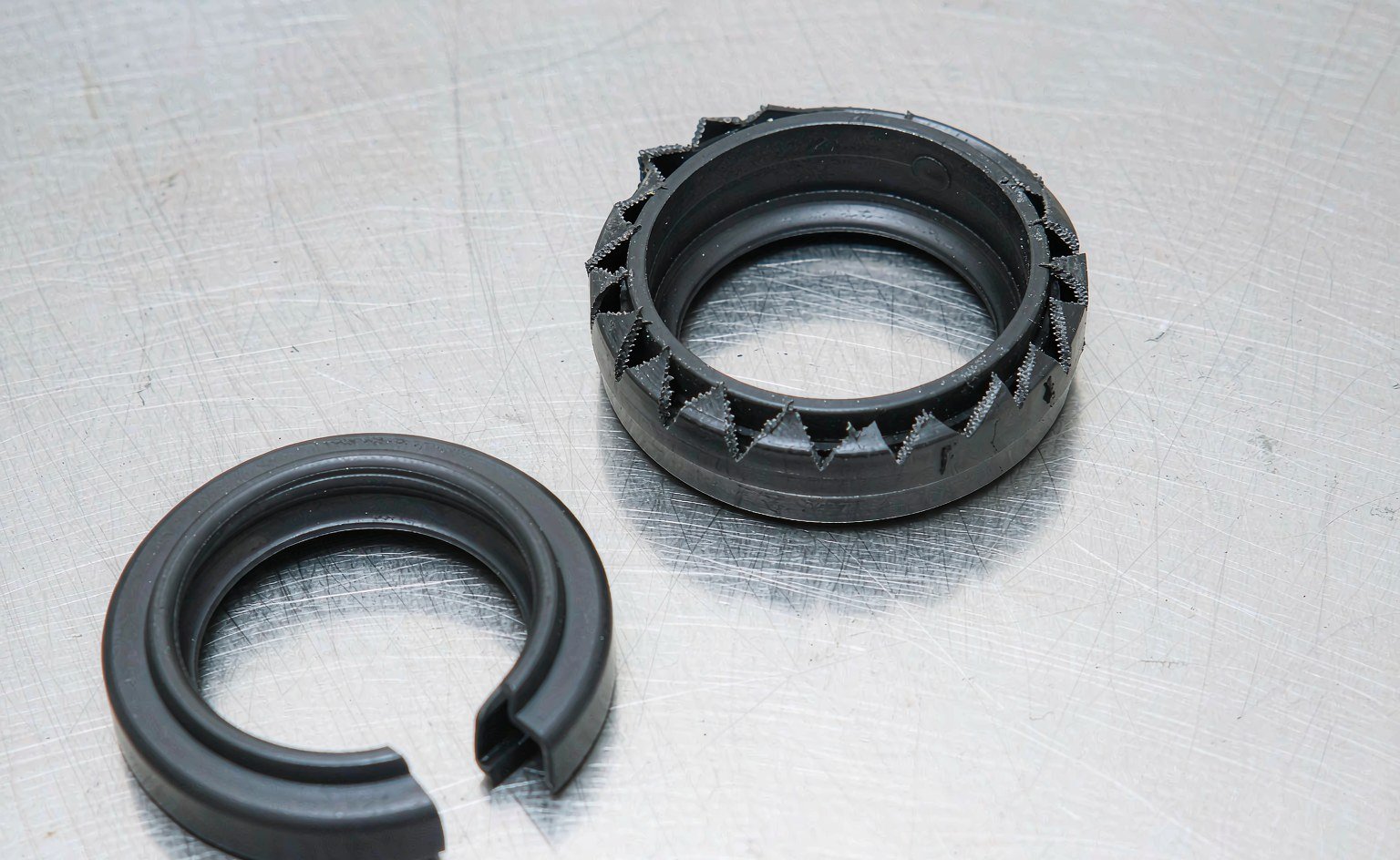
What “Rubber” Means in a Rod Seal Conversation
Rubber is not one material, and the comparison only makes sense once the alternatives are named. In hydraulic rod seals, the realistic field is:
- NBR (nitrile, Buna-N). The default general-purpose elastomer. Excellent mineral oil resistance, good elastic recovery, low cost. Service range roughly −40 to +100 °C, with special compounds reaching 120 °C.
- HNBR (hydrogenated nitrile). Same family, saturated backbone. Better heat ageing and better abrasion resistance than NBR, service range to about 150 °C, higher price.
- FKM (fluoroelastomer). −20 to +200 °C, excellent fluid and ozone resistance, poor low-temperature flexibility, three to four times the cost of NBR in most sizes.
- PU (polyurethane). A thermoplastic elastomer rather than a vulcanised rubber, supplied as polyester-based or polyether-based grades, typically 90–95 Shore A for rod seals, −30 to +80 °C.
PU behaves differently from the other three at a fundamental level. It has a much higher tensile strength and tear strength, a sharper and more stable lip under load, and a higher modulus at the same durometer. Those properties are why it dominates the rod position in mobile equipment, and they are also why it has limits the rubber compounds do not share.
The Abrasion Question, Measured Properly
Abrasion resistance is usually quoted as a Taber loss in mm³ or a weight loss under a specified wheel and load. That number is useful for ranking compounds and nearly useless for predicting rod seal life, because a rod seal does not wear against a grinding wheel. It wears against a chrome surface with a film of oil and, in field service, a layer of particles smaller than the oil film thickness.
The mechanism in a real cylinder is three-body abrasion: the rod, the seal lip, and a particle in between. Two things determine how fast that destroys the lip. The first is how deeply a particle can embed in the seal material, which is a function of hardness and modulus. The second is how well the lip recovers after the particle passes, which is a function of tear strength and elastic recovery. PU wins on both, and that is the honest reason it lasts longer in dirty service. Published comparisons commonly put PU at three to five times the dynamic wear life of NBR in abrasive positions, and our own rebuild records from aggregate and earthmoving customers sit in that range rather than at the top of it.
| Property | Polyester PU | Polyether PU | NBR 90 | HNBR | FKM |
|---|---|---|---|---|---|
| Hardness range used | 90–95 Shore A | 90–95 Shore A | 70–90 Shore A | 70–90 Shore A | 70–90 Shore A |
| Tensile strength | Very high | High | Moderate | Moderate to high | Moderate |
| Tear resistance | Excellent | Good | Moderate | Good | Moderate |
| Continuous temperature | −30 to +80 °C | −30 to +80 °C | −40 to +100 °C | −40 to +150 °C | −20 to +200 °C |
| Compression set at 100 °C | Poor to fair | Fair | Good | Very good | Excellent |
| Hydrolysis resistance | Poor above ~65 °C in water | Good | Good | Good | Good |
| Mineral oil | Excellent | Excellent | Excellent | Excellent | Excellent |
| Water-glycol (HFA/HFB) | Not suitable | Limited | Good | Good | Not suitable |
| Phosphate ester | Not suitable | Not suitable | Not suitable | Not suitable | Excellent |
| Relative cost index | 2–3 | 2–3 | 1 | 2–3 | 4–6 |
Read that table by row rather than by column. On the abrasion rows PU is clearly ahead. On the temperature and fluid rows it is clearly behind. A specification that only asks about abrasion will choose PU every time, including in the applications where it is the worst option.
Where Polyurethane Loses
The failures are specific enough to list.
Hydrolysis. Ester-based PU reacts with water once the temperature climbs past about 60 °C. The reaction is slow below about 60 °C and fast above 65 to 70 °C, and it does not produce a dramatic failure: the material softens, loses tensile strength, and turns slightly tacky before it tears. A rod seal that has hydrolysed looks like it was made of the wrong material, because functionally it was. Wet mines, washdown areas, steam lines, and any circuit with water ingress are a hazard for ester PU.
Hot water and water-based fluids. Water-glycol fire-resistant fluids (HFA and HFB) are outside PU’s compatibility range. NBR and HNBR handle them; PU swells, softens, and loses lip geometry. If a machine is specified with a water-glycol fluid, the rod seal material decision is made for you.
Phosphate ester. Only FKM in this list survives it. PU and the nitriles both fail, and no amount of back-up ring design compensates.
Temperature above 80 °C. PU softens progressively and takes compression set. The lip loses contact pressure, the seal starts to weep, and the weeping gets blamed on wear. In a cylinder with a restricted case drain or a marginal cooler, the oil can sit above 90 °C for hours at a time, which is outside the material’s design envelope no matter what the datasheet’s peak number says.
Cold start below −30 °C. PU stiffens and the lip can crack on the first stroke if the cylinder is moved before the oil warms. NBR is not much better in extreme cold; HNBR is the better choice, and below −40 °C the answer is usually a different seal design rather than a different compound.
Fluid Compatibility Decides Faster Than Abrasion
In practice, the fluid eliminates half the options before abrasion gets a vote. The table below is the sequence we use when a customer sends a fluid specification with a cylinder drawing.
| Fluid or environment | First choice | Acceptable alternative | Do not use |
|---|---|---|---|
| Mineral hydraulic oil, dry site | Polyester PU 93 A | NBR 90 | PTFE lip without energizer |
| Mineral oil, wet or washdown | Polyether PU 93 A | HNBR | Ester PU in continuous wet heat |
| Mineral oil above 90 °C | HNBR | FKM, PTFE-faced seal | PU |
| HFA / HFB water-glycol | NBR 90 | HNBR | PU, FKM |
| Phosphate ester | FKM | PTFE-faced seal with FKM energizer | NBR, HNBR, PU |
| Biodegradable ester | Polyether PU | HNBR, FKM | Some ester PUs swell badly |
| Steam or hot condensate | PTFE-based, EPDM static | FKM for lower temperature steam | PU, NBR |
Only the first row is a genuine PU-versus-rubber contest on abrasion. Every other row is a chemistry decision, and the abrasion advantage of PU becomes irrelevant once the material is incompatible.
Profile and Preload: Same Material, Different Life
A 93 Shore A PU compound in a badly designed gland performs worse than a 90 Shore A NBR compound in a good one. Three profile decisions carry most of the difference.
Lip sharpness and contact width. PU holds a sharp edge better than rubber, which is one of its real advantages. A lip that stays sharp concentrates contact stress and seals at low pressure. A lip that rounds over with wear spreads the load, and once contact stress drops below the fluid pressure, the seal leaks whether or not the material is still intact.
Interference and groove squeeze. PU’s higher modulus means the same percentage squeeze produces a higher contact force. A groove designed for an NBR lip often gives a PU lip too much preload, which raises friction and heat and shortens life. When substituting PU into an existing gland, check the radial interference and consider a slightly lower squeeze rather than matching the rubber dimension exactly.
Back-up support. PU resists extrusion better than rubber but it is not immune. Above roughly 21 MPa with a gap over 0.10 mm, or above 35 MPa at any realistic gap, a back-up ring is doing real work. The rules for gap and hardness are the same for both material families, and the extrusion analysis covers the numbers. A back-up ring in PTFE or PEEK is cheaper than the cylinder repair that follows an extrusion failure.
Where a rod seal carries a buffer ahead of it, the buffer takes the pressure peaks and the primary lip sees a smoothed pressure curve. That arrangement lets a PU lip survive conditions that would otherwise extrude it, and it is standard practice on high-cycle mobile cylinders for that reason.
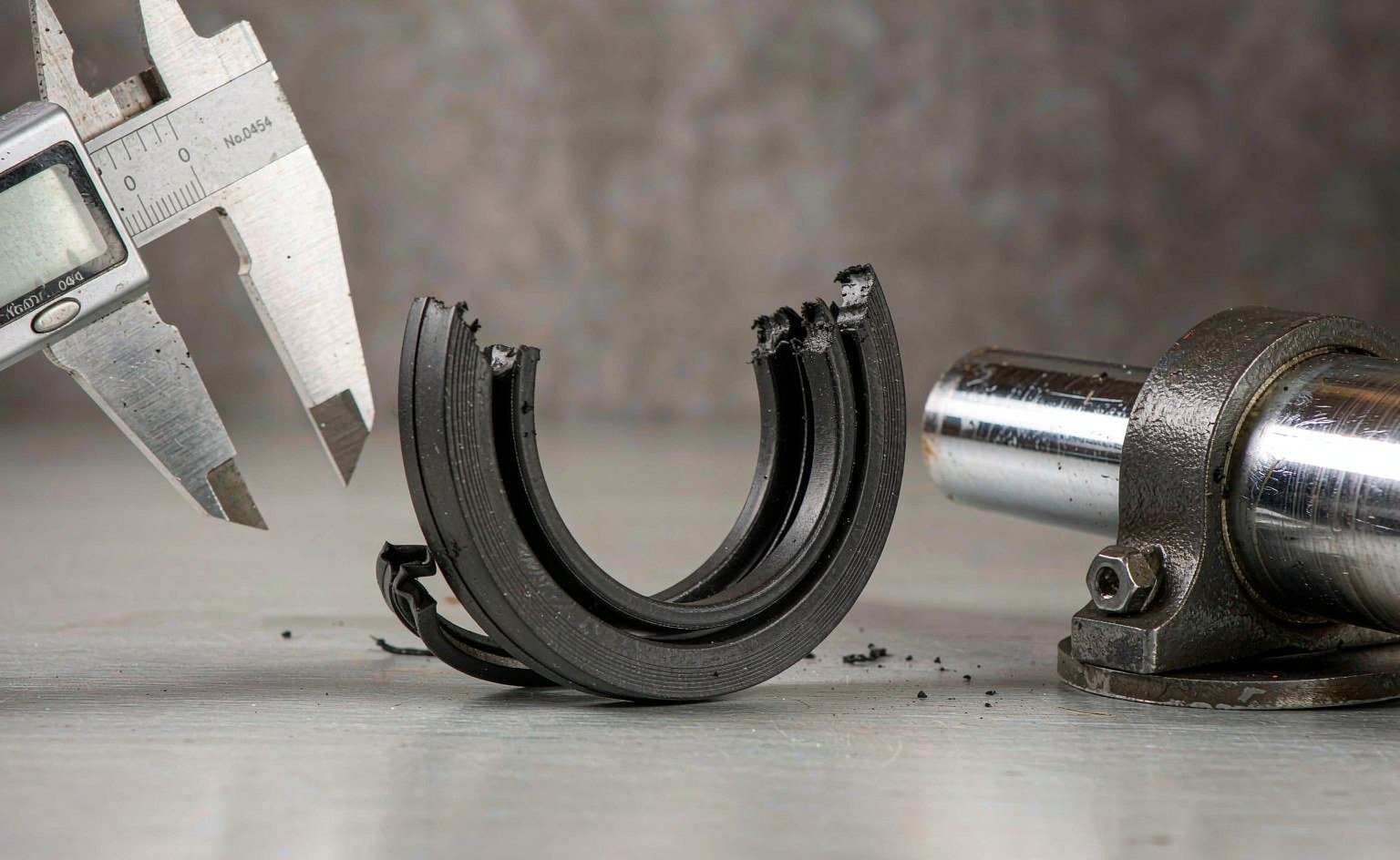
Reading the Failure
The failed part usually answers the material question better than any datasheet. The patterns below are the ones we see most often on rod seals from mobile equipment.
| What you see | What it means | Material implication |
|---|---|---|
| Lip edge nibbled, saw-tooth pattern on the low-pressure side | Extrusion through the gap, usually under pressure spikes | Material was adequate; gap and back-up design were not. Higher hardness alone will not fix it |
| Soft, tacky, or crumbly surface with loss of shape | Hydrolysis or chemical attack | Wrong material family, not a quality problem. Move to polyether PU, HNBR, or FKM |
| Hard, glazed, cracked lip with heat discoloration | Thermal ageing, dry running, or oil above the material limit | Move up the temperature scale; also check lubrication and cooler performance |
| Swollen seal that no longer fits the groove | Fluid incompatibility | Check the fluid specification before ordering a replacement |
| One side worn flat, other side intact | Side load or misalignment | Guide ring, gland concentricity, or rod deflection. No compound change helps |
| Longitudinal scores on the lip and rod | Hard particle trapped at the wiper | Wiper design and rod protection, not rod seal material |
| Torn lip at installation angle | Fitted over threads or a sharp shoulder | Installation practice; use a sleeve |
Three of those seven point at the material. Four point at the system. A buyer who replaces the seal without reading the pattern buys the same failure again at the same interval.
The Arithmetic of Service Life
Seal life in a rod position is governed by wear volume, and wear volume scales with contact pressure, sliding distance, and the abrasiveness of the interface. Sliding distance is easy: stroke length times cycles per hour times hours. A cylinder with a 600 mm stroke running 12 cycles a minute covers roughly 430 metres of rod travel per hour, and about 3,400 kilometres over 8,000 hours. That number is why lip wear, not chemical attack, is usually the limiting factor in clean oil.
Contact pressure is where the material choice enters. A harder, higher-modulus lip carries a narrower contact band at higher stress, which reduces the area being abraded but concentrates the load on the particles. In clean oil that is a win. In dirty oil the concentrated load drives particles deeper, which is why a very hard PU can wear a rod faster than a softer compound in a badly protected gland. The wiper is not optional in either case.
The practical conclusion is that the abrasion ranking between PU and rubber is real but conditional. PU wins decisively when the contamination is external and the wiper is doing its job. It loses when the fluid or the temperature is outside its window, and it can lose on rod wear if the particle load is high enough for a very hard lip to act as a lapping tool.
Specification Sheet for an RFQ
A supplier can only quote accurately if the enquiry carries the following, whichever material you specify. We ask for all of it, and quote faster when it arrives.
- Compound family and hardness, with the tolerance you will accept (typically ±5 Shore A for PU, ±5 for elastomers)
- Fluid type and the maximum continuous oil temperature, not the ambient
- Continuous pressure and expected peak pressure, including relief setting
- Rod diameter, bore, groove dimensions, and the measured gap if the cylinder is used
- Rod surface finish and coating type
- Stroke, cycle rate, and duty hours per year
- Whether a buffer seal, back-up ring, or double wiper is part of the stack
The Bottom Line
Polyurethane is the right default for rod seals in abrasive, mineral-oil hydraulic service, and the gap between it and nitrile in that duty is large enough to be worth the price premium. It is the wrong choice in water-glycol fluids, in phosphate esters, in steam, in sustained temperatures above 80 °C, and in wet service where ester-based grades will hydrolyse. Nitrile and HNBR take those cases, and HNBR increasingly takes the hot-oil cases that used to go to FKM at three times the cost.
Pick the material from the fluid and the temperature first, then use abrasion resistance to choose within the surviving family, then spend the remaining effort on the wiper, the gap, and the rod finish. That order of decisions is what separates a seal that reaches its planned rebuild from one that comes back in six weeks. Our hydraulic rod seal range covers both PU and elastomer lip profiles in metric and inch sizes, and the wiper seal guide covers the element that decides how much abrasive actually reaches the lip. Material test methods for hardness and compression set are defined by ASTM D2240, and compound data for nitrile and hydrogenated nitrile is published by suppliers such as Zeon. PU and elastomer seal design guidance is available from Bal Seal Engineering and Freudenberg, and regional stock lists from Darcoid are a useful check on what is available locally. For the difference between the rod and piston positions, see the rod seal vs piston seal comparison.