
A wiper seal is the ring at the outer face of a hydraulic cylinder gland that scrapes contamination off the rod before it enters the cylinder. It is the only seal in the assembly whose working surface runs dry, the only one exposed to the environment by design, and the one most often left out when a cylinder is rebuilt on price.
The part is small and cheap relative to everything around it. On a 100 mm bore cylinder it might be 1.5 percent of the rebuild cost. It is also the component that decides whether the rod seal behind it survives a season or a month, because every particle that gets past the wiper ends up in the oil film that the rod seal has to seal across.
Where the Wiper Sits and What It Touches
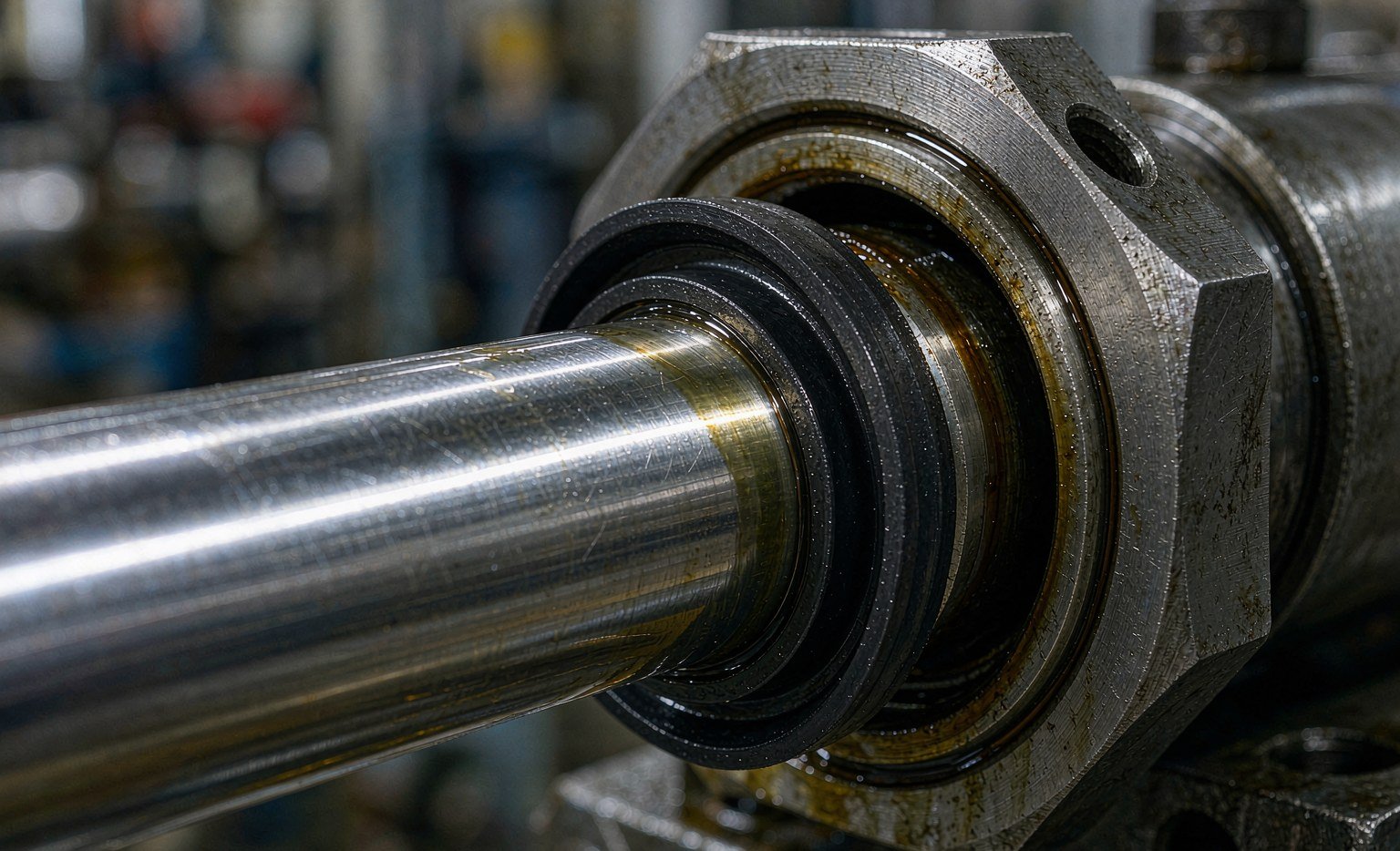
The gland of a typical cylinder carries three elements in line: wiper at the atmosphere end, rod seal behind it, and on heavier duty designs a buffer seal inboard of that. The wiper occupies its own housing, sized to ISO 6195, and its lip contacts the chrome-plated rod with light interference.
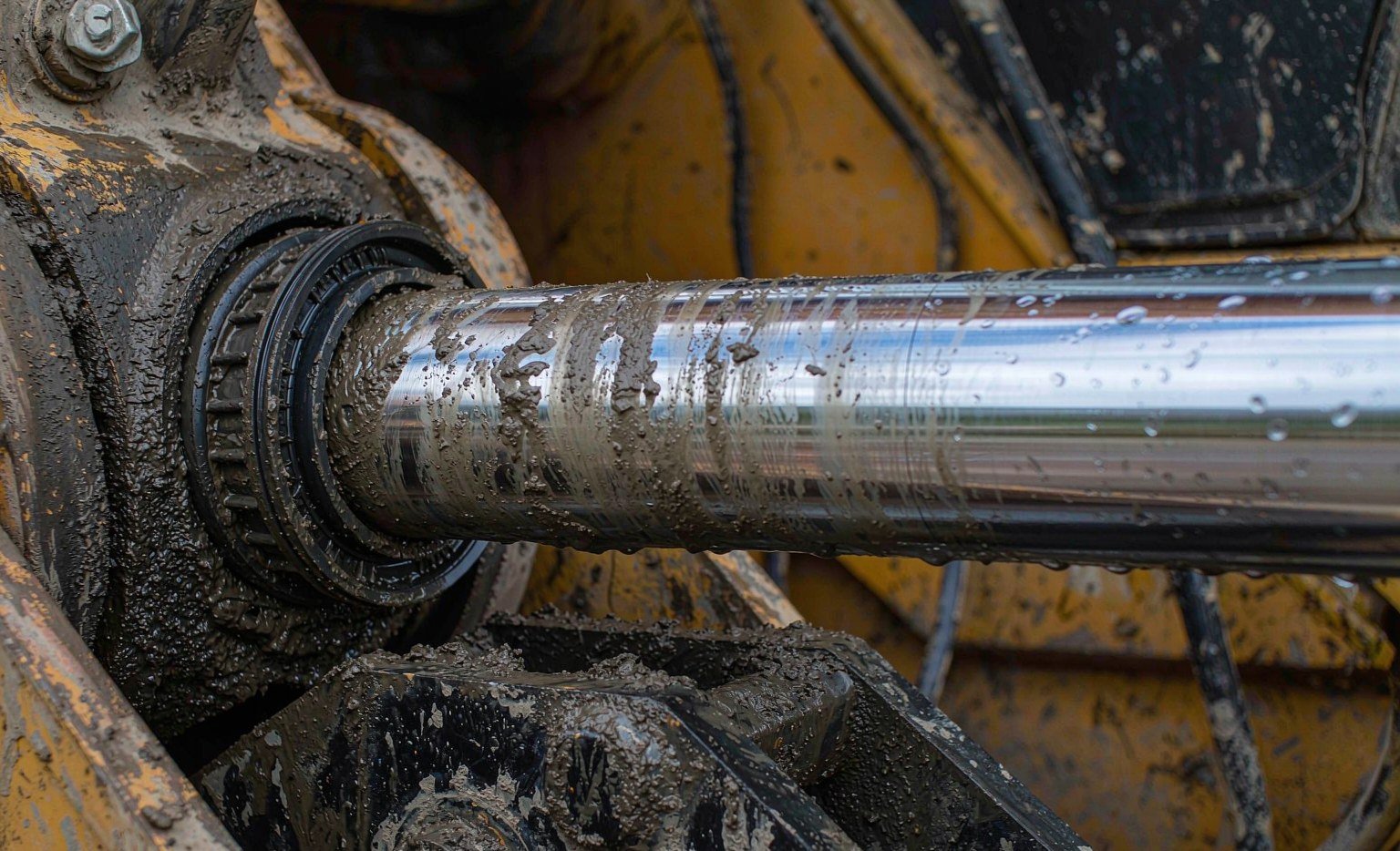
On the outstroke, the rod leaves the cylinder and the wiper lip runs over dry chrome. On the instroke, the lip meets mud, dust, swarf, pressure-wash residue or ice, and pushes it back off the rod. The scraped material accumulates on the face of the wiper and is supposed to fall away or be washed off. Nothing about this is sealed in the way a pressure seal is sealed; it is a mechanical scraping action.
It Is Not a Pressure Seal
The most common specification error we see is a wiper ordered as if it were a rod seal. It is not. A wiper has no pressure-energized geometry, no anti-extrusion feature and no ability to hold fluid pressure. Fit one in a rod seal housing and it will leak from the first stroke; fit a rod seal in a wiper housing and it will run dry against the rod, harden and score the chrome.
The two parts also fail differently. A vedante de haste failure shows up as oil on the rod. A wiper failure shows up as a rod that looks polished in patches, or as a rod seal that keeps failing with no obvious cause. By the time oil appears at the gland, the wiper has usually been gone for a while and the chrome underneath is already damaged. Our breakdown of the common causes of hydraulic seal failure covers that sequence in more detail.
There is one exception worth knowing: some heavy-duty designs use a combined wiper and rod seal in a single housing, with a scraping lip outboard and a sealing lip inboard. These are legitimate parts with pressure ratings, and they are specified against the rod seal housing dimensions, not the wiper ones.
Housing Types: A to E
ISO 6195:2021 covers wiper-ring housings for rod diameters from 4 mm to 450 mm and defines five housing types. The type determines whether the wiper is retained by a cover plate, pressed into an open groove, or snapped into an undercut. Getting the type wrong is the second most common reason a replacement wiper will not seat.
| Housing type | Retention | Wiper it takes | Typical use |
|---|---|---|---|
| A | Groove with a separate cover plate or retaining ring | Single-lip elastomer wiper | ISO 6020-1 / 6022 cylinders, repairable glands |
| B | Open groove, press fit | Wiper with an integral rigid reinforcement | ISO 6020-1 / 6022, high contamination |
| C | Closed groove, snap-in | Double-lip wiper without rigid reinforcement | ISO 6020-2 / 6020-3 compact cylinders |
| D | Undercut groove | Elastomer wiper with a plastic-faced scraping edge | Rods 28 mm and below in split design |
| E | Closed groove, tight axial tolerance | Single-lip elastomer wiper with no reinforcement | ISO 6020-1 / 6022, low radial space |
Housing descriptions follow ISO 6195:2021. Axial length tolerances differ between types, and type E is the tightest at 0 / +0.15 mm, so a generic wiper height will not always fit a type E groove.
Two dimensions in the standard cause most of the field problems. The radial depth sets how much the wiper is compressed against the rod; too shallow and the lip cannot follow rod runout, too deep and the lip barely touches. The lead-in chamfer matters as much: the standard calls for a chamfer finish of Ra ≤ 4 µm, because a burr on the chamfer cuts the wiper lip on installation and the cut becomes a leak path for dirt. Dynamic faces in the housing are specified at Ra ≤ 0.4 µm and Rz ≤ 1.6 µm, with a material ratio between 50 and 80 percent.
Single Lip, Double Lip, and What the Second Lip Does
A single-lip wiper scrapes in one direction and relies on the rod seal behind it to handle whatever film remains. It is cheap, it has low friction, and it is adequate in clean indoor service — machine tools, presses, indoor automation.
A double-lip wiper adds a second, usually shorter lip inboard of the scraping edge. The second lip does not seal pressure. It acts as a secondary scraper and, on some designs, as a return lip that pushes residual oil back toward the gland instead of letting it migrate out. On mobile equipment working in mud, the second lip is the difference between a rod seal that lasts a season and one that lasts a month.
The trade is friction and the risk of running dry. A double-lip wiper with a tight second lip can starve the rod of the thin oil film it needs, which raises rod wear. That is why double-lip wipers are usually specified with a defined interference and a groove that allows a small reservoir of oil between the lips.
Materials: Polyurethane Wins Most of the Time
The wiper works in the least friendly place in the cylinder. It sees UV, ozone, water, grit, and on mobile machines, hydraulic oil only as a trace film. Material choice follows from that, not from the fluid inside the barrel.
| Material | Dureza | Gama de temperaturas | Where it fits | Limitation |
|---|---|---|---|---|
| PU (polyurethane) | 90–95 Shore A | −30 a +100 °C | Mobile hydraulics, construction, mining, general industry | Hydrolyses in hot humid storage; swells in some esters |
| NBR | 70–90 Shore A | −30 a +100 °C | General purpose, low cost, indoor machines | Poor tear strength at sharp scraping edges; ozone cracks |
| FKM | 80–90 Shore A | −20 a +200 °C | Hot applications, near ovens, foundry and steel plant | Expensive, poor low-temperature flexibility, dry running wear |
| PTFE compound with elastomer energizer | — | −50 to +200 °C | Chemical service, high temperature, low friction | Low scraping stiffness; needs a metal or rigid backing |
| Metal-cased PU or NBR | 90 Shore A | Material dependent | Press-fit housings, high mechanical load on the lip | Bore damage on removal; not repairable in the field |
Polyurethane dominates because it combines abrasion resistance with enough elasticity to hold interference on a rod that is not perfectly straight. A 93 Shore A PU wiper on a 63 mm rod will tolerate runout that would cause an NBR lip to lift. The weakness is hydrolysis: PU stored in a humid warehouse for two years before installation can arrive soft and chalky, which is one reason cure dates matter on these parts as much as on O-rings.
Interference, Installation and the Chamfer
Wiper performance is set by a few tenths of a millimetre. The lip needs enough interference to stay in contact with the rod under runout and vibration, and little enough that friction does not heat the lip or wear the chrome. The seal supplier’s drawing gives the value for the specific profile; the installers’ job is to preserve it.
Three habits protect that interference:
- Cover the rod thread and any keyway. A single pass over a thread with the gland nut removed will shave the wiper lip. Tape, a tapered sleeve or a plastic installation cone costs almost nothing.
- Warm, do not force. A PU wiper that will not seat at 10 °C will usually seat after ten minutes in warm water at 50 to 60 °C. Never use a flame, and never hammer the lip.
- Check the chamfer before fitting. A burr or a rough lead-in is the most common cause of a nicked lip that later becomes a contamination path. Deburr, clean, then fit.
For press-fit types, the seating force should be steady and applied to the backing ring, never to the lip. If the wiper goes in at an angle, take it out and start again with a new part; a distorted backing ring will hold the lip off the rod on one side.
Failure Symptoms and What They Mean
| What you see | What it usually means | O que fazer |
|---|---|---|
| Oil film on the rod after an instroke, more than a sheen | Rod seal worn, not the wiper | Check wiper first, then replace rod seal and inspect chrome |
| Polished patches or score marks on the chrome | Wiper lip worn through, grit embedded | Replace wiper, polish or replace rod if scoring exceeds the plating |
| Wiper lip torn or cut on one side | Installation damage over thread or keyway | Replace, use a sleeve, inspect the chamfer |
| Lip hardened, cracked, flattened | Heat, ozone or incompatible cleaning fluid | Check gland temperature; move to FKM if above 100 °C |
| Wiper pushed out of its groove | Wrong housing type or missing retaining ring | Verify ISO 6195 type and axial length |
| Dirt in the oil, filter loading fast | Wiper ineffective or missing | Replace wiper, flush and change filter, sample oil |
Industry sources commonly attribute 70 to 80 percent of hydraulic failures to contamination. Whatever the exact figure, the path is easy to trace on a cylinder: wiper wears, grit passes, rod seal scores, oil weeps out, water and dust come in through the leaking gland, and the pump starts to wear. The cheapest part in the chain starts it.
Specifying a Replacement
Four numbers and one letter are enough to order correctly:
- Rod diameter and housing bore diameter, measured, not taken from a parts list.
- Housing axial length and radial depth.
- Housing type letter from ISO 6195, or a photograph of the groove with a scale.
- Rod surface condition: chrome intact, or plated and polished after repair.
- Duty: indoor machine tool, or mobile equipment in mud and salt.
For fleet work, keep the wiper on the same replacement interval as the rod seal even if it looks serviceable. A wiper that has done 8,000 hours has lost most of its lip geometry even when the damage is not visible, and the cost of the part is trivial against the labour of opening the gland twice. We supply wipers in PU, NBR and FKM to the ISO 6195 housing types, listed with the hydraulic wiper seal range, and they are included as standard in the kits de vedantes hidráulicos rather than sold as an option.
For housing dimensions, ISO 6195:2021 is the primary reference and is sold through national standards bodies. Hallite publishes wiper profiles with housing data, Marco Rubber explains the gland side of the same problem, and A Trelleborg lists wiper materials by temperature and duty. If you are comparing profiles across suppliers, ERIKS keeps a European cross-reference that is useful for checking whether two part numbers are really the same housing.
Perguntas frequentes
Does a wiper seal hold pressure?
No. A standard wiper has no pressure-energized lip and no anti-extrusion element. It scrapes. If the housing sees pressure, it needs a rod seal, or a combined wiper and rod seal designed for that housing.
Can I run a cylinder without a wiper?
In a clean, dry, indoor machine it will run for a while. In anything else the rod seal becomes the filter, and the mean time between failures drops sharply. We would not supply a mobile cylinder without one.
Why does my new wiper leak oil outward?
It is probably a rod seal problem, or the wiper was fitted in a rod seal housing. A wiper will pass a thin film by design; a visible drip means the pressure seal behind it has failed.
PU or NBR for a construction machine?
PU, at 93 to 95 Shore A. It resists abrasion and holds interference on a rod that flexes under load. NBR is the lower-cost choice for clean indoor duty.
How often should wipers be replaced?
With the rod seal, at every gland service. Wiper lip geometry degrades long before the part looks worn, and the labour to reopen the gland costs far more than the wiper.