
A hydraulic cylinder seal kit is the cheapest line item in a rebuild and the one most often ordered wrong. We see it every week: a maintenance planner sends a photo of a machine’s model plate, we ship the kit that matches that model, and the rod seal still does not fit because the cylinder was reworked in 2019 with an oversize rod or a different gland cartridge. The part number was right. The kit was wrong for that specific cylinder.
This guide covers what actually sits inside a cylinder seal kit, how kits are classified, how long the parts last in service, and the information a supplier needs to ship the correct kit on the first attempt. It is written for maintenance engineers, hydraulic repair shops and distributors who order kits in volume and cannot afford a second shipment.
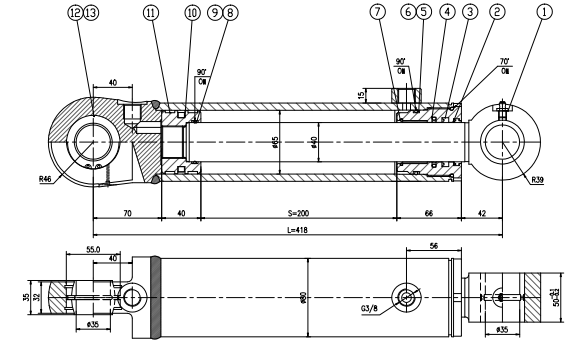
A Seal Kit Is a Bill of Materials, Not a Catalogue Item
There is no international standard that defines what a “seal kit” contains. A kit is a commercial bundle assembled by a cylinder builder, an OEM aftermarket department, or a seal manufacturer working from a drawing. Two kits for the same nominal bore and rod diameter can differ in every dimension that matters: groove width, groove depth, chamfer angle, and the axial space reserved for a wear ring.
That is why a kit ordered by machine model usually works, and a kit ordered by bore and rod size sometimes does not. Machine models are stable. Cylinders are not. OEMs revise gland geometry mid-production, aftermarket rebuilders hone bores and fit oversize rods, and imported equipment is frequently assembled from locally sourced cylinders that never matched the original drawing.
The practical consequence: treat the kit as a bill of materials to be verified against the hardware, not as a catalogue part. The verification takes ten minutes with a caliper and saves four to six weeks of freight and customs time when the first kit is wrong.
What Ships Inside a Cylinder Kit
A complete kit for a double-acting cylinder normally contains five functional groups. Cheap kits quietly drop two of them.
| Component | Job in the cylinder | Typical material | What happens if it is missing |
|---|---|---|---|
| Rod seal (primary) | Holds system pressure at the gland while the rod reciprocates | PU 93 Shore A, NBR 90, PTFE step seal | External leakage from day one; the kit cannot hold pressure |
| Rod wiper / scraper | Strips dirt, ice and metal particles off the rod before they reach the seal | PU 93 Shore A, NBR with metal case | Contamination reaches the rod seal; life drops by half or worse |
| Piston seal | Separates bore and rod side; controls internal bypass and drift | PU, PTFE with O-ring energizer, fabric-reinforced NBR | Cylinder drifts under load and loses speed control |
| Wear rings / guide bands | Keeps the piston centred so the seal is not crushed against the bore | PTFE-bronze, phenolic, PEEK, glass-filled nylon | Metal-to-metal contact, bore scoring, seal extrusion at one side |
| Static O-rings and backup rings | Seal gland, end cap, port and cushion fittings | NBR 70/90, FKM, PTFE or PEEK backup | Leaks at joints that look unrelated to the rod seal |
Two smaller items decide whether a rebuild lasts a season or a month. The first is the backup ring behind the rod seal on high-pressure cylinders: without it, a 70 Shore A O-ring or a soft PU lip can be pushed into the gland clearance above roughly 100 bar and nibbled away within a few thousand cycles. The second is the wiper retaining ring or metal case. A wiper that walks out of its groove stops wiping, and the rod starts carrying abrasive paste straight into the primary seal.
Some kits also include cushion seals, check-valve balls and O-rings, and port plugs. Ask for the kit’s itemised list before you buy. If a supplier cannot produce that list, they are repackaging parts, not building kits.

Single-Acting and Double-Acting Kits Are Not Interchangeable
The single biggest classification error in kit ordering is buying a single-acting kit for a double-acting cylinder. The parts look similar in a photograph and behave nothing alike in service.
| Feature | Single-acting kit | Double-acting kit |
|---|---|---|
| Pressure direction | One side only; return by spring or gravity | Alternating pressure on both piston faces |
| Rod seal | Single lip, often U-cup, one direction | Single lip with back support, or double lip where return-line pressure exists |
| Piston seal | Often a simple lip or O-ring | Double-acting profile, frequently two-piece with an energizer |
| Backup rings | Usually none | Standard above roughly 160–200 bar, both faces of the piston seal |
| Wear rings | One or none | Two, one each side of the piston seal |
| Typical service | Jacks, lift cylinders, spring-return clamps | Excavator boom and bucket, press rams, steering cylinders |
Double-acting cylinders also need the piston seal to survive pressure reversal. A single-lip seal installed in a double-acting cylinder will hold in one direction and leak in the other, which shows up as slow drift rather than a visible puddle. Maintenance teams frequently replace the rod seal three times before someone checks the piston side.
Three Ways Kits Are Sold, and What Each One Costs You
OEM part-number kits. Highest price, highest first-time fit rate, and the only option while the machine is under warranty. Availability is the weakness: a kit for a 2014 harvester can sit on backorder for months.
Dimensional kits. Built from bore, rod and groove measurements rather than a part number. A seal manufacturer cross-references the groove to ISO 5597 (piston and rod seal housings), ISO 7425 (plastic-faced seals) or ISO 6195 (rod wipers) and assembles an equivalent set. This is where most of our export business sits: a repair shop sends a drawing or a photo with caliper readings and receives a kit built to those numbers. Fit rate is high when the measurements are good, and the price is typically 30–55% below the OEM kit. Our hydraulic seal kits and spare seals range is built this way, and the housing dimension conventions are the same ones Trelleborg’s sealing solutions catalogue and Hallite’s hydraulic seal range publish, which is what makes cross-brand replacement practical.
Interchange kits. Sold against a brand cross-reference, for example “replaces kit X for cylinder model Y”. Convenient for distributors holding stock across many machine brands. The risk is generational drift: the cross-reference may point to the first version of a gland that was revised twice. Distributor catalogues such as Seal Sales seal kits are useful for checking what a machine model usually takes before you commit to a dimensional build.
For fleets, the working rule is to standardise on dimensional kits for the machines you rebuild repeatedly, and keep one OEM kit on the shelf as the reference set that all dimensional kits are checked against.
What Drives the Price of a Kit
Kit prices vary by a factor of four for the same nominal size, and the difference is rarely the rubber. It is the tooling amortisation, the inspection cost and the packaging discipline behind the parts.
Moulded profiles carry tooling, and tooling is spread across order quantity. A 40 mm rod seal moulded for a run of 500 kits costs a fraction per kit of the same seal produced 20 times. This is why a low-volume kit for an obsolete machine can cost more than a complete kit for a current excavator, despite being physically smaller.
Inspection is the second cost. A kit built to a drawing involves dimensional checks on every profile: groove width against the drawing, lip angle, and hardness on a sample from each batch. Hardness testing alone adds cost, and it is the check most often skipped by repackagers. A 93 Shore A PU rod seal that arrives at 85 Shore A will install easily and extrude early, and nothing in a visual inspection catches it.
Packaging is the third. Kits that arrive bagged per cylinder position, labelled with bore, rod and material, and sealed against humidity cost more to prepare than parts tipped into one bag. They also cut field assembly errors, which is the cheaper side of that trade.
When a quote comes in far below the others, ask which of these three steps was removed. The answer is usually all three.
How Long Seals Actually Last
No standard specifies a replacement interval for cylinder seals, and any supplier who quotes a single number is guessing. Life depends on pressure, temperature, contamination, rod speed, side load and duty cycle. What can be given is a range from field experience, plus the conditions that move a cylinder to the bottom of that range.
| Duty class | Typical rod seal life | Typical piston seal life | Inspection interval |
|---|---|---|---|
| Clean indoor, oil at ISO 4406 16/14/11, moderate pressure | 8,000–15,000 h | 10,000–20,000 h | Annually, or every 1,000 h |
| General industrial, 160–250 bar, occasional shock | 4,000–8,000 h | 6,000–12,000 h | Every 500 h |
| Mobile hydraulic, dust and weather exposed | 2,000–5,000 h | 4,000–8,000 h | Every 250–500 h, wiper checked at every service |
| Heavy abrasion: mining, demolition, foundry | 800–2,500 h | 2,000–5,000 h | Every 250 h |
| High temperature above 90 °C at the seal | 500–2,000 h | 1,500–4,000 h | Every 250 h plus oil analysis |
These numbers assume the seal was installed correctly and the oil stayed clean. Contamination is the variable that breaks the model: a system running at ISO 4406 20/18/15 instead of 18/16/13 can cut seal life by more than half, because abrasive particles recirculate through the gland clearance and act as a lapping compound on the lip.
Replace on condition where you can measure it, on hours where you cannot. Condition signals that justify a rebuild before failure: a rod that weeps again within a shift after being wiped clean, drift under a held load, rising oil consumption with no external leak, a wiper with a torn lip or a lifted edge, and cycle time that has stretched by more than about 5% against a recorded baseline.
The Four Numbers You Need Before Ordering
Every kit quotation starts with four measurements. Take them with a caliper, not a tape measure.
- Bore diameter. Measured inside the barrel at three depths, rotated 120° apart. Record the smallest reading; a barrel that is out of round by more than 0.1 mm needs honing before new seals go in.
- Rod diameter. Measured on the unworn section, ideally outside the wiper travel. A chrome rod worn below nominal by 0.05 mm will leak past a new seal.
- Stroke. Needed for stroke-dependent profiles and for quoting; also a check that the cylinder matches the drawing you are working from.
- Groove dimensions. Width and depth for the rod seal and piston seal grooves, plus the radial clearance between piston and bore and between rod and gland.
The clearance figure is the one buyers leave out and the one that decides whether the kit survives. A gland clearance of 0.30 mm at 250 bar calls for a backup ring; the same clearance at 100 bar may not. Suppliers who ask for clearance are building a kit. Suppliers who only ask for bore and rod are matching sizes.
Reading the Groove: What the Supplier Needs to See
A photograph of the groove with a caliper held across it is worth more than a page of description. Three views cover most cases: the rod seal groove in cross-section, the piston with its seal and wear rings removed, and the gland face showing the wiper groove and any retaining ring.
Add the seal you removed, laid flat next to a ruler, even if it is destroyed. The failure pattern tells the supplier what the original design was trying to do. A seal with a nibbled low-pressure edge was extruding and needs a backup ring or a tighter clearance. A seal with a hardened, cracked lip ran too hot and needs a different compound. A seal worn asymmetrically points to side load, which no seal compound fixes.

Materials Inside the Kit, and Where Each One Belongs
Most kits mix materials deliberately. A typical mobile hydraulic kit pairs a PU rod seal with a PU wiper, a PTFE-and-elastomer piston seal, PTFE-bronze wear rings, and NBR static O-rings. Substituting a single material across the whole kit is a cost decision that usually shows up as a warranty claim.
Polyurethane (PU), 93 Shore A is the default for rod seals and wipers in mobile equipment: high tear strength, good abrasion resistance, works from about −30 °C to +90 °C in mineral oil. It hydrolyses in water-based and some fire-resistant fluids, and it does not belong in steam or hot-oil service. Most of the rod seals and wiper seals we ship for construction equipment are this grade.
NBR, 70 or 90 Shore A covers static O-rings, low-pressure piston seals and general industrial cylinders. Cheap, widely available, good in mineral oil from −30 °C to +100 °C. It is not the right choice above 100 °C or in ketones, esters and strong acids.
PTFE and filled PTFE appear as piston seals, rod step seals and backup rings. Low friction, wide chemical resistance, −200 °C to +260 °C, but no elasticity of its own, so it always needs an elastomer energizer or a spring. Virgin PTFE creeps under sustained load; bronze or carbon filler raises compressive strength considerably.
FKM goes into kits for high-temperature or fire-resistant fluid service. −20 °C to +200 °C in most grades, with low-temperature variants reaching −40 °C. It costs three to six times NBR and is wasted in a cylinder that never exceeds 80 °C.
Ordering from a Manufacturer Instead of a Dealer
Buying kits directly from a seal manufacturer is routine once the information flow is set up. What makes it work is a repeatable request format, not a long email thread.
Send: bore, rod, stroke, groove width and depth for both dynamic seals, gland clearance, fluid type and grade, operating pressure including any shock peak, operating temperature range including startup, duty cycle in hours per year, and the machine make and model for reference. Add photos of the groove and the failed seal. That package is enough to quote a dimensional kit and to flag design problems before production.
Expect three things back: a kit drawing or itemised list with materials and hardness, a lead time, and a minimum order quantity. For standard profiles the lead time from our Foshan plant is typically 7–15 working days for a first order and shorter for repeats, with tooling only required for non-standard profiles. Kits assembled from existing moulds carry no tooling charge at all, which is the main cost advantage over an OEM kit.
Two commercial points are worth negotiating at the quotation stage. First, ask for the kit to be packed and labelled per cylinder position, not per part type: a rebuild in the field goes faster when the rod seal, wiper and backup ring arrive in one bag labelled for that gland. Second, ask for a spare-parts list with individual part numbers, so that a single worn wiper does not force the purchase of a full kit.
Quality Checks Before a Kit Ships
A kit is only as good as the weakest part in the bag, and the weakest part is usually the one nobody measured. Four checks catch the majority of problems before shipment.
Dimensional: groove width, groove depth, seal height and lip diameter against the kit drawing. A seal that is 0.2 mm too tall will not seat; one 0.2 mm too short has no squeeze and leaks. Hardness: a sample from each production batch, durometer tested and recorded against the material callout, which for nitrile and fluoroelastomer compounds is usually written in ASTM D2000 line-call notation. Compound verification: a cure check or a simple immersion test in the service fluid when the fluid is aggressive. Visual: splits, flash at the sealing lip, mould flow lines across the lip, and contamination embedded in PU parts.
Ask for the inspection record with the shipment. A supplier who cannot produce dimensional readings for the kit they just built is selling parts, not assemblies, and the cost of that difference appears at the machine.
Stocking Policy for Fleets
Fleets that rebuild more than a handful of cylinders per year should hold kits, not individual seals, and hold them at a ratio of roughly one kit per five installed cylinders of the same size. That ratio covers scheduled maintenance without tying up capital in parts that age on the shelf.
Shelf life matters here. Elastomer and PU seals stored per ISO 2230 guidelines — dark, below 25 °C, away from ozone sources such as electric motors and welding equipment, undistorted in original packaging — carry a storage life of about five years from cure date in most suppliers’ documentation. Do not build more than three years of consumption into stock, and rotate on a first-in, first-out basis.
Keep one reference set per cylinder family: a kit you have opened, measured and photographed, with the measurements written on the bag. When a machine arrives with no documentation, that reference set is what turns a two-week identification exercise into a same-day quotation.
Installation Errors That Kill a New Kit
Most premature kit failures we investigate are installation failures, not product failures. The recurring five:
- Installing over a sharp groove edge. A burr or a square chamfer shaves the lip during insertion. Cover the rod thread and any spline with tape or a bullet, and chamfer or radius the groove entry.
- Twisting the seal in the groove. A lip that is rolled rather than seated will leak immediately and then fail within hours. Seat it with a blunt tool and check the full circumference by feel before assembly.
- Reusing old static O-rings. They have taken a set and will not seal again at the same squeeze. Static seals in a kit are cheap; reusing them is the most common cause of a leak that appears at a joint after a rebuild.
- Dry assembly. PU and PTFE lips need clean system fluid or a compatible assembly grease. Dry starts score the bore and burn the lip within minutes.
- Skipping the hard-part check. A scored bore, a worn rod bearing or a bent rod destroys a new kit as fast as the old one. If the rod runout exceeds roughly 0.05 mm per metre, fix the rod before fitting seals.
What This Means for Your Next Order
If you are ordering kits this month, work through this list before contacting any supplier:
- Record bore, rod, stroke, groove width and depth, and gland clearance for each cylinder family, and photograph each groove with the caliper in frame.
- Confirm single-acting or double-acting from the hydraulic schematic, not from the cylinder’s external shape.
- Note the fluid, the pressure including shock peaks, and the temperature at the gland, not the ambient temperature.
- Keep the removed seal for the supplier to read, even if it is in pieces.
- Ask for an itemised kit list with materials and hardness values before approving the quote.
- Standardise one dimensional kit per cylinder family, and hold one OEM kit as the reference.
- Set the stock ratio at one kit per five cylinders, with a three-year maximum holding.
Kits are a small part of the maintenance budget and a large part of the downtime budget. Getting the bill of materials right, once, removes most of the recurring cost of both.