
The complaint arrives with a photograph: a bin of 400 O-rings, cracked along the parting line, some flattened on one side. The purchase order says FKM 75, the batch is 18 months old, and the parts were stored in a rack under a skylight next to the compressor room. Nothing in the quality system flagged it, because the seals met print when they were received. They simply sat in the wrong place for a year and a half.
Rubber ages whether or not anyone is using it. Storage is the cheapest part of a seal’s life to control and the most common reason a good batch fails on installation. ISO 2230:2002, “Rubber products — Guidelines for storage”, is the standard most buyers cite. It is short, it is often misquoted, and the part everyone forgets is that the shelf-life clocks start at the cure date, not at goods receipt.
Here is what the standard actually specifies, what it leaves to you, and how to run a stores area that produces predictable parts instead of surprises.
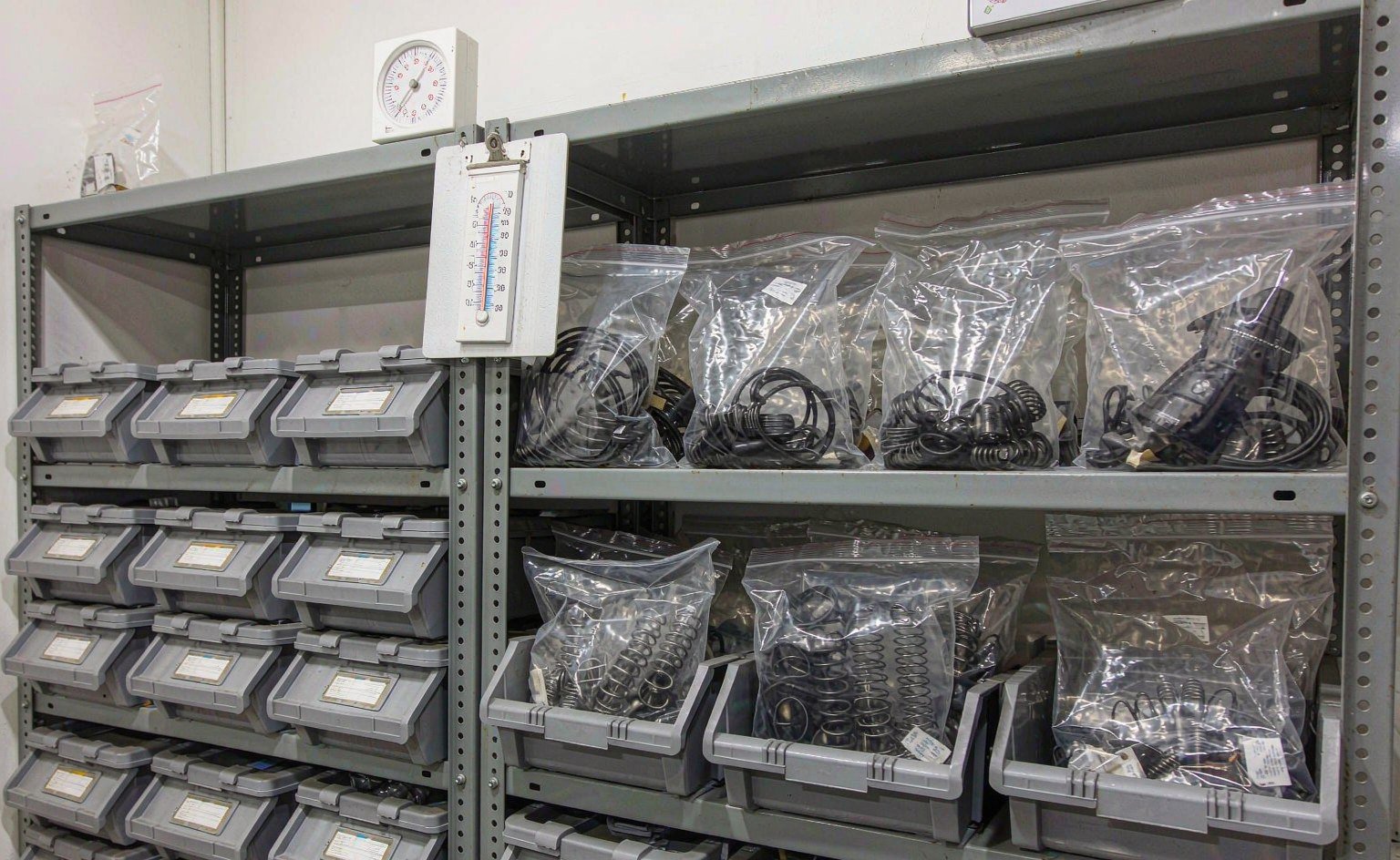
What ISO 2230 Says, and What It Leaves to You
The standard does three things. It sets storage conditions — temperature, humidity, light, ozone, deformation and contact with contaminants. It groups rubber compounds into three families by aging resistance. And it gives each group an initial storage period plus an extension period that applies after a technical inspection.
It does not give a shelf life for a specific part. That number depends on compound, cure system, cross-section and application criticality, and the standard is explicit that the periods are guidance subject to verification. Two FKM compounds from two suppliers can age at different rates because one uses a different filler package or a shorter post-cure.
DIN 7716 covers the same ground for the German-speaking market and is still referenced on many European drawings. The storage conditions are nearly identical; the shelf-life grouping differs slightly. If your customer cites one and your warehouse follows the other, nobody is badly wrong — but write down which one your procedure follows.
Three Groups, Two Clocks
| Group | Typical materials | Initial storage period | Extension after inspection |
|---|---|---|---|
| A | NR, IR, BR, SBR, AU/EU polyurethane | 5 years | +2 years |
| B | NBR, XNBR, HNBR, CR, IIR, ACM, ECO | 7 years | +3 years |
| C | EPDM, EPM, FKM, FFKM, VMQ, FVMQ, CM, CSM | 10 years | +5 years |
Group membership per ISO 2230. For blends, the shorter period of the two components applies. Polyurethane is the one group A material most seal warehouses actually stock, and it is the one that ages fastest.
Two practical consequences follow from this table. Polyurethane rod seals and wipers — group A — have half the storage window of the NBR rings sitting on the next shelf, and nobody treats them that way. And a 10-year period for FKM is not permission to keep FKM in a hot room for a decade; it assumes the storage conditions in the next section are met for the whole period.
The Five Numbers a Stores Area Has to Hold
| Parameter | ISO 2230 target | What we find on site | Cheap fix |
|---|---|---|---|
| درجة الحرارة | 5–25 °C, ideally below 15 °C | 28–35 °C in summer, roof space | Move stock to the lowest, most shaded rack; no roof-only storage |
| Relative humidity | Below 65% (70% general guidance) | 75–90% near doors and in coastal plants | Sealed polyethylene bags with desiccant; hygrometer on the wall |
| Light | No direct sun, no unfiltered UV or fluorescent glare | Skylight directly over the rack | Opaque bins or a UV film on the glazing |
| Ozone | No motors, welders, forklift exhaust nearby | Rack beside the compressor and battery charging | Relocate; ozone cracking shows as fine cracks under stretch |
| Deformation | Relaxed, unstressed, nothing hung or stacked | Seals on hooks, cartons crushed under pallets | Flat shelves, loose bags, large rings coiled in their own packaging |
Temperature dominates. The rule of thumb used across the industry is that storage life roughly halves for every 10 °C above 25 °C, and roughly doubles when stock is held at 10 °C or below. A group C FKM ring with a nominal 10-year period stored at 35 °C is not a 10-year part; treat it as nearer five. The same ring in a cool, dark store at 12 °C gives you the margin the standard promised.
Humidity matters most for polyurethane, which hydrolyses, and for any part with a metal insert or bonded metal cage. Condensation cycles are worse than steady humidity: a store that swings between 15 °C at night and 32 °C by afternoon will condense water on cold metal every morning.
Batch Dating: The Field That Actually Drives FIFO
Most warehouses date stock by receipt. ISO 2230 counts from cure. Those two numbers can differ by a year if the part was molded, shipped by sea and cleared customs before it entered your system — which is normal for anything sourced from Asia.
Three habits make the difference:
- Ask for the cure date on the label and the packing list. A manufacturer that cannot state it is probably trading, not molding. We print cure week and compound batch on every bag for this reason.
- Label at goods-in with the cure date, not just your receipt date. A simple “cured 2026-W12, expires 2036-W12 for group C under controlled storage” line is enough.
- FIFO by cure date. Two deliveries a month apart with cure dates a year apart should not be consumed in arrival order.
If a batch arrives already 18 months past cure, knock that off the clock. It is not a defective batch, but it has spent 15 percent of its group C period before you opened the box, and the remaining life should be calculated accordingly.
Receiving: Five Minutes That Save a Batch
Most storage damage that gets blamed on the warehouse actually happened in transit. A container that sat on a dock in July, or a carton that spent three weeks in a customs yard, can arrive with a year of aging already applied. Check these before the pallet goes on the rack.
- Carton condition. Crushed corners mean the parts inside were compressed. Open the affected cartons and inspect the bottom layer.
- Bag integrity. A sealed bag that has lost its vacuum or shows condensation has been through a temperature swing. Dry the parts, reseal with fresh desiccant, and note it on the batch record.
- Heat exposure indicators. If your supplier ships with a max-temperature label, read it. If not, ask for one on high-value FFKM and polyurethane orders.
- Cure date versus ship date. A gap of more than 90 days on a stock item usually means the part was made to forecast rather than to order. It is legal and it shortens your window.
Five minutes at goods-in, with a photo of anything abnormal attached to the receiving record, settles most shelf-life arguments later. It also gives you leverage with a supplier whose packaging is not holding up.
Inspection at the End of the Period
The extension column only applies if someone inspects. The inspection does not need a laboratory; it needs a defined method and a record.
| Check | Method | Reject if |
|---|---|---|
| Surface condition | Visual, 2× magnification, whole batch sample | Cracks, crazing, bloom that does not wipe off, tackiness, hard spots |
| Elasticity | Stretch a sample ring 20% by hand and release | Visible cracks under stretch, or slow, incomplete recovery |
| الصلابة | Shore A durometer on a flat section, 3 readings | More than 5 points above the original specification |
| Compression set | 24 h at 70 °C on a sample, or ASTM D395 on a witness specimen | Set above 25% for a static seal, 15% for dynamic |
| Dimensions | Caliper on cross-section and ID, 5 pieces | Outside the drawing tolerance, or ovality beyond spec |
Record the result against the batch, not against the part number. The whole point of the exercise is to know which physical box was inspected, and to be able to quarantine it if the answer is no.
Four Mistakes We See in Customer Stores
Bulk bags left open. An open bag in a workshop draws in airborne oil mist, dust and ozone. Once a bag is opened, reseal it or move the remainder into a closed bin. O-rings stored loose in an open tray on a bench are the most common source of “new” parts that fail at installation.
Seals stored under load. Heavy cartons stacked on top of O-ring bags flatten the bottom layer. The deformation is partially permanent even at room temperature, and a flattened ring will not seal a round groove.
Storage next to ozone sources. Electric motors, welders, copy machines, battery charging areas and propane forklifts all generate ozone. NBR and HNBR are the most vulnerable; the damage shows as a network of fine cracks that appears only when the ring is stretched, which is exactly when it is being installed.
Assuming the shelf life resets after inspection. It does not. The extension period is added once, and the part still needs the conditions maintained during the extension. A part that spent five years in a hot room does not become new again because someone looked at it.
When Stored Seals Are Still Usable
A seal past its initial period is not scrap. It is a part with an inspection requirement. If it passes the checks above, it can go into service — with one caveat: for critical static seals in high-pressure or high-temperature service, use the older stock first and keep the new batch for the difficult jobs. Aging is not linear, and the last two years of a storage period are the ones where properties move fastest.
For dynamic seals, be stricter. A rod seal that has hardened by 5 Shore A will leak in a way that a static flange seal will not, because it has to conform to a moving surface thousands of times an hour. If the application is dynamic and the stock is past its initial period, run a compression set check before releasing it.
Action Checklist for the Stores Area
- Put a max-min thermometer and a hygrometer in the rubber store and read them weekly. Record the numbers; a store with no record is a store with no control.
- Move all rubber stock off the top rack, away from skylights, motors and charging areas.
- Require cure date on every incoming label and enter it in the ERP as a separate field from receipt date.
- Keep parts in sealed polyethylene bags with desiccant until the moment of use; reseal opened bags the same shift.
- Classify stock by ISO 2230 group so polyurethane is not treated like FKM.
- Set a calendar reminder at 80% of each batch’s initial period and inspect before it expires, not after.
- Write the inspection result on the batch record and quarantine anything that fails, with a photo.
None of this is expensive. A hygrometer, opaque bins and a label field in the ERP cost less than one unplanned seal change on a hot line. If you source from us, the cure date and compound batch are on the bag; the rubber seals range and the hydraulic seal kits both ship with that data, and the rotary oil seals carry it on the inner box as well.
For the standard text itself, ISO 2230:2002 is sold through national standards bodies. A practical summary with the same storage conditions is published by Seals Direct, ، و ERIKS covers the warehouse side from a distributor’s perspective. For compound-level aging data, Trelleborg publishes material tables, and Balseal documents shelf-life practice for precision seals. Compression set test detail is in ASTM D395.