
Choosing between HNBR and FKM is one of the most common material decisions seal buyers face, and choosing wrong usually shows up months later as warranty claims, not as an immediate failure on the test bench. Both materials are workhorses of industrial sealing, both handle hot oil, and both cost more than standard NBR — but they fail in opposite directions. This guide compares them across temperature, fluid compatibility, mechanical durability, and cost, then gives you scenario-based recommendations you can defend in a design review.
If you want the short version: HNBR wins on mechanical abuse — abrasion, tear, dynamic wear, and low-temperature flexibility. FKM wins on heat and chemical breadth — sustained service at 200°C and resistance to fuels, solvents, and ozone that destroy HNBR. Everything below is detail on that split.
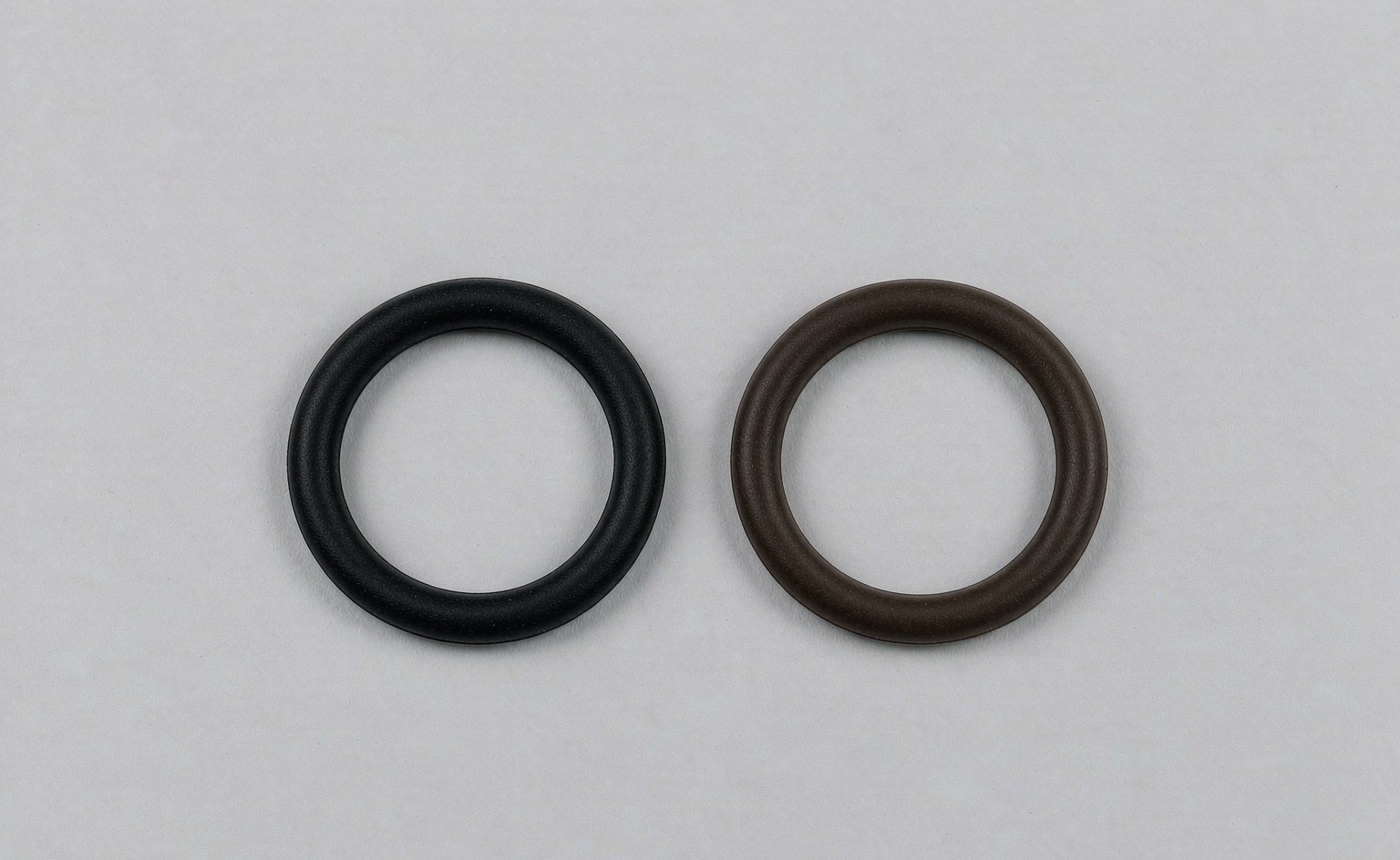
The Two Materials in Brief
HNBR (hydrogenated nitrile butadiene rubber) starts as standard NBR. Manufacturers hydrogenate the butadiene portion of the polymer, saturating the carbon-carbon double bonds that make ordinary NBR vulnerable to heat, ozone, and aging. The result keeps NBR’s excellent oil resistance but adds dramatically better heat aging and ozone resistance. Zeon, the company that commercialized HNBR under the Zetpol brand, remains one of the primary suppliers of the polymer, and the material is now standard in automotive timing belts, oil seals, and oilfield components. Our HNBR compounds are certified to EN 682 for gas and hydrocarbon service, and we wrote a separate article on the difference between NBR and HNBR if you are deciding whether the upgrade from NBR is necessary.
FKM (fluoroelastomer) is a fluorinated rubber, sold under well-known trade names such as Viton. Fluorine atoms bonded to the polymer backbone give FKM its defining traits: chemical inertness across a broad solvent spectrum and continuous heat resistance to roughly 200°C. We covered FKM’s compound families in detail in our fluororubber introduction; the key point here is that standard FKM copolymers and terpolymers behave differently in low-temperature and water-based service — a nuance that matters in the comparison below.
Temperature Range Compared
| Property | HNBR | FKM (standard) |
|---|---|---|
| Continuous upper limit | 150°C (short peaks to 160°C) | 200°C (short peaks to 230°C) |
| Practical low limit | -40°C (special grades to -50°C) | -20°C (special grades to -40°C) |
| Heat aging behavior | Hardens and cracks gradually | Degrades relatively quickly past limit |
| Steam / hot water | Good (sulfur-free grades) | Poor to moderate |
Two nuances worth understanding. First, FKM’s 200°C rating is real, but approaching it in dynamic service shortens life quickly; in hot oil above 150°C, FKM is usually the only sensible choice. Second, FKM’s low-temperature weakness is underappreciated: a standard Viton A-type compound starts losing flexibility around -20°C, and a seal that works in a Texas refinery can crack through a Canadian winter start-up. Low-temperature FKM grades (GLT-type) exist but cost more. HNBR keeps usable flexibility to -40°C in standard formulations.
Fluid Compatibility Compared
| Fluid | HNBR | FKM |
|---|---|---|
| Mineral oils / greases | Excellent | Excellent |
| Diesel / biodiesel | Excellent (biodiesel: watch additive packages) | Excellent |
| ASTM Reference Fuel C (aromatics) | Moderate to good | Excellent |
| Engine oil with amine additives | Good | Moderate (additive attack over time) |
| Water / water-glycol hydraulic fluid | Excellent | Poor (hydrolysis in steam/hot water) |
| HFC fire-resistant fluids | Good | Poor |
| Ozone / weathering | Very good (post-hydrogenation) | Excellent |
| Ketones (acetone, MEK) | Poor | Poor |
| Amines / hot alkaline media | Poor | Poor |
| Dilute acids | Moderate | Good |
| Hot steam above 140°C | Moderate (specific grades) | Poor |
The pattern: both materials cover hydrocarbons well — that is their shared territory. HNBR pulls ahead in water-based fluids, which is why it dominates in water-glycol hydraulic systems and downhole water contact. FKM pulls ahead anywhere aromatic content, high temperature, and chemical aggressiveness combine. Neither handles ketones; that is FFKM or PTFE-jacket territory, not an HNBR-vs-FKM decision at all. For chemically resistant alternatives, Precision Polymer Engineering’s FFKM material range is a solid reference point.
Mechanical Properties and Dynamic Life
This is where HNBR earns its price premium over NBR — and often beats FKM outright.
HNBR compounds typically deliver tensile strength above 25 MPa with strong tear resistance and outstanding abrasion resistance. In sliding dynamic service — reciprocating rod seals, rotary lip contact against moving shafts — HNBR’s abrasion behavior translates directly into longer service life. It is the material of choice for drilling equipment protectors, glycol pumps, and anywhere the seal sees mechanical punishment alongside oil exposure.
FKM’s mechanical package is respectable but not exceptional: lower tear strength, poorer abrasion resistance, and a tendency toward notch sensitivity in dynamic flexing. In a reciprocating application at moderate temperature with clean fluid, a well-formulated HNBR often outlasts FKM. Flip the temperature to 170°C and the ranking reverses immediately, because HNBR’s heat ceiling truncates its life regardless of mechanical quality.
Compression set follows a similar split: HNBR seals hold their shape well through moderate-temperature cycles; FKM compounds need careful curing and compound selection to achieve comparable set values, and set failure in cheap FKM is a common cause of leakage in re-assembled units.
Cost and Sourcing Reality
HNBR typically prices at two to four times standard NBR. FKM typically prices at four to eight times NBR, with specialty grades (GLT low-temperature, ETP base-resistant) higher still. Distributor catalog sites such as Seal Sales list pricing for standard sizes, a quick sanity check before you talk to a manufacturer. Raw material availability swings with the fluorine chemicals market; we documented one such price surge in the fluoroelastomer market in 2021, and buyers in Europe have seen repeat volatility since.
A useful purchasing rule: buy FKM only where its heat or chemical advantages are actually exercised. A hydraulic cylinder seal running at 70°C in mineral oil gains nothing from FKM over HNBR except a higher invoice. Conversely, specify HNBR where the duty is mechanical abuse and moderate heat, and accept that hot, aromatic, or chemically aggressive media will force the FKM decision for you.
Three Field Scenarios
Concrete cases make the decision easier to defend internally.
Scenario 1: Mobile hydraulic cylinders for construction equipment. Duty: mineral oil, ambient -30°C to 80°C, shock loading, abrasive dust with wiper protection. HNBR, without hesitation. The mechanical abuse component — shock, abrasion, cold starts — sits exactly where HNBR is strongest, and FKM would add cost while giving up cold flexibility.
Scenario 2: Chemical transfer pump seals handling aromatic solvents at 120°C. Duty: toluene-bearing media, continuous 110–130°C, occasional dry running. FKM. The aromatic content and sustained heat combine to rule out HNBR even though its mechanical properties would otherwise suffice. Pair FKM with a filled PTFE backup or spring-energized PTFE design if the dry-running intervals are frequent.
Scenario 3: Downhole tool seals in water-based drilling mud at 140°C. Duty: water-glycol and mud chemistry, abrasives, 140°C sustained. This one is genuinely close. Standard FKM hydrolyzes in the water phase; HNBR approaches its heat ceiling. Field practice typically selects hydrogenated nitrile compounds rated for 150°C service with high carbon black loading for abrasion — and upgrades to FFKM or spring-energized PTFE where the temperature actually exceeds 150°C at the seal.
Which One Should You Choose?
Choose HNBR when:
- Operating temperature stays below 150°C, especially with cold starts below -30°C
- The application is dynamic with abrasion or flexing (rod seals, rotary lip seals, protectors)
- The media is oil, diesel, water-glycol, or drilling fluids
- Ozone exposure rules out NBR but heat does not justify FKM
Choose FKM when:
- Continuous temperature exceeds 150°C, up to 200°C
- Media includes aromatic fuels, solvents, or aggressive chemical additives
- Long-term outdoor weathering with hot oil exposure combines
- The seal must survive sterilization or hot dry gas rather than steam
Neither works for ketones, hot amines, or steam above 150°C — move to FFKM, PTFE, or spring-energized PTFE jacketed designs for those.
The Bottom Line
HNBR and FKM overlap in hydrocarbon service, which is why the choice confuses buyers. The honest discriminator is a two-question test. First: does temperature ever exceed 150°C continuously? If yes, FKM. Second: is the duty mechanically brutal, water-based, or cold? If yes, HNBR. When both answers are no, either works — choose on total cost, and standardize on one material across your fleet to simplify spares.
We manufacture both materials across O-rings, custom molded seals, and X-profile cord stock, with certifications including EN 682, RoHS and REACH. If you send us your media list and temperature range, our engineers will confirm the right compound and quote standard or custom sizes — typical sample lead time for custom-molded HNBR or FKM parts is one to two weeks from our Foshan facility.